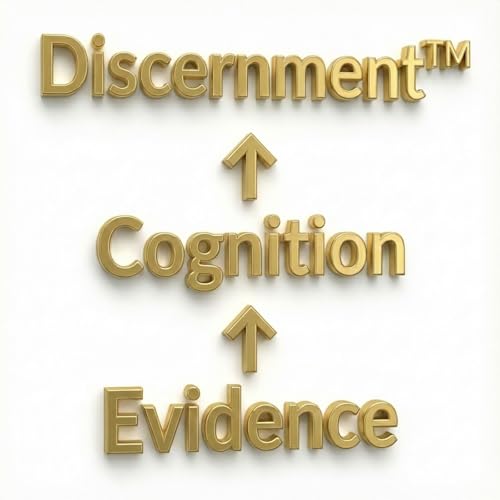
『Evidence → Cognition → Discernment™️ - Your Pathway to AI Leadership』のカバーアート

Evidence → Cognition → Discernment™️ - Your Pathway to AI Leadership

Evidence → Cognition → Discernment™️ - Your Pathway to AI Leadership

著者: Greg Twemlow
無料で聴く

概要

XperientialAI — Pathway to AI Leadership explores how people can collaborate with AI without outsourcing judgment. The spine is a three-step method: Evidence → Cognition → Discernment — a bridge from what’s scattered to what’s chosen. Through essays, reflections, and practical examples, I show how the Context & Critique Rule™ keeps thinking visible, decisions explainable, and responsibility human.FusionBridge Podcasts are the Copyright of Greg Twemlow マネジメント マネジメント・リーダーシップ 個人的成功 経済学 自己啓発
エピソード
  • Interface-Tax and Agentic AI Cognitive Dividend
    2026/02/09
    This memo outlines a strategic proposal for executives to manage the cognitive dividend created by the decline of traditional software interfaces and the rise of agentic AI. The author argues that reducing coordination friction will reclaim thousands of hours, which must be treated as strategic capital rather than being wasted on mindless speed. To avoid "organisational noise," the framework suggests redirecting this newfound time toward high-value tasks like precise problem definition and rigorous human verification. By implementing a "Human Pause" for high-stakes decisions, leaders can ensure that AI systems are guided by clear intent and ethical boundaries. Ultimately, the text highlights that future competitive advantages will belong to companies that prioritise human judgment and depth over mere mechanical acceleration. Read the article.

    About the Author - Greg Twemlow writes and teaches at the intersection of technology, education, and human judgment. He works with educators and businesses to make AI explainable and assessable in classrooms and boardrooms — to ensure AI users show their process and own their decisions. His cognition protocol, the Context & Critique Rule™, is built on a three-step process: Evidence → Cognition → Discernment — a bridge from what’s scattered to what’s chosen. Context & Critique → Accountable AI™. © 2025 Greg Twemlow. “Context & Critique → Accountable AI” and “Context & Critique Rule” are unregistered trademarks (™).
    続きを読む 一部表示
    14 分
  • Cognitive Capacity Released by the End of SaaS
    2026/02/08
    This text explores the anticipated decline of the Software-as-a-Service (SaaS) model as artificial intelligence begins to automate tasks once managed through rigid digital interfaces. The author argues that this shift creates a cognitive energy dividend, liberating workers from the fragmented, high-tempo demands of constant app switching and manual data entry. Organisations are encouraged to adopt a staged portfolio transition to move away from traditional software dependencies while mitigating counterparty risks. For individuals, the transition represents a move from tool fluency to intent literacy, where value is found in human judgment rather than software navigation. Ultimately, the source suggests that reclaiming mental continuity allows for deeper, more meaningful cognition that is no longer dictated by machine-driven workflows. The future of work will therefore be defined by our ability to redirect this newfound capacity toward truth, trust, and discernment. Read the article.

    About the Author - Greg Twemlow writes and teaches at the intersection of technology, education, and human judgment. He works with educators and businesses to make AI explainable and assessable in classrooms and boardrooms — to ensure AI users show their process and own their decisions. His cognition protocol, the Context & Critique Rule™, is built on a three-step process: Evidence → Cognition → Discernment — a bridge from what’s scattered to what’s chosen. Context & Critique → Accountable AI™. © 2025 Greg Twemlow. “Context & Critique → Accountable AI” and “Context & Critique Rule” are unregistered trademarks (™).
    続きを読む 一部表示
    15 分
  • Tempo Matters More Than Capability
    2026/02/05
    Greg Twemlow argues that the primary danger of artificial intelligence is its excessive speed, which often bypasses critical human thought. Because AI produces polished and fluent results instantly, users frequently mistake this surface-level quality for deep understanding and personal authorship. To counter this "tilted terrain" of effortless acceptance, the author proposes a Context & Critique Rule designed to reintroduce necessary friction into the workflow. This framework utilises a reasoning trail known as a Context & Critique Graph to document the human's specific goals, critiques, and final approval. By making the cognitive process visible, users can confidently defend their work and ensure their judgment leads the machine rather than trailing behind it. This approach shifts the focus from merely prompting a tool to engaging in a traceable act of thinking. Read the article.

    About the Author - Greg Twemlow writes and teaches at the intersection of technology, education, and human judgment. He works with educators and businesses to make AI explainable and assessable in classrooms and boardrooms — to ensure AI users show their process and own their decisions. His cognition protocol, the Context & Critique Rule™, is built on a three-step process: Evidence → Cognition → Discernment — a bridge from what’s scattered to what’s chosen. Context & Critique → Accountable AI™. © 2025 Greg Twemlow. “Context & Critique → Accountable AI” and “Context & Critique Rule” are unregistered trademarks (™).
    続きを読む 一部表示
    15 分
まだレビューはありません