

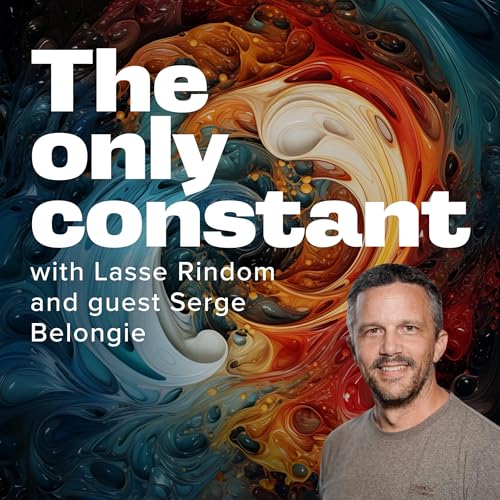
Episode #75 | Serge Belongie | On AI as ordinary technology, and the bias of anthropomorphisms
カートのアイテムが多すぎます
カートに追加できませんでした。
ウィッシュリストに追加できませんでした。
ほしい物リストの削除に失敗しました。
ポッドキャストのフォローに失敗しました
ポッドキャストのフォロー解除に失敗しました

Episode #75 | Serge Belongie | On AI as ordinary technology, and the bias of anthropomorphisms
-
ナレーター:
-
著者:
このコンテンツについて
In this episode of The Only Constant, Lasse Rindom sits down with Serge Belongie, Director of the Pioneer Centre for AI and one of Europe’s leading AI thinkers, for a conversation that cuts through the noise of hype and panic to reach something far more enduring.
Together, they explore:
- Why AI isn’t a revolution but a continuation of the march of automation
- How the “idiot wind” of hype always blows through history and major technological changes
- Why spreadsheets once terrified CEOs the same way large language models now do
- The problem of “data washing” and how a biased baby monitor reveals the limits of clean datasets
- Why AI should be treated as statistics and software - ordinary technology - until proven otherwise
- The dangers of anthropomorphizing chatbots and why friction can be a democratic safeguard
Belongie’s blend of historical analogy, dry humor, and academic precision makes this conversation one of the most illuminating yet and a standout episode of The Only Constant.
About Serge Belongie:
Serge Belongie is a professor of Computer Science at the University of Copenhagen, where he also serves as the head of the Pioneer Centre for Artificial Intelligence (P1).
Previously, he was a professor of Computer Science at Cornell University, an Associate Dean at Cornell Tech, a member of the Visiting Faculty program at Google, and a professor of Computer Science & Engineering at UC San Diego. His research interests include Computer Vision, Machine Learning, Augmented Reality, and Human-in-the-Loop Computing. He is also a co-founder of several companies including Digital Persona and Anchovi Labs.
He is a recipient of the NSF CAREER Award, the Alfred P. Sloan Research Fellowship, the MIT Technology Review “Innovators Under 35” Award, the Stibitz-Wilson Award, the Helmholtz Prize, the Everingham Prize, and the Koenderink Prize for fundamental contributions to the Computer Vision community.
He is a member of the Royal Danish Academy of Sciences and Letters and serves on the board of the European Laboratory for Learning and Intelligent Systems (ELLIS).