『Episode 33: Project 100,000』のカバーアート

Episode 33: Project 100,000

Episode 33: Project 100,000

無料で聴く

ポッドキャストの詳細を見る
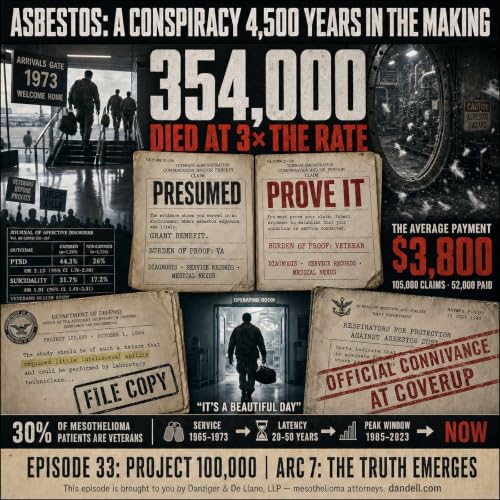
March 29, 1973. The last American POWs board a transport home. 591,000 servicemembers are discharged that final year. At airports across the country — Travis AFB, San Francisco International, O'Hare — some of them are met with protesters. Spat on. Called baby killers. A 1990 academic study would find that 44.3 percent of Vietnam veterans reported low homecoming support. Nearly twice the rate of other veterans. Controlling for combat, for deployments, for demographics — that hostile reception was independently associated with 2.13 times higher odds of PTSD. 1.91 times higher suicidality. The war damaged them. The homecoming compounded it. And for the men who had spent years in Navy boiler rooms, there was a third betrayal waiting — one that wouldn't announce itself for another twenty years.In 1991, Congress passed the Agent Orange Act. Veterans who'd been sprayed with dioxin herbicides in Vietnam finally got presumptive service connection — automatic disability benefits without having to prove the link between their cancer and their service. The PACT Act of 2022 extended the same to burn pit exposure. The system has learned. Twice. But not for asbestos. A veteran with mesothelioma today — diagnosed right now, in 2026 — still has to individually prove current diagnosis, documented service exposure, and a medical nexus opinion linking the cancer to the service. Even with 30 percent of all mesothelioma patients being veterans. Even with federal court findings of "official connivance at coverup." The burden is still on them.Episode 33 documents the homecoming no one talks about — and why the men most exposed became the men most overlooked.What This Episode CoversThe hostile homecoming — 1973 — Veterans returning from Vietnam faced a documented pattern of hostility unmatched in American military history. A 1990 academic study found 44.3% reported low homecoming support — nearly double the 26% rate for all veterans. Bob Greene collected hundreds of first-person accounts for his 1989 book Homecoming: When the Soldiers Returned from Vietnam. Controlling for combat exposure and demographics, low homecoming support independently produced 2.13x higher PTSD odds and 1.91x higher suicidality. The disease the men carried home in their lungs was invisible. The damage done at the airport was also invisible — in the data — until researchers finally measured it.Project 100,000 — August 1966. Defense Secretary Robert McNamara announced a program to accept 40,000 recruits per year who previously would have been rejected for low test scores. A social uplift program, he promised. President Johnson privately called them "second-class fellows." By December 1971, 354,000 men had been inducted. Hamilton Gregory, who wrote the definitive account (McNamara's Folly), documented that Project 100,000 recruits died at three times the rate of other Americans serving in Vietnam. A 1986 follow-up found they had lower incomes and higher divorce rates than if they had never served at all. The high-asbestos-exposure roles in the Navy — boiler tender, machinist's mate, engine room watch — went to lower-ranking enlisted personnel. Project 100,000 recruits were specifically assigned to positions requiring "little intellectual ability." The overlap is structural. The documentation doesn't exist, or hasn't been found. But the shape of it is visible.Agent Orange vs. asbestos — why one got recognition and the other didn't — Agent Orange was specific to one war, one time window, one government spray operation. It was visible — people saw the planes. It involved two chemical companies. Asbestos was everywhere: ships, planes, barracks, vehicles, all branches, all eras, hundreds of manufacturers. Agent Orange became a cause célèbre. The Agent Orange Act of 1991 created presumptive service connection. The PACT Act of 2022 extended it to burn pits. Asbestos veterans remained on their own — required to individually prove what the Navy documented and buried decades before their service began. The complexity of the asbestos industry protected the asbestos industry.Icom — Navy veteran. USS Kearsarge and USS John A. Bole. Boiler tender. Diagnosed with mesothelioma. His first doctor told him "it might go away." It didn't go away. Icom became the first VA patient to receive a cutting-edge P/D protocol — pleurectomy/decortication. He walked into surgery saying: "It's a beautiful day." Eight years later, Icom was still alive. His story appears in Beating the Odds: Surviving Mesothelioma, compiled by Dave Foster and available free to any family facing a diagnosis through Danziger and De Llano.The peak mortality window — right now — Vietnam service ran 1965 to 1973. Asbestos latency is 20 to 50 years. The math puts peak mesothelioma diagnosis between 1985 and 2023. We are in that window. Men who are 75 to 80 years old today were 20-year-old boiler tenders in the Gulf of Tonkin. They survived the war. They survived ...
adbl_web_anon_alc_button_suppression_t1
まだレビューはありません