

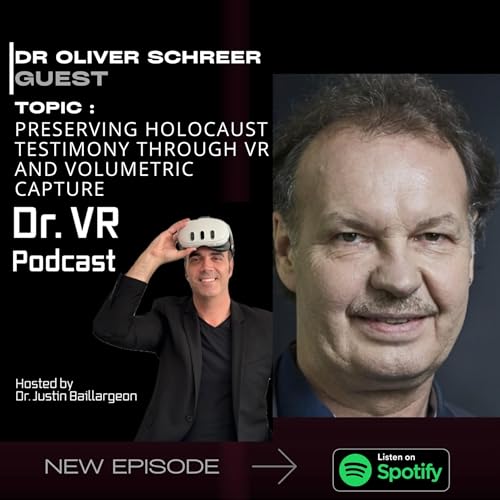
Ep. 46 - Preserving Holocaust Testimony Through VR and Volumetric Capture
カートのアイテムが多すぎます
ご購入は五十タイトルがカートに入っている場合のみです。
カートに追加できませんでした。
しばらく経ってから再度お試しください。
ウィッシュリストに追加できませんでした。
しばらく経ってから再度お試しください。
ほしい物リストの削除に失敗しました。
しばらく経ってから再度お試しください。
ポッドキャストのフォローに失敗しました
ポッドキャストのフォロー解除に失敗しました

Ep. 46 - Preserving Holocaust Testimony Through VR and Volumetric Capture
-
ナレーター:
-
著者:
In this episode of Dr. VR, I sit down with Dr. Oliver Schreer, who is an Associate Professor at the Technical University of Berlin and Head of the Immersive Media & Communication Group at the Fraunhofer Heinrich Hertz Institute, to explore how cutting-edge volumetric capture technology is being used to preserve Holocaust testimony in VR.
Dr. Schreer and his team developed two powerful VR experiences featuring Holocaust survivors: Eva Umlauf and Ernst Grube. Rather than relying on CGI avatars, they used high-fidelity volumetric capture to preserve the survivors exactly as they are—life-sized, realistic, and present. The result is not just immersive media, but a carefully designed encounter with living history and testimony.
We discuss:
- How 32-camera volumetric capture systems reconstruct humans in 3D
- The technical challenges behind real-time mesh reconstruction and texturing
- A subtle but powerful innovation that enables eye contact in VR
- The ethical boundaries of modifying testimonial data
- How people respond emotionally and cognitively to immersive testimony
- Whether VR should become part of educational curricula
- The future of real-time 3D video communication beyond Zoom and Teams
adbl_web_anon_alc_button_suppression_t1
まだレビューはありません