エピソード

  • The Evangelical Pattern: Beautiful and Broken
    2026/02/23

    Evangelicalism is one of the most influential movements in modern Christian history, and one of the most fragile.

    In this opening episode of the Evangelicalism series, I lay out the core pattern that keeps repeating: evangelicalism is beautiful and broken, because its greatest strengths and its greatest weaknesses are often the same thing.

    We trace the instincts that made evangelicalism travel, scale, and “work”, revival urgency, conversion culture, activism, biblicism, and why those same instincts can also produce emotional strain, defensiveness, division, and constant reinvention.

    This is not a hit piece. It’s an attempt to understand the movement properly, historically, so we can talk honestly about its future.

    続きを読む 一部表示
    31 分
  • Ritualism Under Pressure: An Introduction
    2026/02/23

    Victorian ritualism is often reduced to aesthetics, controversy, or ecclesiastical tribalism. But in the places that mattered most — the slums, the docklands, the overcrowded industrial parishes — it was something far more serious.

    This episode opens a 12-part series on 19th-century Anglican ritualism by asking a harder question: what kind of Christianity can actually survive under pressure?

    Through the world of the slum priests, we explore ritualism not as taste or nostalgia, but as a claim about the nature of Christian life itself. Was it a system of dignity that offered beauty, structure, and endurance to the poor? Or was it a form of control that built institutions around power and discipline? Often, it was both.

    At its heart, ritualism insisted that Christianity has a shape — that faith is embodied, structured, practised, and sustained through time. In parishes marked by poverty, disease, instability, and conflict, that claim was tested daily.

    This is not a romantic defence, nor is it a takedown. It is an attempt to understand what these priests thought they were building, what it produced, and why it provoked such intense backlash.

    Because the deeper question is not only Victorian.

    What kind of Christianity are we building now?

    And will it hold under pressure?

    続きを読む 一部表示
    44 分
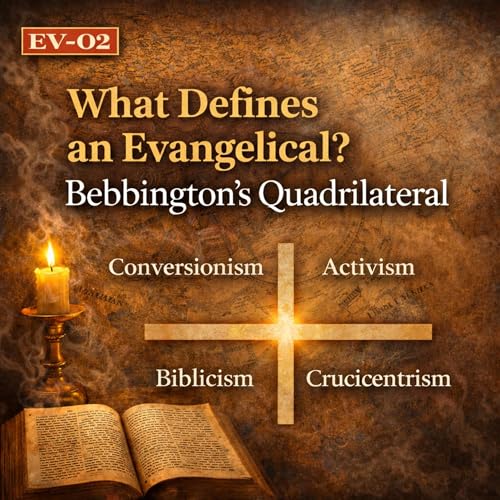
  • What Defines an Evangelical? Bebbington's Quadrilateral
    2026/02/23

    What is an evangelical, actually?

    In this episode I start where most modern discussions begin: David Bebbington’s Quadrilateral. Four markers that scholars use again and again to describe evangelical identity:

    1. Conversionism (lives need to be changed)
    2. Activism (the gospel expressed in action)
    3. Biblicism (a high regard for Scripture)
    4. Crucicentrism (the cross at the centre)

    But the point isn’t just listing them. The point is asking what this definition explains, what it hides, and why it’s been so persuasive for so long.

    We’ll also keep one question in view the whole time: is evangelicalism a distinct movement, or have we simply described normal Christianity in a particularly Protestant key?

    This is the foundation stone for the rest of the series.

    続きを読む 一部表示
    46 分
  • Wesley and the Problem of Experience: The Birth of Evangelicalism
    2026/02/23

    John Wesley did not invent religious experience. But he changed how it functioned.

    In this episode we look at the moment evangelicalism ignites: the shift from belief as inherited structure to belief as felt, narrated, and testified.

    Wesley helped make experience central rather than incidental. Faith was no longer only doctrine received, it was assurance known, grace felt, conversion narrated, holiness pursued.

    But once experience becomes evidence, something else happens. Urgency increases. Intensity rises. Stability becomes fragile.

    We explore:

    1. Wesley’s theology of grace and response
    2. The role of crisis in early Methodist preaching
    3. The fear of “enthusiasm” and the shadow of the Montanists
    4. How experience became both the engine and the instability of evangelicalism

    This is not a caricature of Wesley. It is an attempt to understand the inheritance.

    Because the same fire that renews the church can also unsettle it.

    続きを読む 一部表示
    39 分
  • Clapham: When Revival Became Respectable
    2026/02/23

    In this episode of the Evangelicalism series, we move the fire indoors.

    After the open-air urgency of Wesley and Whitefield, we step into late eighteenth-century Clapham, into drawing rooms, Parliament, pamphlets, schools, law courts, and a tight circle of wealthy Anglican evangelicals who helped end the British slave trade and helped build the modern evangelical machinery of missions, publishing, education, and moral reform.

    We meet the key figures, William Wilberforce, Granville Sharp, Henry Thornton, Hannah More, Zachary Macaulay, John Venn, and Charles Simeon, and we ask what their story really means.

    Because Clapham is not just a heroic episode. It is a trade-off.

    What do we gain when revival becomes an institution, a strategy, and public power, and what do we lose when the gospel gets wrapped in respectability?

    At its best, Clapham looks like mercy in public: justice, protection of the vulnerable, and Christian courage aimed at the real world. But the same grammar can slide into moralism, control, and the management of the poor, where “reformation of manners” becomes a substitute for grace.

    This is not a takedown. It is an attempt to tell the truth about a movement that did extraordinary good, while also planting patterns that evangelicalism still wrestles with today.

    Empire of the Son is long-form English religious history, theology, and lived Christianity, told carefully, and told from inside the Christian story.

    続きを読む 一部表示
    1 時間 8 分
  • Holy Things for Hard Places: Why Slum Parishes Needed Ritual
    2026/02/23

    In this episode I want to argue for something simple, and a bit unfashionable.

    Victorian slum priest ritualism was not mainly a debate about taste. Not “lace vs plain”. Not “candles vs no candles”. Not an aesthetic hobby for bored clergy.

    It was a theory of formation. A way of building steadiness when life was chaotic.

    Because poverty does not just make people poor. It destroys time. Sleep. Hope. The sense that tomorrow is real. And in that kind of pressure, “holy things” start to include holy time, holy habits, and holy spaces. A rhythm that can hold people steady.

    We look at the names early in the series, Dolling, Stanton, Mackonochie, Lowder, Headlam. We visit St Alban’s, Holborn, with its daily Eucharist, confession, and its famous court cases, not because the gossip is fun, but because the prosecutions prove a point. People do not go to court over “taste”. The authorities treated ritual actions as public theological claims.

    We then move to Dolling in Landport, Portsmouth, where you can actually see the wider ecosystem. The gym, the table, the fellowship, the camps, order without humiliation. Not theatre. Not control for its own sake. A kind of pastoral mercy, built as a pattern.

    And we keep the channel’s method the same. More curious than outraged. Primary sources rather than rumours. No panto villains. I’m not asking you to become Anglo-Catholic. I’m asking us to be fair about motives before we judge appearances and outcomes.

    This is Part 2 of a 12-part series on Victorian ritualism in the slums.

    Next episode, we talk about cost. Not mainly money, but lungs, sleep, infection, and why “externals” mattered when staying put had a price.

    続きを読む 一部表示
    54 分
  • The First Vision: Mormonism’s Missionary Hinge
    2026/02/23

    In this episode, we go slow and do history. If you’ve ever had missionaries at your door, you’ll recognise the shape of the conversation, because there’s a moment they want you to reach, a sacred origin story. For Latter-day Saints, that hinge is the First Vision.

    So we read the story as a story, then we put the accounts next to each other. Joseph Smith leaves multiple tellings; they overlap, and they also clash in places. The Church’s own missionary manual admits there are four accounts, but it centres one version, then uses the others as supporting detail. That raises a fair question: Is this normal variation, or is it smoothing over real tension?

    We also look at the 12-year gap between the claimed event (1820) and the earliest surviving written account (1832), and we bring in a British print example from 1851 to show how quickly the First Vision becomes portable, standardised, and exportable.

    This is not a “gotcha” video. I’m outside the LDS camp, but I’m trying to be fair, and I’m using LDS sources. The aim is simple, to help historic Christians know what the real pressure points are, so conversations with missionaries can be honest rather than just noisy.

    続きを読む 一部表示
    1 時間 3 分
  • An Impeachment of the False – Arthur Stanton (Matthew 5:20)
    2026/02/23

    This episode is a reading of An Impeachment of the False, a sermon preached by Father Arthur Stanton on Matthew 5:20:

    “Except your righteousness shall exceed the righteousness of the scribes and Pharisees, ye shall in no case enter into the kingdom of heaven.”

    Preached in the late nineteenth century and published in Faithful Stewardship and Other Sermons, this address is not an attack on ritual but a warning against formalism. Stanton confronts mechanical religion, hairsplitting morality, and ceremony without heart — while defending the Mass, incense, and lights as expressions of living faith.

    Christ’s words are treated as an indictment of religious complacency. Not of outsiders. Of insiders.

    A searching sermon on what it means for righteousness to exceed.

    Read from the published text.

    続きを読む 一部表示
    15 分