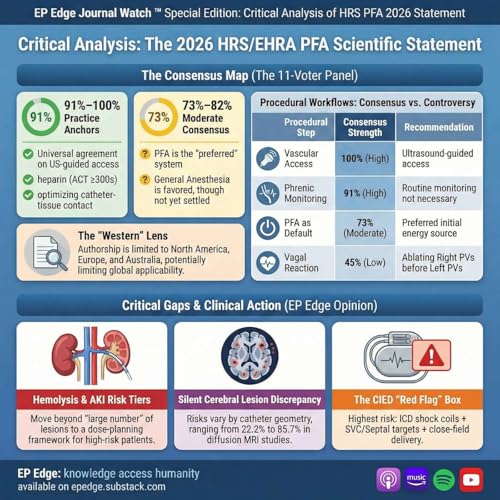
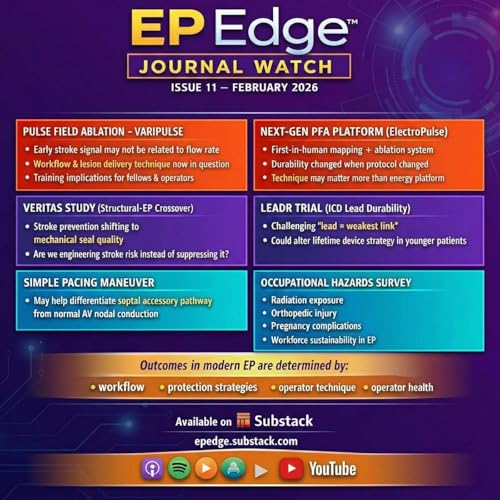
『EP Edge Journal Watch』のカバーアート

EP Edge Journal Watch

EP Edge Journal Watch

著者: Niraj Sharma MD FACC FHRS
無料で聴く

このコンテンツについて

Welcome to EP Edge Journal Watch — where cardiac electrophysiology meets evidence, precision, and perspective. Hosted by Dr. Niraj Sharma, this bi-weekly podcast distills high-impact cardiovascular and EP research into clear, clinically meaningful insights. Each episode goes beyond headlines and abstracts to uncover what new studies actually mean for patient care, decision-making, and the future of electrophysiology. What EP Edge Journal Watch stands for: Evidence-based practice Precision electrophysiology A forward-thinking, edge-driven approach to how we interpret and apply data in real-world clinical settings. Whether you’re an electrophysiologist, cardiologist, researcher, trainee, or allied health professional, EP Edge Journal Watch brings you the signal — not the noise. Expect sharp summaries, thoughtful commentary, and practical takeaways designed for the busy clinician who wants to stay ahead of the curve© 2026 Niraj Sharma MD FACC FHRS 生物科学 科学 衛生・健康的な生活 身体的病い・疾患
エピソード
  • LAAO vs Anticoagulation Explained: WATCHMAN FLX, AF Ablation Recurrence, Post-TAVR Heart Block & ICU AF, Hormones and TdP – EP Edge Journal Watch
    2026/01/12

    EP Edge Journal Watch Podcast — Issue 6 (January 2026)

    Left Atrial Appendage Occlusion, AF Ablation Insights, Post-TAVR Conduction, ICU Anticoagulation & Translational EP Signals

    EP Edge Journal Watch is your high-yield, evidence-driven electrophysiology podcast—designed for busy clinicians who want clinical relevance, mechanistic insight, and practice-changing nuance without wading through every paper.

    In Issue 6 (January 2026), we anchor the episode around Left Atrial Appendage Occlusion (LAAO)—examining long-term randomized outcomes, implant mechanics that truly matter, and frontier strategies for the most complex patients—then expand into essential EP topics you’ll actually use on rounds.


    What’s covered in this episode?

    1. LAAO vs Oral Anticoagulation — Long-Term Outcomes

    We break down a contemporary randomized trial meta-analysis (including OPTION) examining:

    • Stroke and systemic embolism
    • Hemorrhagic vs non-procedural bleeding
    • A provocative mortality signal favoring LAAO
      Practical implications for counseling ablation patients and high-bleeding-risk populations.

    2. WATCHMAN FLX Mechanics — Why Compression Matters

    A deep dive into device sizing and compression:

    • Over-compression thresholds
    • Impact on peridevice leak (PDL)
    • How this data should influence real-world implant decisions.

    3. Persistent LAA Thrombus — Is There a Salvage Path?

    We discuss a multicenter experience using:

    • Percutaneous aspiration thrombectomy
    • Embolic protection strategies
    • Same-session, no-touch LAA closure
      A feasibility signal—not for routine practice, but critical for expert centers facing clinical dead-ends.

    OPTION Sub-Analysis — Does LAAO Worsen AF Recurrence?

    Using the largest randomized dataset available:

    • Concomitant vs staged LAAO with ablation
    • AF recurrence, cardioversion, redo ablation
    • Why “no AF recurrence” ≠ “no stroke risk”.

    4. Post-TAVR Conduction Disturbances

    A physiology-forward look at:

    • Intraprocedural vs delayed high-grade AV block
    • HV interval and PR prolongation as rule-out tools
    • Practical EP risk stratification after TAVR.

    5. Early Recurrence After Persistent AF Ablation

    Insights from CAPLA challenge the traditional blanking period:

    • Timing and burden of early recurrence
    • Why late blanking-period events matter most
    • How this should reshape post-ablation follow-up.

    6. Septic Shock + AF — ICU Anticoagulation Reality

    A clinically uncomfortable but crucial topic:

    • Therapeutic anticoagulation in septic shock
    • Mortality vs bleeding tradeoffs
    • Why EP input matters even in the ICU.

    7. Sex Hormones & Torsades de Pointes — A Translational EP Signal

    A paradigm-shifting study linking:

    • Hypogonadism, hyperestrogenism, and QT prolongation
    • Cellular electrophysiology and real-world TdP severity
    • A new biologic layer in arrhythmic risk.


    Want more?

    Subscribe to:


    EP Edge Journal Watch (Weekly):
    https://lnkd.in/e-Wa4diC

    A concise, high-yield weekly digest of the most important EP studies—curated, contextualized, and clinically translated so you don’t have to read everything to understand what matters.


    The EP Edge Newsletter (In-Depth Issues):
    https://lnkd.in/ep3NdZUz

    Our flagship, deep-dive editions, where we go far beyond abstracts—breaking down:

    • Technology and mechanisms
    • Trial design and statistical nuance
    • Efficacy, durability, and complications
    • What truly differentiates one approach from another

    The upcoming EP Edge deep-dive issue on Pulsed Field Ablation will do exactly that—offering a comprehensive, evidence-driven analysis of PFA platforms, mechanisms, outcomes, safety, and where the field is headed next.

    続きを読む 一部表示
    14 分
  • Pulsed Field Ablation, Atrial Fibrillation Progression & Leadless Pacing | EP Edge Journal Watch – Jan 2026 (Issue 5)
    2026/01/05

    EP Edge Journal Watch — January 2026 | Issue #5

    Pulsed Field Ablation, Device Therapy, and the Era of Personalized EP

    Welcome to EP Edge Journal Watch – Issue #5 (January 2026), your high-yield, evidence-driven electrophysiology podcast designed for practicing EPs who want more than just abstracts.

    As 2026 begins, electrophysiology is entering a defining phase—where pulsed field ablation (PFA) matures beyond feasibility, device therapy is reframed by competing risk, and “one-size-fits-all” ablation strategies give way to personalization.

    In this episode, Dr. Niraj Sharma MD FACC FHRS breaks down practice-changing trials, real-world registries, and mechanistic insights that are actively reshaping how we approach atrial fibrillation ablation, ICD decision-making, leadless pacing, and AF progression.

    What’s covered in this issue:

    • Long-term ICD outcomes in nonischemic cardiomyopathy
      Why preventing sudden death does not always translate into survival benefit—and how age and competing risk matter.
    • Leadless pacing evolution
      Dual-chamber leadless pacemakers, operator learning curves, and why high acute atrial thresholds don’t predict chronic failure.
    • Reducing CIED infections
      How a simple iodinated adhesive drape significantly lowers contamination and infection risk.
    • AF progression as a biologic signal
      Why device-detected AF progression predicts mortality, heart failure, and stroke risk.
    • Monitoring-driven AF management
      How implantable cardiac monitors change rhythm-control strategies and outcomes.
    • Pulsed Field Ablation at scale
      CE-Mark data, IDE trials, and the MANIFEST-US registry defining safety, durability, and workflow in real-world PFA.
    • Rare but serious delayed PFA complications
      What every electrophysiologist should know about delayed ischemia and malignant arrhythmias.
    • Personalized AF ablation strategies
      LA wall thickness–guided ablation, sex-specific outcomes, and patient-factor–driven lesion optimization beyond PVI-only.

    Why this episode matters:

    This is not headline medicine. This is mechanism-aware, data-literate electrophysiology, focused on:

    • Durability over acute success
    • Precision over dogma
    • Biology over empiricism

    Whether you’re performing AF ablation weekly, implanting devices, or shaping EP programs, this episode provides context you can apply immediately in the lab and clinic.

    Want more?

    • EP Edge Journal Watch (Weekly): concise, curated EP research updates
    • EP Edge Newsletter (In-Depth): deep dives into trials, mechanisms, and clinical implications

    All references, figures, and infographics discussed in this episode are available in the EP Edge Journal Watch LinkedIn Newsletter.

    Subscribe, follow, and stay at the edge of electrophysiology.

    Niraj Sharma, MD FACC FHRS
    Cardiac Electrophysiologist | Founder, EP Edge

    続きを読む 一部表示
    34 分
  • AF Beyond the Lesion: Can We Stop Anticoagulation, Trust Sham Trials, and Treat AF as a Metabolic Disease?
    2025/12/18

    In this December 2025 episode of EP Edge Journal Watch, Dr. Niraj Sharma breaks down the most provocative atrial fibrillation trials of the year—studies that force us to rethink what really drives AF outcomes beyond the ablation lesion

    EP EDGE JW Dec 2025 Newsletter.

    We dive deep into four game-changing themes shaping modern electrophysiology:

    • Can we safely stop anticoagulation after AF ablation?

    A critical analysis of OCEAN (NEJM 2025) and ALONE-AF, exploring DOAC de-escalation, aspirin as a comparator, and whether selected AF-free patients may safely discontinue oral anticoagulation.

    • Is AF ablation real—or partly placebo?

    A deep dive into sham-controlled ablation trials, including SHAM-PVI and the landmark PFA-SHAM trial, providing definitive evidence that both thermal and pulsed-field ablation deliver true reductions in AF burden and meaningful quality-of-life benefits.

    • Are metabolic drugs the next AF substrate therapy?

    We examine emerging data on GLP-1 receptor agonists (semaglutide), metformin, and SGLT2 inhibitors after AF ablation—highlighting which therapies reduce recurrence and which fail when used purely as off-label antiarrhythmics.

    • Why do women run faster sinus rates than men?

    A fascinating look at human sinoatrial node transcriptomics, explaining sex-specific heart-rate biology and its implications for inappropriate sinus tachycardia, sinus node dysfunction, and AF progression.

    What you’ll learn

    • Why the “DOAC for life” paradigm after AF ablation is beginning to crack
    • How sham trials finally settle the debate about ablation’s true efficacy
    • Which metabolic drugs actually modify AF substrate—and which do not
    • How sex-specific sinus node biology should influence EP decision-making

    This episode moves electrophysiology beyond lesion sets toward precision, whole-patient AF care—integrating stroke prevention, substrate modification, and biologic reality.

    Full trial graphics, references, and detailed breakdowns are available in the EP Edge Journal Watch – December 2025 Issue on LinkedIn.
    Questions or feedback? Email epedgecast@gmail.com

    This is EP Edge Journal Watch — where data meets clinical judgment.

    続きを読む 一部表示
    16 分
まだレビューはありません