


Duckrabbits Talk Back
カートのアイテムが多すぎます
カートに追加できませんでした。
ウィッシュリストに追加できませんでした。
ほしい物リストの削除に失敗しました。
ポッドキャストのフォローに失敗しました
ポッドキャストのフォロー解除に失敗しました

Duckrabbits Talk Back
-
ナレーター:
A podcast about postartistic antifascism.
Duckrabbits Talk Back gathers thinkers, activists, artists, and postartists to discuss the global rise of fascism, ask questions together, and formulate possible responses. Duckrabbits — those wonderfully ambivalent creatures that can be seen as ducks or rabbits, or both at once — guide us through the tangled web of contemporary theory, postartistic practice, and antifascist imagination. From antifascist comics to networked movements, from intersectional struggles to economies of interdependence, duckrabbits and guests map how cultural work confronts both old and newly mutating forms of authoritarianism.
The series stems from a postartistic intuition: that artistic potentials bloom fully only when planted beyond the narrow confines of the professionalised field of art. This line of thinking has a long tradition, rooted in historical avant-gardes and postconceptual art: from Allan Kaprow’s call for artists to “drop out” of art, through Mierle Laderman Ukeles’ maintenance art and Rasheed Araeen’s push to move art beyond art, to Jerzy Ludwiński’s lectures on art in the postartistic age. Writing in 1971, Ludwiński suggested that art had already transformed into something else — something that escaped our capacity to name it, but carried greater potential.
These historical calls respond to contemporary urgencies. As liberal globalisation unravels under authoritarian pressure, postartistic antifascism emerges as a way to blur the line between art and life, image and action, irony and commitment. In Poland, for example, Ludwiński’s thought became a Leitmotiv of antiauthoritarian counterculture after years of right-wing authoritarian backsliding. Postartistic practitioners carried paintings as protest signs, organised marches for hospitality, and invented new antifascist visual idioms.
The Duckrabbit is the mischievous mascot of this radical ambivalence. It can be seen as a duck, a rabbit, or both at once. It can be seen as a duck, a rabbit, or both at once. In the same way, postartistic practices can be viewed as art, activism, both, or neither, depending on whom you speak with, how you act, and what kind of perspective you adopt. This double-sidedness has political implications. Against fascist rigidity, scapegoating, hate campaigns, and conspiratorial certainty, the Duckrabbit links absurdist humour with antifascist conviction, and postartistic flair with antiauthoritarian resistance.
Now the Duckrabbit returns — and talks back. Across seven episodes, Duckrabbits Talk Back brings together artists, theorists, organisers, and cultural workers to discuss antifascist network cultures, economic interdependence, complex simplicity, intersectionality, and the politics of cultural work today. What can art do when authoritarianism mutates? What forms of solidarity, organisation, and imagination are needed now? And what is to be done, today, with art, non-art, and postart?
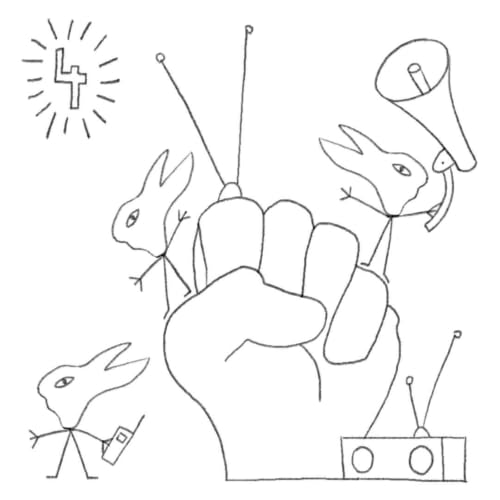
Duckrabbits Talk Back is hosted by Aria Spinelli, Kuba Szreder, and Sepp Eckenhaussen, and produced by Anielek Niemyjski at the Institute of Network Cultures. The cover image was illustrated by Kacper Greń and the jingle was created by Olka Dąbrowska. The series is inspired by the comic treatise Duckrabbits Unveiled: A Sneak Peek at the Postartistic Theory and Practice, published by INC in 2025.
Amsterdam, Institute of Network Cultures, 2026
Institute of Network Cultures 2026-
 1 時間 3 分
カートのアイテムが多すぎます
ご購入は五十タイトルがカートに入っている場合のみです。カートに追加できませんでした。
しばらく経ってから再度お試しください。ウィッシュリストに追加できませんでした。
しばらく経ってから再度お試しください。ほしい物リストの削除に失敗しました。
しばらく経ってから再度お試しください。ポッドキャストのフォローに失敗しました
ポッドキャストのフォロー解除に失敗しました
-
 2026/07/141 時間 1 分
カートのアイテムが多すぎます
ご購入は五十タイトルがカートに入っている場合のみです。カートに追加できませんでした。
しばらく経ってから再度お試しください。ウィッシュリストに追加できませんでした。
しばらく経ってから再度お試しください。ほしい物リストの削除に失敗しました。
しばらく経ってから再度お試しください。ポッドキャストのフォローに失敗しました
ポッドキャストのフォロー解除に失敗しました
-
 1 時間 5 分
カートのアイテムが多すぎます
ご購入は五十タイトルがカートに入っている場合のみです。カートに追加できませんでした。
しばらく経ってから再度お試しください。ウィッシュリストに追加できませんでした。
しばらく経ってから再度お試しください。ほしい物リストの削除に失敗しました。
しばらく経ってから再度お試しください。ポッドキャストのフォローに失敗しました
ポッドキャストのフォロー解除に失敗しました