『Docs With Disabilities』のカバーアート

Docs With Disabilities

Docs With Disabilities

著者: Dr. Lisa Meeks and Dr. Peter Poullos
無料で聴く

このコンテンツについて

Join hosts Drs. Lisa Meeks, Peter Poullos and guest hosts as they take a deeper dive into the experiences of health care providers with disabilities through critical conversations with the doctors, researchers, administrators, faculty and policy makers that work to ensure medicine remains an equal opportunity profession.Copyright © 2019 Lisa Meeks 衛生・健康的な生活 身体的病い・疾患
エピソード
  • Episode 124: Mapping the Landscape of Technical Standards: A Nationwide Review of Medical Schools
    2025/11/13
    Mapping the Landscape of Technical Standards: A Nationwide Review of Medical Schools Interviewees: Carol Haywood, PhD, OTR/L — Assistant Professor, Medical Social Sciences, Northwestern University Feinberg School of Medicine Chris Moreland, MD, MPH — Professor of Internal Medicine; Division Chief for Hospital Medicine; Interim Associate Chair for Faculty Affairs and Development, Dell Medical School (Comments made in ASL and voiced through interpreters) Interviewer: Lisa Meeks, PhD, MA — Guest Editor, Academic Medicine Supplement on Disability Inclusion in Undergraduate Medical Education Description: In this episode of Stories Behind the Science, we sit down with Dr. Carol Haywood and Dr. Chris Moreland to explore a deceptively powerful document: the medical school technical standards. These quietly influential statements—often tucked deep in an admissions webpage—shape who feels welcome to apply, who gains access, and how institutions imagine the future of their profession. Haywood and Moreland, co-authors of a national analysis featured in the Academic Medicine supplement on Disability Inclusion in Undergraduate Medical Education, unpack what happens when ambiguous language, outdated assumptions, and vague expectations collide with real people making real decisions about their careers. Together, they dig into the nuances of functional vs. organic standards, the importance of clarity for applicants who lack insider knowledge, and the ripple effects of inequitable policies across a learner's entire training experience. What emerges is both sobering and hopeful: a field undergoing change, a growing recognition that words matter, and a roadmap for institutions ready to bring their values into alignment with their practices. The discussion reviews: How technical standards became a gatekeeper—and why revising a single sentence can shift an entire culture. Why students with disabilities read these documents differently—and why that matters for equity. How ambiguity in admissions can deter talented future physicians long before they step foot in a classroom. What schools can do now to create standards that prioritize competence, flexibility, and inclusion. Dr. Haywood brings a researcher's lens and an occupational therapist's creativity to the conversation, illuminating how functional expectations—not assumptions about bodies—should guide medical training. Dr. Moreland shares deeply personal reflections on navigating technical standards as a deaf physician, offering rare insight into how these documents land on applicants with lived experience. This episode invites the audience to imagine a medical education landscape where technical standards do what they should do—define competence, set expectations, and open doors—rather than unintentionally closing them. Bios: Carol Haywood, PhD, OTR/L, is Assistant Professor of Medical Social Sciences in the Determinants of Health Division and core faculty in the Center for Health Services and Outcomes Research at Northwestern University Feinberg School of Medicine in Chicago, IL. Building from her work as an occupational therapist in acute rehabilitation, she completed a PhD in occupational science at the University of Southern California and a postdoctoral fellowship in health services and outcomes research at Northwestern University. Using qualitative, mixed methods, and community-engaged research approaches, she studies disability in a variety of contexts, as well as health care access, coordination, and quality. She is driven by a vision of health care that facilitates equity for people with disabilities. Chris Moreland, MD MPH, is a professor of medicine, interim associate department chair for faculty affairs, and division chief for hospital medicine at Dell Medical School at UT Austin. He practices clinically as a hospitalist. As a career-long clinician educator, his teaching has been recognized regionally and nationally. His collaborative advocacy and research efforts describe the experiences of our healthcare workforce and learners with disabilities, as well as strategies to foster pathways to thriving clinicians. He has served as president and longtime board member for the Association of Medical Professionals with Hearing Losses; he holds current roles on the Docs with Disabilities Initiative advisory board, the AAMC Group on Diversity and Inclusion steering committee, and as a consultant with the National Deaf Center. Transcript: https://docs.google.com/document/d/18hUPguWf_jWeDC1fmOgSKSXPv4xGnkQIPUi3zhfH540/edit?usp=sharing Resources: Singer, Tracey; Madanguit, Lance MD; Fok, King T. MD, MSc; Stauffer, Catherine E. MD; Meeks, Lisa M. PhD, MA; Moreland, Christopher J. MD, MPH; Huang, Lynn MS; Case, Benjamin MPH; Lagu, Tara MD, MPH; Kannam, Allison MD; Haywood, Carol PhD, OTR/L. Mapping the Landscape of Technical Standards: A Nationwide Review of Medical Schools. Academic Medicine 100(10S):p S144-S151, October 2025. | DOI: ...
    続きを読む 一部表示
    42 分
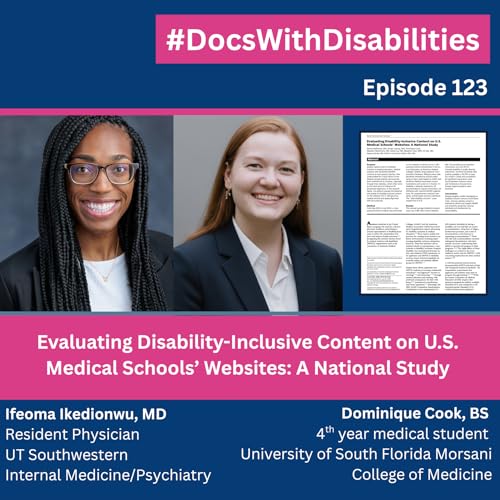
  • Episode 123: Evaluating Disability-Inclusive Content on U.S. Medical Schools' Websites: A National Study
    2025/10/22

    Episode 123: Evaluating Disability-Inclusive Content on U.S. Medical Schools' Websites—A National Study

    Interviewees:
    Ifeoma Ikedionwu, MD — Psychiatry and Internal Medicine Dual Intern, UT Southwestern
    Dominique Cook — Fourth-Year Medical Student, University of South Florida

    Interviewer:
    Lisa Meeks, PhD, MA — Guest Editor, Academic Medicine Supplement on Disability Inclusion in Undergraduate Medical Education

    Description:
    In this episode of Stories Behind the Science, Dr. Lisa Meeks sits down with Dr. Ifeoma Ikedionwu and Dominique Cook, co-authors of the first national study examining how medical school websites communicate disability inclusion. Their paper, Evaluating Disability-Inclusive Content on U.S. Medical Schools' Websites: A National Study, is part of the Academic Medicine supplement on Disability Inclusion in Undergraduate Medical Education.

    What do medical schools' digital front doors say about who belongs? The conversation explores how public-facing messages shape applicants' sense of access, belonging, and possibility—and why visibility is the first step toward equity. Ikedionwu and Cook share how their lived experiences as medical students with and without disabilities inspired a research project that merges advocacy, analysis, and systemic change.

    Together, they unpack the challenges of quantifying inclusivity, the nuance of intersecting identities, and the powerful role of student-led research in shaping institutional accountability. The episode underscores how every mission statement, technical standard, and accessibility page sends a message—and how aligning those messages with institutional values can create a more inclusive path for future physicians.

    Listeners will leave with actionable insights:

    • Audit your institution's website for clarity, tone, and accessibility.

    • Engage learners with lived experience in reviewing public materials.

    • Translate inclusion from policy into practice—and from practice into visibility.

    Because as Ikedionwu reminds us, "It's not enough to do the work—you have to share it, so others can find their way."

    Transcript: https://docs.google.com/document/d/1UmiXVs8wESM28eRYAM-d13IuJTV6VzR2khagExHF12A/edit?usp=sharing

    Resources:
    Article from Today's Talk:
    Ikedionwu I, Cook D, Kim N, Cotts J, Case B, Meeks LM. Evaluating Disability-Inclusive Content on U.S. Medical Schools' Websites: A National Study. Academic Medicine. 2025;100(10S):S60–S67. Read the full article here →

    Related Reading:
    Equal Access for Students with Disabilities: The Guide for Health Science and Professional Education (2nd Ed). Meeks LM, Jain NR, & Laird EP. Springer Publishing, 2020.

    🎧 The Docs With Disabilities Podcast: https://www.docswithdisabilities.org/docswithpodcast

    Key Words: Disability inclusion · Medical education · Admissions · Accessibility · Representation

    続きを読む 一部表示
    44 分
  • Episode 122: Clinical Accommodations in Undergraduate Medical Education
    2025/10/17
    Interviewees: Matthew Sullivan, PhD, Assistant Director of Disability Resources, Washington University School of Medicine in St. Louis Suchita "Suchi" Rastogi, PhD. MPH Candidate, University of Illinois Chicago; CEO, Disability in Medicine Mutual Mentorship Program Interviewer: Lisa Meeks, PhD, MA, Guest Editor, Academic Medicine Supplement on Disability Inclusion in Undergraduate Medical Education Description: In this episode of Stories Behind the Science, Dr. Lisa Meeks talks with Matt Sullivan (Washington University School of Medicine) and Suchita "Suchi" Rastogi (UIC; DM3P) about their paper, "Standardized Language for Clinical Accommodations in U.S. Undergraduate Medical Training: Results From a National Modified Delphi Consensus Study,"part of the Academic Medicine supplement on Disability Inclusion in UME. Their conversation explores how a grassroots idea—born from students' lived experiences and practitioners' urgent need for clarity—grew into the first national, evidence-based language guide for clinical accommodations. Together, they unpack how a modified Delphi process brought students, Disability Resource Professionals, and leaders together to build consensus around the precise language that transforms intention into implementation. The trio discuss how language and word choices can make the difference between support and confusion, and how transparent, shared language strengthens trust and access for all. Dr. Meeks, Sullivan, and Rastogi also reflect on the collaborative model that made this project possible—one that centers disabled voices, encourages vulnerability in leadership, and demonstrates how clarity in communication is the foundation of equity. Listeners will come away with practical takeaways for institutions and leaders: audit your accommodation templates, build structured partnerships between DRPs and Student Affairs, and engage students as co-creators in designing accessible clinical environments. Transcript: https://docs.google.com/document/d/1ooJ5TP8V8s4t35EECoWHNTta7qqwbKlx-Fgu_WIiPG4/edit?usp=sharing Bios: Matt Sullivan PhD Dr. Sullivan is the Assistant Director of Disability Resources, At Washington University in St. Louis, and serves as DR's liaison to WashU's School of Medicine, acting as the primary contact for SoM faculty/staff, students, and prospective students. In this role, Matt works closely with all parties to create an accessible and inclusive educational environment for disabled students pursuing their degrees within Health Sciences and Medicine. Dr. Sullivan is a research-oriented practitioner dedicated to promoting disability awareness and inclusion within the higher education environment. In his student affairs roles, Dr. Sullivan has experience providing leadership and direction for a variety of programs and services in the areas of disability, testing, tutoring, Supplemental Instruction, and academic coaching. Working in the field of disability services for more than a decade, Matt has dedicated his time and energy to the education and development of students, faculty, and staff surrounding the intersectionality of disability with race, culture, gender, and other prominent identity factors. Suchita "Suchi" Rastogi PhD Suchi is an MPH student at the University of Illinois Chicago and CEO of the Disability in Medicine Mutual Mentorship Program (DM3P). A former MD-PhD student at Stanford University, she advocates for accessible medical education and leads community-based efforts to promote disability inclusion and peer mentorship. As a South Asian disability activist, she values health equity and compassionately designed systems that serve all people with dignity. She believes everyone deserves respect, access to material resources, and psychosocial support. These values compel her to improve healthcare and public health infrastructure for disabled patients, increase disability representation in medicine, and shift attitudes towards persons with disability. To accomplish this, she 1) run a mentorship program (DM3P) for healthcare professionals with disability, 2) conducts disability health equity research, and 3) advocates for evidence-based policies that center accessibility. Key Words: Clinical accommodations · Disability inclusion · Medical students · Disability Resource Professionals ADA Resources: Article from Today's Talk: Dhanani Z, Rastogi S, Sullivan M, Betchkal R, Poullos P, Meeks LM. Standardized Language for Clinical Accommodations in U.S. Undergraduate Medical Training: Results From a National Modified Delphi Consensus Study.Academic Medicine. 2025;100(10S):S92–S97. DOI: 10.1097/ACM.0000000000006150 Read the full article here → Equal Access for Students with Disabilities: The Guide for Health Science and Professional Education (2nd Ed). Meeks LM, Jain NR, & Laird EP. Springer Publishing, 2020. Read here → The Docs With Disabilities Podcast: https://www.docswithdisabilities.org/docswithpodcast
    続きを読む 一部表示
    58 分
まだレビューはありません