

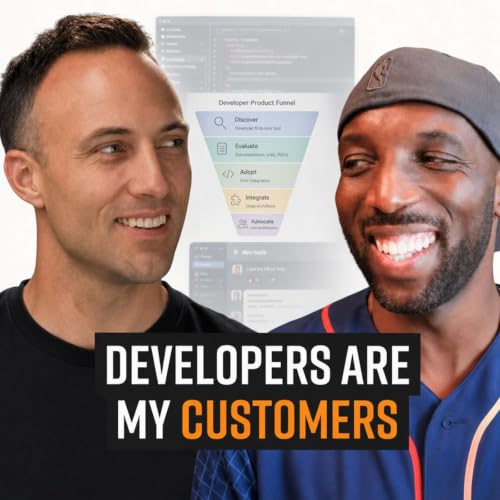
Developer customers, AI skills, and durable product judgment with Ben Ilegbodu
カートのアイテムが多すぎます
カートに追加できませんでした。
ウィッシュリストに追加できませんでした。
ほしい物リストの削除に失敗しました。
ポッドキャストのフォローに失敗しました
ポッドキャストのフォロー解除に失敗しました

Developer customers, AI skills, and durable product judgment with Ben Ilegbodu
-
ナレーター:
-
著者:
If you build internal tools, AI enablement, or platform work, this episode is for you. Kent talks with Ben Ilegbodu about treating developers as customers, measuring success without a checkout funnel, and the durable skills that still matter when agents write more of the code.
They cover agentic workflows and skills at Netflix, closing the agent loop for TV UI development, verification and harness engineering, and why deciding what to build beats shipping three times more features.
- (00:00) - Meet Ben Ilegbodu
- (01:06) - From React speaking to Netflix AI enablement
- (02:56) - Training engineers for agentic workflows
- (04:17) - Skills, context, and insulating teams from churn
- (08:41) - Product engineering for internal tools
- (10:06) - How to measure success without a checkout funnel
- (12:07) - Closing the agent loop for TV UI
- (18:34) - Durable skills: what to build, specs, verification
- (23:45) - Harness builders and agent experience
- (26:33) - Agent-to-agent PR review
- (28:21) - Intent docs and harness engineering
- (29:36) - Do users want 3x more features?
- (32:00) - Retrospective skills that improve the system
- (36:56) - AI is here to stay
- (39:11) - Homework: turn repeated prompts into skills
Ben Ilegbodu has spent years helping other engineers move faster - first through React education and UI tooling, and now on Netflix's TV UI productivity team focused on AI enablement. In this conversation, he and Kent talk about what product engineering looks like when your customers are other developers, not the people paying for Netflix.
A major theme is that internal tooling still needs product judgment. Ben argues the product is what you deliver to developers, and that feedback can be even more direct than consumer product work because your users Slack you when something breaks. Measuring success means observability, usage, and silence that is not always golden. On the AI side, they dig into skills as reusable context for agents, the hard problem of closing agent loops for TV apps that are not web browsers, and why durable skills like deciding what to build, writing specs, and verification will outlast any particular harness.
They also talk about agent-to-agent workflows, retrospective skills that improve the system from real usage, and the temptation to turn 3x throughput into 3x feature spam. Ben's homework is practical: notice the prompts and workflows you repeat while developing with an agent, and turn those into skills so you stop retyping the same guidance every session.
Homework
- While you develop with an agent, notice the prompts or workflows you repeat over and over.
- Turn one of those repeated instructions into a skill (or part of a larger skill) so the agent can reuse it.
- Run with that skill on your next task and notice what details you can stop retyping every session.
Resources
- Ben Ilegbodu
- Ben on X
- Ben on GitHub
- Netflix
Guest: Ben Ilegbodu
- Company: Netflix
- GitHub: @benmvp
- 𝕏: @benmvp
Host: Kent C. Dodds
- Website: kentcdodds.com
- 𝕏: @kentcdodds
- GitHub: @kentcdodds
- YouTube: kentcdodds-plus
- Podcast: epicproduct.engineer
See on Epic Product Engineer