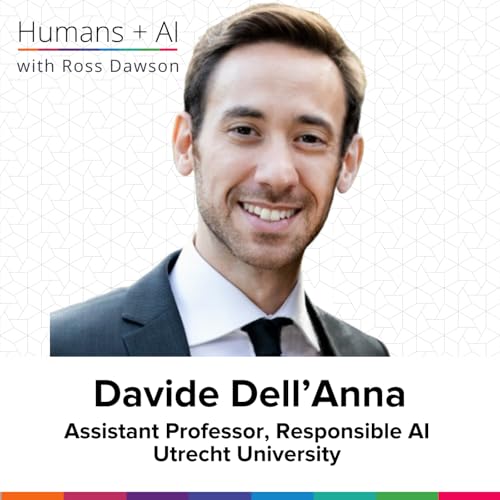
『Davide Dell’Anna on hybrid intelligence, guidelines for human-AI teams, calibrating trust, and team ethics (AC Ep33)』のカバーアート

Davide Dell’Anna on hybrid intelligence, guidelines for human-AI teams, calibrating trust, and team ethics (AC Ep33)

Davide Dell’Anna on hybrid intelligence, guidelines for human-AI teams, calibrating trust, and team ethics (AC Ep33)

無料で聴く

ポッドキャストの詳細を見る
“In this sense, human and AI means a synergy where teams of humans and AI together lead to superior outcomes than either the human or the AI operating in isolation.” – Davide Dell’Anna About Davide Dell’Anna Davide Dell’Anna is Assistant Professor of Responsible AI at Utrecht University, and a member of the Hybrid Intelligence Centre. His research focuses on how AI can cooperate synergistically and proactively with humans. Davide has published a wide range of leading research in the space. Website: davidedellanna.com LinkedIn Profile: Davide Dell’Anna University Profile: Davide Dell’Anna What you will learn The core concept of hybrid intelligence as collaborative human-AI teaming, not replacementWhy effective hybrid teams require acknowledging and leveraging both human and AI strengths and weaknessesHow lessons from human-human and human-animal teams inform better design of human-AI collaborationKey differences between humans and AI in teams, such as accountability, replaceability, and identityThe importance of process-oriented evaluation, including satisfaction, trust, and adaptability, for measuring hybrid team effectivenessWhy appropriately calibrated trust and shared ethics are central to performance and cohesion in hybrid teamsThe shift from explainability to justifiability in AI, emphasizing actions aligned with shared team norms and valuesNew organizational roles and skills—like team facilitation and dynamic team design—needed to support successful human-AI collaboration Episode Resources Transcript Ross Dawson: Hi Davide. It’s wonderful to have you on the show. Davide Dell’Anna: Hi Ross, nice to meet you. Thank you so much for having me. Ross: So you do a lot of work around what you call hybrid intelligence, and I think that’s pretty well aligned with a lot of the topics we have on the podcast. But I’d love to hear your definition and framing—what is hybrid intelligence? Davide: Well, thank you so much for the question. Hybrid intelligence is a new paradigm, or a paradigm that tries to move the public narrative away from the common focus on replacement—AI or robots taking over our jobs. While that’s an understandable fear, more scientifically and societally, I think it’s more interesting and relevant to think of humans and AI as collaborators. In this sense, human and AI means a synergy where teams of humans and AI together lead to superior outcomes than either the human or the AI operating in isolation. In a human-AI team, members can compensate for each other’s weaknesses and amplify each other’s strengths. The goal is not to substitute human capabilities, but to augment them. This immediately moves the discussion from “what can the AI do to replace me?” to “how can we design the best possible team to work together?” I think that’s the foundation of the concept of hybrid intelligence. So hybrid intelligence, per se, is the ultimate goal. We aim at designing or engineering these human-AI teams so that we can effectively and responsibly collaborate together to achieve this superior type of intelligence, which we then call hybrid intelligence. Ross: That’s fantastic. And so extremely aligned with the humans plus AI thesis. That’s very similar to what I might have said myself, not using the word hybrid intelligence, but humans plus AI to say the same thing. We want to dive into the humans-AI teaming specifically in a moment. But in some of your writing, you’ve commented that, while others are thinking about augmentation in various ways, you point out that these are not necessarily as holistic as they could be. So what do you think is missing in some of the other ways people are approaching AI as a tool of augmentation? Davide: Yeah, so I think when you look at the literature—as a computer scientist myself, I notice how easily I fall into the trap of only discussing AI capabilities. When I talk about AI or even human-AI teams, I end up talking about how I can build the AI to do this, or how I can improve the process in this way. Most of the literature does that as well. There’s a technology-centric perspective to the discussion of even human-AI teams. We try to understand what we can build from the AI point of view to improve a team. But if you think of human-AI teams in this way, you realize that this significantly limits our vocabulary and our ability to look at the team from a broader, system-level perspective, where each member—including and especially human team members—is treated individually, and their skills and identity are considered and leveraged. So, if you look at the literature, you often end up talking about how to add one feature to the AI or how to extend its feature set in other ways. But what people often miss is looking at the weaknesses and strengths of the different individuals, so that we can engineer for their compensation and amplification. Machines and people are fundamentally ...
adbl_web_anon_alc_button_suppression_c
まだレビューはありません