• Why Efficiency Is Making Us Care Less │Data Malarkey with Judah Armani
    2026/09/22

    What if design is not really about products at all, but about bridging the gap between the world as it is and the world we hope for?

    In this episode of Data Malarkey, Master Data Storyteller, Sam Knowles, speaks with Judah Armani, Head of the Public Service Design Practice CIC. Judah is a collaborative designer, educator, and social entrepreneur. The two discuss design as problem solving, insight as a "liquid understanding", and the role of care, curiosity, and creativity in tackling some of society's toughest challenges.

    Judah's work spans public service design, education, prison reform, and systems change. From founding the world's first record label launched in prison and run by prisoners, to creating football-based learning programmes and teaching around the world, he offers a completely different lens on how data, information, and human understanding can lead to action.

    In this episode, you'll learn:

    • Why Judah sees design as the connective tissue between reality and aspiration

    • Why solving problems is something everyone does, not just trained designers

    • How gathering information, specifying intent, and taking action underpin most problem solving

    • Why taxonomy shapes what we can see and what we miss

    • Why efficiency can quietly erode care if we are not careful

    • How Judah defines insight as a "liquid understanding"

    • Why outliers, clues, and hints often matter more than neat summaries

    • How InHouse Records was created inside prison to reduce reoffending

    • Why Judah sees AI as useful for summarising, but not yet for true creativity

    Topics we cover:

    • Design as problem solving

    • Retirement, mission, and a life spent solving problems

    • Taxonomy, categorisation, and reordering information

    • von Humboldt, Ruskin, and different ways of seeing the same world

    • Care, efficiency, and what modern systems make us lose

    • Socratic inquiry and the different states of knowledge

    • Outliers, patterns, and the power of different vantage points

    • InHouse Records and designing for social impact

    • AI, creativity, and the limits of large language models

    About the guest:
    Judah Armani is a collaborative designer, educator, and social entrepreneur whose work focuses on social change, public service design, and reimagining systems for those most often left out. He has worked across product design, charities, education, and justice, and is the founder of projects including InHouse Records and Crossbar.

    Links and resources mentioned:

    • Judah's LinkedIn profile - https://www.linkedin.com/in/hodajudaharmani/

    • His CIC's home page - https://www.hodajudaharmani.design/

    • InHouse Records - https://www.inhouserecords.org/

    • Crossbar Education Innovation Programme - https://ifdesign.com/en/winner-ranking/project/crossbar/744665

    • Take the Data Storytelling Scorecard: https://data-storytelling.scoreapp.com

    続きを読む 一部表示
    51 分
  • How to Turn Data Into Real Insight │Data Malarkey with Louise Twycross-Lewis
    2026/09/08

    What turns data into insight, and why does that distinction matter so much in media, research, and strategy?

    In this episode of Data Malarkey, Master Data Storyteller, Sam Knowles, speaks with Louise Twycross-Lewis, Managing Partner and Head of Insight at media agency PHD. They address how insight teams move beyond "what is happening" to uncover "what it means" and "what should happen next".

    Louise shares her definition of insight, the practical tools and techniques she and her teams use to get there, and how AI is changing the way research teams work - from open-text analysis to identifying themes at scale. They also explore the promise and risks of synthetic data, the danger of bias in AI-trained systems, the challenge of training junior talent in an AI-assisted world, and the findings from PHD's Culture Currents research into optimism and anticipation.

    In this episode, you'll learn:

    • Why insight is so much more than a hypothesis or a chart

    • Why clear objectives and hypotheses matter before research even begins

    • How Louise uses AI to speed up analysis while keeping humans in the lead (not just in the loop)

    • Why human truth still matters more than efficiency alone

    • How bias in AI systems can distort decision-making

    • Why the industry needs to think hard about how it trains junior talent

    • What PHD's Culture Currents research says about optimism in a difficult world

    • Why anticipation has become more valuable, not less

    • How brands and media can play a role across the full anticipation journey

    Topics we cover:

    • Defining insight in media and communications

    • Moving from data to story

    • AI-assisted analysis and human oversight

    • Synthetic data and the limits of generated research

    • Bias, representation, and "ultra-processed" data

    • Entry-level roles, compression culture, and learning by doing

    • Culture Currents research and optimism

    • Culture Current research and anticipation, eventification, and dopamine

    • Why brands should think beyond the moment of reward

    About the guest:
    Louise Twycross-Lewis is Managing Partner and Head of Insight at PHD. She has spent her career in media research and insight, working across media owners and major agencies, and is a recognised leader in the industry as well as a champion of cultural and ethnic diversity.

    Links and resources mentioned:

    • Louise's profile on LinkedIn - https://www.linkedin.com/in/louise-twycross-lewis-1b655b2/

    • PHD's Culture Currents research and publications - https://www.phdmedia.com/our-publications/

    • Take the Data Storytelling Scorecard: https://data-storytelling.scoreapp.com

    続きを読む 一部表示
    39 分
  • How Algorithms Are Putting Children at Risk │Data Malarkey with Andy Burrows
    2026/07/28

    What happens when platform design, recommendation algorithms, and commercial incentives collide with teenage vulnerability?

    In this episode of Data Malarkey, Master Data Storyteller, Sam Knowles, speaks to Andy Burrows, Chief Executive of the Molly Rose Foundation, about online safety, suicide prevention, tech accountability, and the systemic failures that continue to expose children to harmful content online.

    Andy explains how the Foundation's research tested Instagram and TikTok through the eyes of a 15-year-old girl, why the findings were so disturbing, and how advertising, platform incentives, legal action, and regulation all fit into a bigger picture. He also reflects on Molly's story, the role of whistleblowers, the limits of self-regulation, and why the current approach to online safety remains nowhere near strong enough.

    In this episode, you'll learn:

    • How recommendation algorithms can intensify harm at scale

    • What the Molly Rose Foundation's research found on Instagram and TikTok

    • Why harmful content and advertising adjacency is such a serious issue

    • How whistleblowers and legal disclosures have been so important

    • Why advertisers may be part of the problem, but also part of the solution

    • Why Andy sees recent US court rulings as a "big tobacco" moment for tech

    • Why self-regulation has failed and stronger, safety-by-design rules are needed

    • Why a social media ban is not the magic bullet many think it could be

    • How AI risks are making the online safety challenge even worse

    Topics we cover:

    • Molly Russell's story and the mission of the Foundation in her name

    • Testing harmful algorithmic recommendations

    • Platform incentives and the economics of attention

    • Brand safety and ad placement near harmful content

    • Whistleblowers, disclosures, and Meta's conduct

    • US litigation and the erosion of tech immunity arguments

    • The Online Safety Act and Ofcom's limitations

    • The Australia-style social media ban under the spotlight

    • AI companions, AI slop, and history repeating itself

    About the guest:
    Andy Burrows is Chief Executive of the Molly Rose Foundation, which works at the intersection of suicide prevention, online safety, and tech accountability. He has spent much of his career representing vulnerable groups, previously working in regulation, consumer policy, and online safety, including on the Online Safety Act.

    Links and resources mentioned:

    • The Molly Rose Foundation: https://mollyrosefoundation.org/

    • Molly vs the Machines on Channel 4 - https://www.channel4.com/programmes/molly-vs-the-machines

    • Take the Data Storytelling Scorecard: https://data-storytelling.scoreapp.com

    続きを読む 一部表示
    53 分
  • What Happens to Your Data When You Die? │ Data Malarkey with Carl Öhman
    2026/07/14

    What happens to your data when you die?

    In this episode of Data Malarkey, Master Data Storyteller, Sam Knowles, welcomes Carl Öhman, Assistant Professor in Political Science at Uppsala University and author of The Afterlife of Data: What Happens to Your Information When You Die and Why You Should Care.

    Carl explores one of the most overlooked questions in the digital age: what becomes of the vast trail of data we all leave behind, and who gets to control it once we are gone. From history, archives, and memory to big tech business models, digital afterlife products, environmental costs, and the politics of forgetting, this is a rich and thought-provoking conversation about the future of our digital remains.

    In this episode, you'll learn:

    • Why the data we leave behind after death is a major political and ethical issue

    • Why our so-called digital "trash" may become one of the richest archives in human history

    • How social and digital media platforms are building unprecedented records of human behaviour

    • Why digital afterlife products raise unsettling questions about grief, memory, and authenticity

    • What happens when dead users start to outnumber living users on platforms like Facebook

    • Why big tech has powerful incentives to keep hold of the data of the dead

    • Whether regulation should include a kind of "right to be forgotten" after death - a "posthumous GDPR"

    • Why data storage and environmental cost matter in debates about digital remains

    • How AI and data may be creating something like a new digital theology

    Topics we cover:

    • Carl's route into studying death and digital traces

    • Digital dandruff, archives, and the value of informational leftovers

    • Ownership, memory, and the politics of historical record

    • The future of historical research in a world of platform-controlled archives

    • Black Mirror, digital resurrection, and the digital afterlife industry

    • Big tech incentives and "holding our loved ones hostage"

    • Regulation, GDPR, and who should guard the guards

    • The carbon footprint of storing dead people's data

    • Carl's next book, on AI: The Gods of Data

    About our guest:
    Carl Öhman is Assistant Professor in Political Science at Uppsala University. His research focuses on the politics and ethics of AI, digital memory, and the governance of information. He is the author of The Afterlife of Data and works at the intersection of technology, politics, and culture.

    Links and resources mentioned:

    • The Afterlife of Data by Carl Öhman - https://press.uchicago.edu/ucp/books/book/chicago/A/bo209942751.html

    • Carl's page at Uppsala University - https://bit.ly/4tIeXHX

    • Take the Data Storytelling Scorecard: https://data-storytelling.scoreapp.com

    続きを読む 一部表示
    51 分
  • What should marketing and communications leaders actually do with AI right now?
    2026/06/30

    In this live episode of Data Malarkey - recorded live on stage at the 'AI for PR' conference in June 2026 - Master Data Storyteller, Sam Knowles, speaks with Pete Markey, Chief Communications & Marketing Officer at the University of Nottingham. Their wide-ranging discussion covered, AI, brand relevance, trust, creative judgement, and the future of marketing.

    Pete has led marketing and communications across some of the UK's best-known brands, from More Th>n, RSA, and the Post Office to Aviva, TSB and Boots. Drawing on decades of experience with some of the UK's best-known and most progressive brands, he shares a highly practical view of what AI is useful for, where it creates real value, and where brands still need strong human oversight.

    From customer experience, creative versioning, and strategic thinking, to measurement, reputation, and the future world of work, this is a thoughtful conversation about how to embrace AI without losing what the humanity that can make brands truly distinctive.

    In this episode, you'll learn:

    • Why brand relevance is still one of the most important North Stars in marketing

    • Why authenticity matters even more in an AI-mediated world

    • Why AI can be brilliant for speed, efficiency, and creative adaptation

    • Why Pete draws firm guardrails around AI-generated people and brand authenticity

    • How data and testing are reshaping the role of the CMO

    • Why marketing leaders need to educate their boards and exec teams on AI

    • What skills younger and older comms professionals should be building now

    • Why AI and human craft must coexist

    Topics we cover:

    • Staying relevant as a brand

    • Trust, authenticity, and fragile public brands

    • AI adoption at Boots and beyond

    • Creative development, speed, and retail responsiveness

    • The scientist, artist, and politician balance in the CMO role

    • Measurement, eye tracking, and data-led campaign decisions

    • AI in marketing operations and digital journeys

    • The changing relationship between brands and agencies

    • Entry-level jobs, future skills, and marketing careers in the AI era

    About the guest:
    Pete Markey is Chief Communications & Marketing Officer at the University of Nottingham. Across his career he has led marketing and communications for a range of major UK brands including More Th>n, RSA, the Post Office, Aviva, TSB, and Boots. Pete is known for combining strong brand thinking with a deep focus on data, effectiveness, and practical innovation.

    Links and resources mentioned:

    • Pete's LinkedIn profile https://www.linkedin.com/in/petermarkey/

    • University of Nottingham website https://www.nottingham.ac.uk/

    • Take the Data Storytelling Scorecard: https://data-storytelling.scoreapp.com

    続きを読む 一部表示
    37 分
  • "Real to Reel - Using Data Smarter" Data Malarkey Season 10 highlights: equality, AI, and the Four-Day Week
    2026/05/26

    What were the standout moments from Season 10 of Data Malarkey?

    In this end-of-season special, host and Master Data Storyteller, Sam Knowles, looks back at some of the best bits, biggest ideas, and sharpest soundbites from across Season 10. This "greatest hits" episode brings together a brilliant and eclectic mix of guests and topics, from gender equality in football and inclusion in advertising, to online safety, AI, insight, the four-day week, startup success, and making sense of data in organisations.

    Featuring clips from Karen and Charlie Dobres, former Directors of Lewes FC, Ali Hanan, Harriet Kingaby, Ahti Heinla, Dino Delić, and Charlotte Rae, this episode is both a recap for existing listeners and a perfect jumping-in point for anyone new to Data Malarkey.

    In this episode, you'll hear:

    • How Lewes FC used attention, sponsorship, and crowd-building to drive gender equality in football

    • Why equal FA Cup prize money remains a live issue

    • What the new ROI - "return on inclusion" - means and how it drives advertising effectiveness

    • Why the collapse of truth online should worry all of us

    • How Skype and Starship Technologies were built from early-stage uncertainty into category-changing, global scaling businesses

    • What the four-day week really means, and why it can improve both wellbeing and productivity

    • Why many organisations still struggle to communications turn data into useful action

    • How better questions, better framing, and better internal alignment lead to better decisions

    Featured guests and themes:

    • Karen and Charlie Dobres on Lewes FC and Equality FC

    • Ali Hanan on return on inclusion

    • Harriet Kingaby on truth, trust, and AI

    • Ahti Heinla on Skype, Starship Technologies, and building world-changing tech

    • Dino Delić on data, action, and why tools are not the problem

    • Charlotte Rae on the four-day week

    Take the Data Storytelling Scorecard: https://data-storytelling.scoreapp.com

    続きを読む 一部表示
    59 分
  • How the four-day week boosts sleep, wellbeing, and output with Charlotte Rae
    2026/05/12

    The four-day week gets talked about a lot, but what happens when you stop talking about the theory and start measuring impact properly?

    In this episode of Data Malarkey - the podcast about using data, smarter - Master Data Storyteller, Sam Knowles, speaks to Charlotte Rae, Associate Professor in Psychology at the University of Sussex. Charlotte is one of the UK's leading quantitative researchers on the impact of the four-day working week. She explains how the Sussex 4 Day Week research project studies real employers, real staff, and real outcomes to understand what changes when businesses move to working time reduction.

    From productivity and sleep to motivation, meetings, AI, and whether the "honeymoon effect" wears off, this is a brilliant conversation about what the evidence says and where the practical challenges still sit.

    In this episode, you'll learn:

    • The difference between working time reduction, compressed hours, and part-time working

    • How the Sussex 4 Day Week programme helps businesses prepare, trial, and measure results

    • Why productivity rose by around 8% on average in the trial period

    • Why improved sleep appears to be linked to improved productivity

    • How motivation and behaviour change drive better output in less time

    • Which sectors and business sizes are best suited to shorter working weeks

    • Why most four-day week businesses do not simply shut on Fridays

    • How AI may help enable shorter working weeks, but only if used in a structured way

    Topics we cover:

    • Four-day week models explained

    • Measuring productivity, wellbeing, burnout, sleep, and motivation

    • Why little tweaks often beat big grand changes

    • The role of rest, recovery, and hobbies

    • Sector differences: knowledge work, manufacturing, care, rota-based businesses

    • Which non-working day businesses choose most often

    • Long-term stickability of the four-day week

    • Whether AI could accelerate working time reduction

    About the guest:
    Charlotte Rae is an Associate Professor in Psychology at the University of Sussex and leads the Sussex 4 Day Week research project. With a background in psychology and neuroscience, she applies a rigorous, data-driven approach to studying how shorter working weeks affect productivity, wellbeing, and workplace performance.

    Links and resources mentioned:

    • Sussex Four Day Week: https://sussex4dayweek.co.uk

    • Take the Data Storytelling Scorecard: https://data-storytelling.scoreapp.com

    続きを読む 一部表示
    55 分
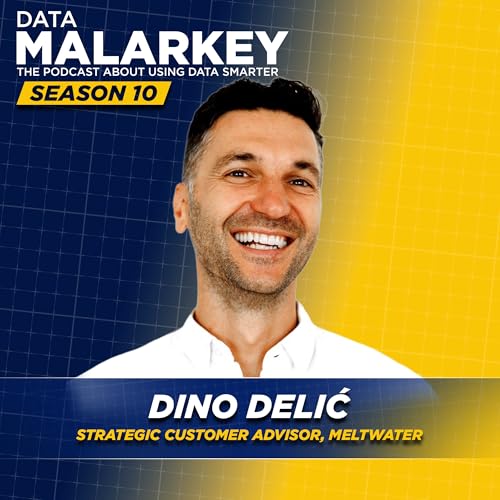
  • Why comms teams fail, even with great tools | Dino Delić
    2026/04/28

    What if the problem is not your tool?

    In this episode of the Data Malarkey podcast, Master Data Storyteller, Sam Knowles, speaks with Dino Delić of Meltwater, the global leader in media intelligence. Sam and Dino cover data, comms, capability-building, AI, and why too many teams are still using powerful tools to produce underwhelming outcomes. Dino is sharp, direct, gloriously opinionated, and obsessed with helping people stop hiding behind "best practices" and start solving the right problem.

    They explore why data often fails to drive action inside organisations, how comms teams can become more strategically useful, why AI is creating both huge opportunity and total chaos, and why capability matters far more than buying the latest shiny thing.

    In this episode, you'll learn:

    • Why Dino hates the phrase "best practices"

    • Why most teams are not held back by their tools

    • How to start with the real moment of frustration, not generic advice

    • Why the CEO's priorities should shape your data communications strategy

    • How to turn reporting into decision-making

    • Why AI can massively help, but only if you know what good looks like already

    • Why most people are still "the cat chasing the laser pointer"

    • How Dino thinks about capability, experimentation, and constant improvement

    Topics we cover:

    • Dino's background from Bosnia to Australia to the US

    • Sales, persuasion, and making ideas land

    • Why "tool + skills + resources" matters

    • The difference between collecting data and using data

    • Why AVEs and lazy measurement still hang around

    • AI hype, maturity, and common mistakes

    • Meltwater's Run Club, newsletter, and open learning approach

    • Why communicators need debate, not just agreement

    About the guest:
    Dino Delić is Strategic Customer Advisor at Meltwater. He works at the intersection of communications, data, measurement, enablement, and customer success, helping teams turn information into action and become more effective, persuasive, and data-driven in the work they do.

    Links and resources mentioned:

    • Meltwater's Data Driven Communications Run Club and newsletter - https://community.meltwater.com/p/ddc

    • Follow Dino Delić on LinkedIn - https://www.linkedin.com/in/dinodelic/

    Take the Data Storytelling Scorecard: https://data-storytelling.scoreapp.com

    続きを読む 一部表示
    57 分