『Data & AI Mastery』のカバーアート

Data & AI Mastery

Data & AI Mastery

著者: Cambridge Spark
無料で聴く

In the age of rapid technological change, how can you harness the power of data and AI to transform your business?

Welcome to Data & AI Mastery, the podcast where cutting-edge insights meet practical strategies for success.

Hosted by Dr Raoul-Gabriel Urma, founder of Cambridge Spark, this show dives deep into how leading organisations across the globe are using data & AI to revolutionise operations, streamline efficiency, and drive innovation.

Each episode features conversations with senior leaders, revealing their career stories and real-world case studies and actionable takeaways that you can apply, whether you're climbing the career ladder or already in the C-suite.

From AI-driven solutions to practical tips for navigating your data transformation journey, Data & AI Mastery will equip you with the tools to thrive in the AI era.

Stay ahead, stay inspired, and unlock your potential with Data & AI Mastery: your ultimate guide to mastering data and AI for business.

This feed is also home to Inside the Algorithm, our sister show hosted by Chief AI Officer Dr Jeremy Bradley, featuring in-depth conversations with the researchers and technical experts working at the frontier of artificial intelligence. New episodes from both shows drop fortnightly, on alternate weeks.

Follow now so you never miss an episode from either show. 🎙️

2024 Cambridge Spark
政治・政府
エピソード
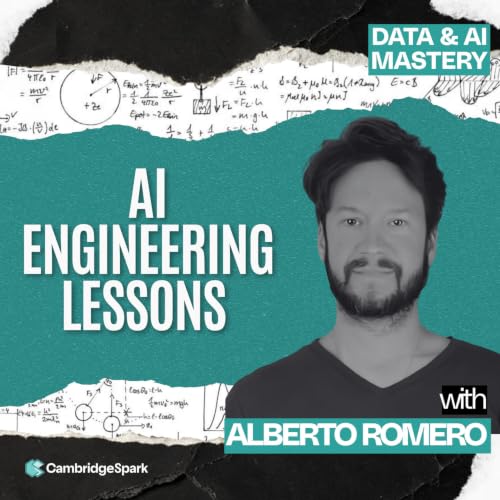
  • DAIM: Inside The Algorithm | Alberto Romero on Engineering AI at scale at Aviva
    2026/08/05

    👉 Discover how Cambridge Spark helps organisations build the data and AI capabilities needed to turn strategy into measurable impact: cambridgespark.com

    What does it actually take to ship machine learning inside one of the UK's largest insurers? Jeremy Bradley sits down with Alberto Romero, director of AI engineering at Aviva, to trace his path from InsurTech founder to enterprise AI leader.

    Alberto explains why prototypes are so often mistaken for finished products and what production readiness really demands once edge cases, drift and adversarial behaviour enter the picture. The conversation covers how to get genuine explainability out of large language models rather than plausible-sounding justification, when fine-tuning earns its place in a regulated stack, and why Aviva built its own internal platform to govern AI use cases at scale.

    Alberto also shares his take on fraud detection as an adversarial ML problem and the one failure mode he sees engineering teams repeat most often.

    Follow Data & AI Mastery so you never miss an episode, and share it with a colleague working through similar production challenges.

    If you enjoyed this conversation, you might also like this episode featuring Sarah Self. She joined us on Data and AI Mastery to explore what most organisations get wrong when deploying AI.

    Apple: https://podcasts.apple.com/gb/podcast/from-cybersecurity-to-ai-director-sarah-self-on-leading/id1779783413?i=1000764247007

    Spotify: https://open.spotify.com/episode/0BpSq5X1ZP8ctIYTxWVAJT?si=1264586e79f3446f

    YouTube: https://www.youtube.com/watch?v=2jgM095SYG0

    Glossary Terms

    RAG: Retrieval-Augmented Generation is an AI methodology that enhances Large Language Models by pulling factual context from external knowledge bases.

    GAN: Generative Adversarial Network is a deep learning architecture in which two neural networks compete against each other to create highly realistic synthetic data from a training dataset

    Non-deterministic: describes a process, algorithm, or system whose outcome is inherently unpredictable and cannot be guaranteed to repeat exactly, even when it starts from the exact same initial conditions

    ReAct (Reasoning + Acting) approach: a prompting technique that enables AI models to solve complex problems by alternating between thinking and taking action

    Chapter Markers

    (00:00) - Cold open: why prototypes get mistaken for production

    (02:53) - Avoiding common AI adoption pitfalls in regulated sectors

    (05:44) - Real explainability versus post-hoc justification in LLMs

    (09:18) - From startup founder to enterprise: the mindset shift

    (11:38) - Managing AI across 70+ use cases at Aviva

    (13:31) - Standards first, technology second

    (17:19) - Where fine-tuning earns its place

    (20:33) - Building Aviva's own governed AI platform

    (23:51) - Fraud detection as an adversarial ML problem

    (28:34) - Quick fire: the most common AI failure mode

    (29:37) - What deserves more attention as AI scales

    Useful Links

    Connect with Alberto Romero on LinkedIn: https://uk.linkedin.com/in/albertoromero-uk

    For more AI insights follow Jeremy on LinkedIn: https://uk.linkedin.com/in/jeremy-bradley

    Explore Cambridge Spark’s AI upskilling programmes at https://www.cambridgespark.com

    続きを読む 一部表示
    32 分
  • DAIM: Inside The Algorithm | Why Neurosymbolic AI Solves What Scaling Alone Cannot with Dr Vaishak Belle
    2026/07/08
    👉 Discover how Cambridge Spark helps organisations build the data and AI capabilities needed to turn strategy into measurable impact: cambridgespark.com Large language models are surprisingly good at producing fluent, plausible text. So why do they still confidently get simple things wrong? In this episode, Dr Jeremy Bradley is joined by Dr Vaishak Belle, Reader at the University of Edinburgh's School of Informatics, Alan Turing Institute Faculty Fellow and Director of Research and Innovation at the Bayes Centre. Vaishak has spent 16 years working at the intersection of logic, probability and machine learning and brings that lens to one of AI's most persistent problems: hallucination. The conversation traces why scaling alone will not solve reliability, what neurosymbolic AI actually is and why tools like Claude Code quietly depend on it, how theory of mind is being engineered into language models, and where reinforcement learning fits into the future of AI reasoning. If you work at the frontier of AI research or engineering, this is a grounded, technically rich conversation worth your time. Follow Data & AI Mastery so you never miss an episode. If you enjoyed this conversation, you might also like this episode featuring Dr Petar Veličković. Petar joined us on Data and AI Mastery to explore how graph neural networks bring structured reasoning into systems like Google Maps and how AI is being used as a genuine discovery partner in mathematics. Apple: https://podcasts.apple.com/gb/podcast/bridging-ai-research-and-real-world-impact-dr-petar/id1779783413?i=1000734000576 Spotify: https://open.spotify.com/episode/7qA0AY9MlLS2L9PANqlXNi?si=37d8a8fb43c14cc9 YouTube: https://www.youtube.com/watch?v=GwMUSNidnvE Glossary Terms Neurosymbolic AI: an emerging field that merges the intuitive pattern recognition of neural networks with the logical, rule-based reasoning of symbolic AI. Theory of Mind: refers to an AI’s capacity to attribute mental states to humans or other agents and understand that these states may differ from its own. Confabulation: In AI, it is the generation of factually incorrect, distorted, or entirely fabricated information presented as absolute truth. Delegation Module: a software component that allows users or systems to assign tasks, roles, or access rights to others. Retrieval Augmented Graphs: an advanced AI framework that enhances large language models by grounding their responses in interconnected data networks, such as knowledge graphs. Reinforcement Learning: a machine learning method where an AI agent learns to make decisions through trial and error. Dynamic Pathway Analysis: a computational method used in systems biology and bioinformatics to model and simulate how biological processes change over time. Chapter Markers (00:00) - Why LLM hallucinations happen (02:12) - The biggest shift in AI over the last 16 years (07:42) - How logic and probability shaped Vaishak's path into AI (10:11) - Introducing neurosymbolic AI (11:27) - Claude Code, algebraic delegation and the theory of mind problem (20:01) - Theory of mind in robotics and human computer interaction (21:54) - Confabulation versus hallucination (26:42) - Why AI errors are not the same as human dishonesty (27:24) - Reinforcement learning, reward signals and learned behaviour (32:36) - Syntax checks and the engineering behind reliable code (37:52) - What happens to the software engineer's role (40:49) - Advice for early career AI thinkers Useful Links Connect with Dr Vaishak Belle on LinkedIn: https://uk.linkedin.com/in/vaishakbelle Learn more about Vaishak’s work here: https://www.vaishakbelle.org/ Read Vaishak's report on The Future of Neuro-Symbolic AI: https://ojs.aaai.org/index.php/AAAI/article/view/42130 For more AI insights follow Jeremy on LinkedIn: https://uk.linkedin.com/in/jeremy-bradley Explore Cambridge Spark’s AI upskilling programmes at https://www.cambridgespark.com
    続きを読む 一部表示
    43 分
  • DAIM: Inside The Algorithm | Network Forecasting & Data Science Leadership with Dr Judit Guimera Busquets
    2026/06/03

    👉 Discover how Cambridge Spark helps organisations build the data and AI capabilities needed to turn strategy into measurable impact: cambridgespark.com

    This week, Dr Judit Guimera Busquets, Head of Data Science at Datasparq, joins Dr Jeremy Bradley to trace the journey from her PhD on air traffic network forecasting through to leading data science teams delivering real-world AI projects.

    Judit explains why forecasting inside a complex network is fundamentally different from standard demand prediction: when a single airport pair is removed, the cascade effect ripples across an entire system. She walks through the multi-stage modelling framework she developed, covering city pair demand generation, network evolution, itinerary assignment, and long-term scenario planning.

    The conversation then turns to what actually happens when structural shocks like a pandemic break a model's core assumptions and why human-in-the-loop design is not optional. Judit also sets out what she looks for in data scientists: pragmatism over perfection, simplicity over complexity, and a production-first mindset from day one.

    She closes with her view on where applied AI is heading, including the rise of small, fine-tuned specialist models and why AI governance remains the most overlooked challenge in the field.

    Follow Data & AI Mastery on Apple Podcasts, Spotify, or YouTube to stay ahead of the algorithm.

    If you enjoyed this episode, why not check out the Data & AI Mastery episode with Richard Masters, VP of Data and AI at Virgin Atlantic. You will learn more about how the airline leverages AI and data-driven strategies to enhance operations, optimise pricing, and deliver premium customer experiences:

    Apple: https://podcasts.apple.com/gb/podcast/mastering-data-ai-insights-from-virgin-atlantics-vp/id1779783413?i=1000697801419

    Spotify: https://open.spotify.com/episode/1MY3AZCvDr5eS1HlfBudHy?si=ca5ec9b2fe6d44b1

    YouTube: https://www.youtube.com/watch?v=DQ3mTwTzJvA

    Glossary Terms

    Hub-and-spoke Model: a centralised organisational architecture where a central core connects to multiple peripheral nodes. Traffic, communication, or inventory flows through the hub rather than directly between spokes.

    Network Theory: a multidisciplinary framework used to analyse complex systems by representing them as mathematical graphs

    Econometrics: the application of statistical and mathematical models to economic data

    Human-in-the-Loop: a collaborative AI approach where humans actively participate in an automated system's training, refinement, or operation.

    Linear Regression Model: a fundamental statistical and machine learning algorithm that models the relationship between a dependent variable and one or more independent variables by fitting a straight line to the data.

    Chapter Markers

    (00:00) - What makes network forecasting different from standard demand prediction

    (05:54) - How historical data fails when the network itself evolves

    (10:05) - Modelling link addition and removal as classification problems

    (13:26) - Designing for medium and long-term policy evaluation, not daily operations

    (17:57) - What happens to a model when a structural shock like a pandemic hits

    (22:22) - Human-in-the-loop: adjusting elasticities and running what-if scenarios

    (27:20) - What great data scientists actually look like in a consulting environment

    (30:03) - Getting stakeholders to use AI: champions, end users and change readiness

    (32:00) - Where applied AI is heading: small specialist models and the governance gap

    Useful Links

    Connect with Dr Judit Guimera Busquets on LinkedIn: https://uk.linkedin.com/in/judit-guimera-busquets-696ab74a

    Learn more about Judit’s PHD here: https://openaccess.city.ac.uk/id/eprint/24689/1/Busquets%2C%20Guimera.pdf

    For more AI insights follow Jeremy on LinkedIn: https://uk.linkedin.com/in/jeremy-bradley

    Explore Cambridge Spark’s AI upskilling programmes at https://www.cambridgespark.com

    続きを読む 一部表示
    34 分
adbl_web_anon_alc_button_suppression_t1
まだレビューはありません