エピソード

  • Damian Hughes, High-Performance Speaker and Bestselling Author
    2025/12/02

    Damian Hughes is an international speaker, bestselling author and co-host of the High Performance Podcast. From formative years in a Manchester boxing gym shaped by his father’s belief in community and belonging, to a career spanning Unilever, elite sport and academic work as a visiting professor, Damian combines his background in sport, organisational development and change psychology to help leaders and teams create high-performing cultures grounded in behaviour and human connection.


    In this episode of Culture de-cooded, Damian explores the central question he has asked across more than 500 conversations with leaders, athletes and creatives: what really defines high performance? His guiding insight is simple and inclusive. High performance is doing the best you can, in the moment you’re in, with the resources you have.


    Drawing on stories from his upbringing in the Manchester boxing gym, his work across England football, rugby union and rugby league, as well as interviews and research that underpin Microhabits, Damian explains why exceptional cultures are those where people feel seen, heard and loved. He reveals how leaders close the say-do gap by replacing abstract values with lived, observable behaviours.

    Damian also explores why clarity, consistency and trust matter, how standards are formed, and why personal reflection sits at the heart of sustainable leadership. Through examples ranging from Clive Woodward to Toto Wolff and insights gathered from 20 years working inside high-pressure environments, he shows how small, practical habits become the foundation of performance.


    Finally, Damian reflects on his own journey, including the turning point at Unilever that pushed him toward dedicating his career to human performance, culture and behavioural change. It is an honest, practical and deeply human conversation about what it takes to build environments where people can truly thrive.


    Podcast Chapters


    00:00:00 Welcome to the episode
    00:01:33 Introducing Damian Hughes
    00:02:12 What is high performance
    00:03:36 Phil Neville’s definition
    00:05:45 Growing up in a Manchester boxing gym
    00:07:43 A culture where people feel seen, heard and loved
    00:09:24 Are great cultures replicable
    00:10:30 The Eleven Madison example
    00:12:03 Culture and outcomes
    00:13:42 What happens in the shadows
    00:14:36 Turning values into behaviours
    00:17:46 The say-do gap
    00:19:50 Trust and behavioural consistency
    00:22:24 Standards and non-negotiable behaviours
    00:27:48 Transparency, consistency and hard calls
    00:31:00 The leader’s self-mastery challenge
    00:33:59 Behaviour as personality plus environment
    00:41:08 The “Dickhead Test” and context
    00:44:47 Psychological safety (SAFE)
    00:48:36 Humility and the valley of humility
    00:52:12 Lessons from Nims Purja
    00:56:55 Damian’s journey from boxing to Unilever
    01:02:11 The Durban boardroom moment
    01:04:06 Working in elite sport and culture
    01:05:36 Damian’s leadership journey in a song: Just Say Yes

    続きを読む 一部表示
    1 時間 9 分
  • Dan Strode, Global Culture & Innovation Expert
    2025/06/24

    Dan Strode, a culture and innovation strategist with a track record of transforming organisations across 32 countries, opens Season 2 of Culture de-cooded with a masterclass on leadership at scale.

    From his formative years as Global Culture Lead at Santander Group to his current role as Principal at Coode, Dan shares a deeply practical, human approach to shifting behaviours and embedding cultural change in global systems.

    In this episode, Dan unpacks what it means to lead with purpose and clarity in fast-moving environments. He reflects on the three guiding questions that shaped his work at Santander, exploring how they evolved alongside the organisation. He discusses how local and global cultures intersect, and why measuring cultural progress requires more than just metrics, it demands nuance, dialogue, and consistent alignment between strategy and lived behaviour.

    Dan introduces listeners to the “Cyborg Mindset”, a philosophy that balances the rise of AI with core human traits like curiosity, empathy, and collaboration. With sharp insight and candid reflection, he explores the future of work, the importance of psychological safety, and how leaders can create conditions for innovation and autonomy to thrive.

    Blending systems thinking with frontline experience, Dan makes a compelling case for culture as both a strategic lever and a deeply human endeavour, one that, when understood and nurtured, can unlock extraordinary performance across teams, geographies, and industries.

    Podcast Chapters

    00:00:00-Welcome to Season 2

    00:01:24-Introducing Dan

    00:02:24-Career Path to Santander

    00:05:15-Global Culture at Santander Group

    00:11:14-Becoming the first global culture lead at Santander

    00:15:37-Three Core Questions & Adapting Over Time

    00:20:01-Global vs Local Culture

    00:26:34-Tracking Progress By measuring Culture

    00:31:29-Life After Santander & Writing The Books

    00:38:54-AI, Innovation & the Cyborg Mindset

    00:44:42-Ants.

    00:45:30-Dans leadership Journey in a Song

    続きを読む 一部表示
    48 分
  • Kerem Hasan, Pioneering Global Conductor
    2025/01/22

    Kerem, a London-born conductor with Cypriot roots, has gained international acclaim from his early win at the Nestlé and Salzburg Festival’s Young Conductors Award in 2017 to serving as Chief Conductor of the Tiroler Symphony Orchestra in Austria and performing globally, Kerem shares invaluable insights into his craft.He emphasises the importance of collaboration, active listening and adaptation to orchestras different styles, as he embarks on an incredible feat this year, in directing sixteendifferent orchestras, across sixteen of the world’s big cities, in just six months.

    Kerem describes orchestras as high-performing teams and discusses how he guides them with authenticity, perceptiveness, and a strong sense of self, citing deep intuition and sensitivity as key to unlocking the potential of an ensemble. Kerem highlights the need to embrace mistakes as opportunities to learn and improve through intense practice, constantly refining his approach.

    He introduces the concept and importance of multiple layers of awareness in leadership and underscores the evolving role of conductors in making classical music accessible, fostering community connections, and harnessing the universal power of the arts to bridge cultural divides.

    Podcast Chapters

    00:00:00-Welcome Kerem to Culture de-cooded

    00:02:47-The Role of the Conductor

    00:09:11-Adaptation to orchestras across the globe

    00:13:13-Importance of continuous improvement & collaboration

    00:18:47-Relationship between orchestra and conductor

    00:22:03-Authentic leadership

    00:29:15-Ability to read the room

    00:31:16-Education in Glasgow & Zurich

    00:36:09-Importance of Sleep

    00:38:20-Looking ahead...

    00:43:09-Idealism & the power of music

    00:44:53-Kerem's Inspirations

    00:48:27-Kerem's leadership philosophy in a song


    A collaboration between ⁠Coode⁠ and ⁠Culture15⁠, intended to highlight the best in thought leadership and effective implementation on the topic of organisational culture.

    続きを読む 一部表示
    50 分
  • Paul Taylor, CEO and founder of Thought Machine
    2024/11/25

    In this episode Paul shares his experiences of the AI and tech industry and discusses the trials and tribulations of building culture and founding a business.

    Before founding Thought Machine, Paul successfully launched two companies, the second of which was acquired by Google in 2010. At Google, he led the text-to-speech team, which developed the cutting-edge technology that is now found in all of Google's navigation and voice search products. Paul holds a PhD in AI and has held teaching positions at Edinburgh and Cambridge Universities.

    Paul highlights how explicit and intentional the team at Thought Machine are when it comes to culture, and as such they have a set of core principles which guide it, inspired by Google.

    He touches on the importance of work ethic, and the encouragement of certain behaviours in building a productive and inspiring culture, as Thought Machine encourage all employees to facilitate debates and be “do-ers”.

    This episode is packed with insight, anecdotes and advice for all listeners looking to learn more about culture, AI and business.


    Chapters

    00:00:00-Introduction to Paul Taylor

    00:01:45-About Thought Machine

    00:03:31-Modernising banking infrastructure

    00:07:47-Thought Machine bridging the gap between challenger and legacy banks

    00:10:58-Shaping culture at Thought Machine

    00:17:03-"The problem with company values"

    00:19:18-Maintaining culture in a growing organisation

    00:20:39-"Good cultures get owned by people, who replicate it and buy into it"

    00:25:28-Lessons from Google and other ventures

    00:36:16-Deep dive into AI

    00:42:11: "You can do simple things very well, and build a great buisness"

    00:43:11-Reflections on leadership & Entrepreneurship

    00:49:30-Closing questions

    00:52:03-Pauls career journey as a song

    A collaboration between ⁠Coode⁠ and ⁠Culture15⁠, intended to highlight the best in thought leadership and effective implementation on the topic of organisational culture.

    続きを読む 一部表示
    54 分
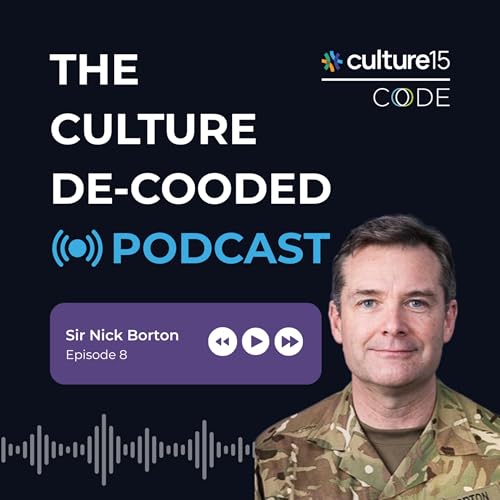
  • Lieutenant General Sir Nick Borton KCB DSO MBE, Former Senior British Army Officer and NATO Commander
    2024/08/27

    Lieutenant General Sir Nick Borton KCB DSO MBE is a former Senior British Army Officer who commanded NATO’s Allied Rapid Reaction Corps from 2021 to 2024.

    Commissioned into the Royal Highland Fusiliers in 1991, he served in multiple global locations and held key instructional and leadership roles. He commanded 16 Air Assault Brigade from 2013 to 2015 and the 3rd (UK) Division from 2016 to 2018. Promoted to Lieutenant General, he became Chief of Staff Operations at the Permanent Joint Headquarters before leading the Allied Rapid Reaction Corps. In 2023, he was appointed Knight Commander of The Order of the Bath.

    The episode not only delves into global politics and military strategy but also highlights the transferable leadership skills that apply across all sectors. Sir Nick reflects on individuality, responsibility, and the importance of understanding the people you lead, this episode offers powerful lessons for listeners from all walks of life.

    Chapters

    00:00:00-Introduction to Sir Nicks Career

    00:03:26-NATO and Russia’s Invasion of Ukraine

    00:08:33-Putin & global power dynamics

    00:17:52-A “pre-war” phase

    00:20:39-Culture in the British Army

    00:29:39-Diversity of thought in the Army

    00:33:18-3 things make soldiers fight

    00:41:49-Military Leadership

    00:51:04-Challenging the hierarchy

    00:53:49-The Military as an animal

    00:55:53-Sir Nick’s journey as a song

    A collaboration between ⁠Coode⁠ and ⁠Culture15⁠, intended to highlight the best in thought leadership and effective implementation on the topic of organisational culture.

    続きを読む 一部表示
    59 分
  • Dame Sally Davies, Former Chief Medical Officer for England
    2024/07/22

    In this episode, Charlie speaks to Dame Sally Davies, the 40th - and first female - Master of Trinity College Cambridge and also the first female Chief Medical Officer for England and the UK's special envoy on antimicrobial resistance (AMR). Recorded in the Master's Lodge at Trinity College, Cambridge, the episode delves into Dame Sally's illustrious career and her lifelong dedication to tackling antimicrobial resistance (AMR). She describes her work as health diplomacy as she raises awareness of and attempts to influence policy on AMR, highlighting the critical need for global action against superbugs. The conversation also touches on her earlier work with sickle cell patients and her role in establishing the National Institute for Health Research.Dame Sally emphasises the challenges of changing institutional mindsets and creating sustainable health policies, sharing insights from her experiences in health diplomacy and international cooperation. She reflects on her role as Master of Trinity, saying her leadership style encourages the 192 Fellows to recognise and pursue innovation as a collective endeavour. Dame Sally highlights that her style of leadership is one of influence, not power, freedom, not constraint and evolution not revolution.

    Chapters:

    00:00:00-Introduction to Dame Sally’s life works

    00:03:37-Anti-microbial resistance (AMR) explained

    00:08:42-Challenges of shifting beliefs & policy change

    00:13:30-Childhood, personal values & passion

    00:15:46-Pathway to overcoming AMR

    00:18:47-Diplomacy & global influence on AMR

    00:27:25-Behavioural change is needed

    00:32:19-Resilience & mindset

    00:37:57-First woman Chief Medical Officer

    00:42:12-Trinity College Fellowship

    00:47:00-Leadership of 192 fellows

    00:49:59-Dame Sally’s journey as a song

    A collaboration between ⁠Coode⁠ and ⁠Culture15⁠, intended to highlight the best in thought leadership and effective implementation on the topic of organisational culture.

    続きを読む 一部表示
    52 分
  • Sir Anthony Seldon, Historian, Political Author and Educator
    2024/06/17

    In this episode, Charlie speaks to Sir Anthony Seldon, political author and the current head of Epsom College. Anthony has led three of the most influential independent schools in the UK and was the vice-chancellor of Buckingham University, the UK’s first private university. As the official biographer of No. 10 Downing Street, Seldon has also written the authorised biographies of consecutive Prime Ministers over the last 25 years, from John Major to Boris Johnson.

    The conversation with Seldon ranged widely, from defining education as ‘to lead out students potential’ and establishing the role of leaders as ‘releasers’. Seldon reflects on the damaging effect of standardisation on the education system, which leaves little room for individuality and connects the dots between positive psychology and student performance.

    Seldon reflects on what makes a good (and bad) prime minister. He also affirms that schools no longer teach character, suggesting this may be why recent prime ministers led with their career prospects in mind and not their principles.Seldon also offers up the idea that the politics of today are shifting to a consumer form of politics rather than a conviction of principle-led politics.

    Seldon’s deep spirituality and broad education and experience provides rich insights from this episode of the Culture de-cooded podcast.

    Chapters

    00:00:00-Introduction, diverse career and upbringing.

    00:05:20-Education system and its impact on students.

    00:13:19-Effective Leadership and length of tenure.

    00:16:54-Political Leadership

    00:20:04-Leaders as releasers

    00:27:17-‘Politics should be principle-led, not consumer driven’

    00:36:00-Energy,ego and building bridges.

    00:47:36-Seldon’s journey as a song.

    A collaboration between ⁠Coode⁠ and ⁠Culture15⁠, intended to highlight the best in thought leadership and effective implementation on the topic of organisational culture.


    続きを読む 一部表示
    50 分
  • Tamara Rojo, Artistic Director of San Francisco Ballet
    2024/05/20

    In this episode Tamara Rojo shares her experience as artistic director of both English National Ballet (2012-2022) and more recently San Francisco Ballet (since 2022). Tamara speaks of her love of dance as an art form and its ability to change lives.

    Having been at the forefront of cultural transformation at the English National Ballet (ENB) for 10 years, Tamara champions the importance of personal accountability from individuals within an organisation and reflects on her belief in investing in new voices. She also highlights the importance of speed, citing quick change and therefore quick reward, as the cornerstone of cultural and organisational success. She also reminisces fondly over the late chairman, Justin Bickle, who shared her passion and workload during cultural change at ENB, which enabled Tamara to ‘not have to fight every battle alone’.

    Originally from Spain, Tamara didn’t train at any of the traditionally admired institutions in the ballet world, but from a small school in Madrid, and she says this ‘outsider status’ gives a fresh perspective and the ability to always question everything. As an accomplished principal dancer herself, Tamara openly discusses the mindset of a ballerina and the pursuit of excellence. Tamara states that she finds it easy being ‘ambitious on behalf of others’, and highlights that success doesn’t happen alone. She encourages all dancers in her company to take pride in their common responsibility to deliver an outstanding performance worthy of applause every time they take the stage.

    Chapters

    00:00:00-Welcome to Episode 5

    00:01:16–Introduction to Tamara’s career

    00:02:50-10 years as Artistic director of theEnglish National Ballet (ENB)

    00:09:18-Cultural transformation at ENB

    00:18:21-Uniting dancers with purpose

    00:23:29-The pursuit of excellence as aperson and a professional

    00:27:44-Ambition, pride and the ability toquestion everything

    00:34:13-Adapting to a role off the stage

    00:41:49-Whats next for Tamara and the SanFransisco Ballet

    00:45:24-Reclaiming the Swan

    00:47:49-Tamaras choice of song

    A collaboration between ⁠Coode⁠ and ⁠Culture15⁠, intended to highlight the best in thought leadership and effective implementation on the topic of organisational culture.

    続きを読む 一部表示
    51 分