『Creating New Spaces: Interviews with artists redefining spaces through technology』のカバーアート

Creating New Spaces: Interviews with artists redefining spaces through technology

Creating New Spaces: Interviews with artists redefining spaces through technology

著者: Robin Petterd
無料で聴く

Explore the practice of creating media art installations with the Creating New Spaces podcast. In each episode, the host Robin Petterd brings you interviews with artists who are pushing the boundaries of art and technology. The podcast focuses on the intricacies of media installation and art, revealing the creative and technical processes behind the scenes. Perfect for artists, students, educators, and anyone interested in experimental art practice. Listen to hear conversations that illuminate the processes and challenges of new ways of working.Robin Petterd アート
エピソード
  • How Craig Walsh uses projection to transform trees into temporary public monuments
    2026/07/04

    In this interview, Craig Walsh explores the creative process behind Monuments. Monuments is a long-running outdoor projection project that uses projected portraits on trees to create temporary public monuments. The project began at Woodford Folk Festival in 1993, when Craig discovered how a projected portrait could align with the form of a tree and become a sculptural presence in public space.

    Craig Walsh is an Australian artist known for pioneering approaches to projection, installation, and site-responsive public art. Over more than 30 years, his work has animated trees, rivers, mountains, urban architecture, and live event environments across Australia and internationally with projections.

    In this conversation, Craig discusses how Monuments has evolved from early slide projections into a touring project shaped by each site and community. The structure of the work remains clear: projection, trees, night-time public space, portraiture, and temporary monument. What changes is the community, the selected people, the site, and the local meaning attached to each portrait.

    Listen to this podcast to learn about:

    • How Craig thinks about projection as sculpture rather than screen-based video.
    • Why subtle movement can be more powerful than direct interaction.
    • What artists need to consider when making media art in public space.


    Chapters

    (00:00:00) Working outside the gallery

    (00:02:18) Projection as sculpture and installation

    (00:05:42) The origins of Monuments

    (00:15:18) Choosing who is represented in public space

    (00:19:10) Stillness, sound and subtle movement

    (00:20:31) Weather, trees and outdoor uncertainty

    (00:24:17) Projection, spectacle and light festivals

    (00:25:59) Touring Monuments and installation process

    (00:34:20) Trust, responsibility and representing people at scale

    (00:37:20) Advice for artists working with projection in public space


    About Craig Walsh

    Craig Walsh is an Australian artist known for pioneering approaches to projection, installation, and site-responsive public art. Over the last 30 years, his work has animated unconventional sites, including trees, rivers, mountains, urban architecture, and live event environments across Australia and internationally. His practice combines digital media, public space, and strong conceptual frameworks to create large-scale works that respond to the conditions and histories of each site. Craig has also developed major community-based projects, including Home Gwangju in South Korea, Traces—Blue in Setouchi, Japan, and FIVE with DADAA Inc. in Western Australia.

    Links from the podcast with Craig Walsh

    • Learn more about Monuments
    • Visit Craig Walsh’s website
    • Follow Craig Walsh on Instagram
    続きを読む 一部表示
    40 分
  • Using technology as a social instrument with Georgie Pinn
    2026/05/16

    In this podcast you will learn how Georgie Pinn designs interactive media artworks for public space. You’ll hear how Georgie builds participation, accessibility, and emotional impact. This interview is part of our series that focuses on media artworks in public space. In this interview, Georgie Pinn explores the creative process behind Echo, an interactive work that has evolved across multiple public-facing iterations, from an intimate one-on-one booth experience to a large-scale outdoor presentation.

    Georgie describes Echo as an "empathy engine." It is a guided encounter where a stranger’s story is experienced through a face transformation that gradually becomes your own. We discuss the changes when a deeply personal work is placed into public space. This includes designing for walk-up participation, making interaction intuitive across ages, and shaping narrative for unpredictable audiences.

    Listen to this podcast to learn how to:

    • Design interactive work for public space that supports multiple entry points and non-linear viewing.
    • Create walk-up engagement so audiences understand what to do within seconds.
    • Prototype with unfamiliar participants to refine UI, affordances, and accessibility across ages.
    • Build for touring, with portability and repeatable installation and operation.

    Chapters

    (00:00:00) Introduction

    (00:00:47) Public space origins

    (00:02:40) Echo empathy booth

    (00:04:47) Residency spark

    (00:06:44) Education role

    (00:07:35) Stories and archive

    (00:09:53) Consent and ethics

    (00:11:52) Breaking echo chambers

    (00:14:16) New iterations ahead

    (00:16:26) Prototyping process

    (00:18:50) Collaboration roles

    (00:20:53) Creative collective

    (00:22:26) Current projects

    (00:23:55) Advice for artists

    (00:26:54) Closing


    About Georgie Pinn

    Georgie Pinn is an interactive creative technologist who makes large-scale multi-sensory experiences using projection mapping and interactive, generative, and sound-responsive animation. She has over two decades of experience across public art, festivals, cultural institutions, AR and VR experiences, music videos, and stage-based work. Her practice is informed by an ongoing interest in how immersive technology and intimate storytelling can elicit empathy and connection. Her artwork has been presented internationally, including venues such as the Barbican in London, Drive in Berlin, the Powerhouse in Sydney, and Lusail in Qatar.

    Links from the podcast

    • Learn more about Echo
    • Visit Georgie Pinn’s website
    • Follow Georgie Pinn on Instagram
    • Learn more about Ars Electronica
    • Learn more about the World Science Festival
    続きを読む 一部表示
    28 分
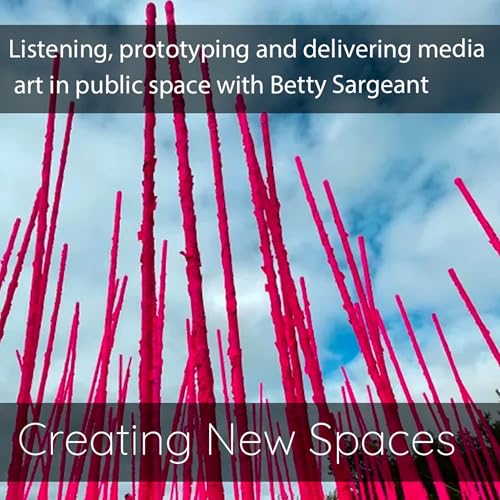
  • Listening, prototyping and delivering media art in public space with Betty Sargeant
    2026/03/28

    In this conversation, we hear how Betty Sargeant develops site-led installations through listening, prototyping, and stakeholder collaboration. We also discuss why delivery skills matter as much as ideas when working in public space. This interview is part of our series that focuses on media artworks in public space.

    Betty shares the creative process behind The Fauxrest and what it takes to make media art that can survive real-world conditions, including weather, public interpretation, and the layered expectations of councils, communities, and collaborators.

    AI sits in the background of this conversation as a conceptual provocation. Betty explains her “AI robot” persona, and how the claim of an “AI-created” installation sparked rumour, backlash, and debate. Those reactions provide a way into bigger questions about trust, authorship, and agency in public space.

    Listen to this podcast to learn about:

    • How listening builds trust and reduces friction in public space projects
    • Prototyping site-led work through fast sketches, rough models, and material tests
    • Why visual mock-ups are essential for keeping stakeholders aligned over time
    • How participation shifts when audiences have not opted in
    • What it takes to take a public artwork from idea to install, and why project management protects your agency

    Chapter

    (00:00:00) Finding the site first

    (00:00:29) Podcast intro and acknowledgement

    (00:01:02) Meet Dr. Betty Sargeant

    (00:01:52) Inside the Fauxrest artwork

    (00:02:38) Why public art matters

    (00:04:19) The AI robot provocation

    (00:06:04) Public reactions and town halls

    (00:09:38) Fauxrest and Satire

    (00:10:33) Performing Betty Sargeant AI

    (00:12:22) Backlash and misunderstandings

    (00:16:52) Collaboration and stakeholders

    (00:20:33) Prototyping and models

    (00:26:11) Visual communication for projects

    (00:27:24) Three career essentials

    (00:28:23) Why project management matters

    (00:29:51) Wrap up and thanks

    About Betty Sargeant

    Betty Sargeant is a Melbourne-based media artist and researcher and co-creative director of the art-technology duo PluginHUMAN with Justin Dwyer. Her practice spans public art and immersive installation, using light, moving image, sound, and sculptural form to place audiences inside multi-sensory experiences. She has received Good Design Awards in 2018 and 2020, and a Victorian Premier’s Design Award in 2017. Her recent project, Betty Sargeant AI, uses satire and performance to question authorship, agency, and the stories we tell about automation.

    Links from the podcast with Betty Sargeant

    • Visit Betty Sargeant’s website
    • Follow Betty Sargeant on Instagram
    • Learn more about The Fauxrest
    • Learn more about Betty Sargeant AI
    • Learn more about PluginHUMAN
    続きを読む 一部表示
    31 分
adbl_web_anon_alc_button_suppression_t1
まだレビューはありません