エピソード

  • #173 A Voice for the Glossies: How Fifteen-Year-Old Spencer Hitchen Is Inspiring a Generation to Stand Up for Nature
    2026/05/11

    At just fifteen years old, Spencer Hitchen has become one of Australia’s most recognisable young conservation voices — not through political slogans or social media trends, but through patient observation, powerful photography, and an unwavering commitment to protecting nature.


    From the Wallum woodlands of Noosa on Queensland’s Sunshine Coast, Spencer has transformed a childhood fascination with glossy black cockatoos into a global conservation movement. Along the way, he has launched World Stand Up For Nature Day, contributed to campaigns influencing environmental protections, produced award-winning wildlife photography, and inspired thousands of young people to reconnect with the natural world.

    But for Spencer, the journey began with a single bird.


    Falling in Love with the Glossies

    Spencer was only six years old when he first joined a local environment group and met a conservationist known as “Glossy Bob”, who had spent more than two decades observing glossy black cockatoos in the Noosa region.


    Together, they would visit a local waterhole where the cockatoos gathered each evening.


    Spencer quickly became captivated by the birds — their calls, their behaviours, and the fragile ecosystem that sustained them.


    “I just fell in love with them,” Spencer said.


    More Information

    https://www.instagram.com/savesunriseglossies/

    https://www.savesunriseglossies.com.au/

    https://www.facebook.com/savesunriseglossies


    If you enjoy this podcast, please like and subscribe to our show wherever you get your podcasts.

    Leave us a review and share this show with your friends.

    It really helps us to reach more citizen scientists, like you.


    Contact the Show

    We are always looking for more guests to tell us about interesting citizen science projects, research and events.

    You can email us at: info@citizenscienceshow.com

    Hosted on Acast. See acast.com/privacy for more information.

    続きを読む 一部表示
    37 分
  • #166 Protecting Sharks Means Protecting Their Homes: Inside the Global ISRA Project with Rima Jabado and Asia Armstrong
    2026/05/10

    Scientists map the ocean’s most critical shark and ray habitats in a race against extinction


    Marine conservationists around the world are racing to identify the ocean habitats most critical to the survival of sharks and rays before it is too late.


    At the centre of that effort is the Important Shark and Ray Areas (ISRA) project, a global initiative led through the International Union for Conservation of Nature (IUCN) Shark Specialist Group. The project aims to pinpoint the breeding grounds, feeding hotspots and migration corridors essential to sustaining shark, ray and chimaera populations worldwide.


    For Dr Rima Jabado, chair of the IUCN Species Survival Commission Shark Specialist Group, the project represents a major shift in marine conservation thinking.

    “It’s not just about protecting the species anymore,” Rima said. “It’s about identifying the places in the ocean that are most important for those species to survive.”


    Joining Rima on the Citizen Science Show podcast was marine scientist Dr Asia Armstrong, whose work in spatial ecology and threatened species conservation has made her a key contributor to the project.


    Together, the pair described an ambitious global effort built not only on science, but also on the observations of ordinary ocean users.


    More Information

    https://sharkrayareas.org/


    If you enjoy this podcast, please like and subscribe to our show wherever you get your podcasts.

    Leave us a review and share this show with your friends.

    It really helps us to reach more citizen scientists, like you.


    Contact the Show

    We are always looking for more guests to tell us about interesting citizen science projects, research and events.

    You can email us at: info@citizenscienceshow.com


    Hosted on Acast. See acast.com/privacy for more information.

    続きを読む 一部表示
    39 分
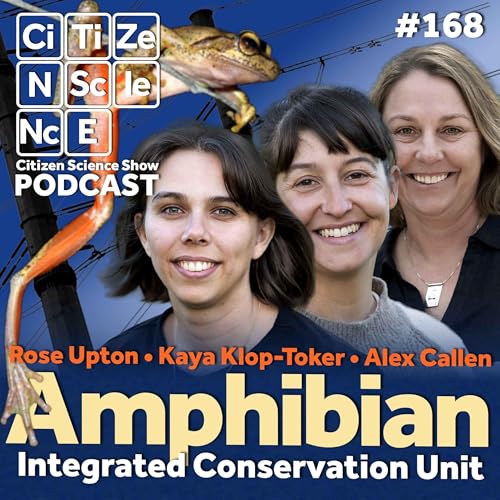
  • #168 Inside the Amphibian ICU: The Fight to Save Australia’s Frogs
    2026/05/04

    A pioneering team blends science, technology and community action to protect one of the world’s most threatened animal groups—amid growing pressure from development.


    In the forests of New South Wales, a quiet crisis is unfolding—one that scientists say is pushing some of Australia’s most unique frog species to the brink. At the centre of the response is a team of researchers working across laboratories, wetlands and digital platforms, united under an initiative known as the Amphibian ICU.


    Led by Dr Kaya Klop-Toker, Dr Rose Upton and Dr Alex Callen, the Integrated Conservation Unit is taking an ambitious, multi-disciplinary approach to halt amphibian decline—combining ecological restoration, reproductive science and citizen engagement in what they describe as a “One Plan” strategy for species recovery.


    More Information

    https://www.facebook.com/groups/312367045929495/

    https://www.facebook.com/AussieArk

    https://www.wildlifesydney.com.au/


    Email the Minister

    https://protectljtf.good.do/protectthelittlejohnstreefrog/email-the-minister/


    Littlejohn's Tree Frog Photo Credit: Krishna Pavan Komanduri


    If you enjoy this podcast, please like and subscribe to our show wherever you get your podcasts.

    Leave us a review and share this show with your friends.

    It really helps us to reach more citizen scientists, like you.


    Contact the Show

    We are always looking for more guests to tell us about interesting citizen science projects, research and events.

    You can email us at: info@citizenscienceshow.com

    Hosted on Acast. See acast.com/privacy for more information.

    続きを読む 一部表示
    46 分
  • #163 Climbing Into the Canopy: Mark Cashmore on Trees, Technology and the Future of Urban Ecology
    2026/04/30

    A Life That Grew Into Trees

    For Mark Cashmore, a career in arboriculture was not a lifelong plan but a gradual evolution. After years of varied work—including teaching English overseas—he discovered tree climbing through weekend work. What began as a practical skill quickly revealed itself as an entry point into a complex and deeply engaging field.

    Arboriculture is far more than cutting and pruning. It encompasses the long-term care, planning and management of trees, particularly in urban environments. From establishing healthy young trees to shaping entire urban forests, the discipline blends physical skill with ecological understanding.

    “It’s an astonishing industry,” Mark reflects. “Every tree is different, every day is different.”


    More Information

    https://proofsafe.com.au/

    https://www.treetec.net.au/

    https://naturetrackers.au/projects/where-where-wedgie/


    To learn more about Hollow Watch Australia - Citizen Science initiative

    https://proofsafe.com.au/pages/nest_boxes_and_hollows


    If you enjoy this podcast, please like and subscribe to our show wherever you get your podcasts.

    Leave us a review and share this show with your friends.

    It really helps us to reach more citizen scientists, like you.


    Contact the Show

    We are always looking for more guests to tell us about interesting citizen science projects, research and events.

    You can email us at: info@citizenscienceshow.com

    Hosted on Acast. See acast.com/privacy for more information.

    続きを読む 一部表示
    35 分
  • #162 How Citizen Divers Built Sydney’s Living Ocean Trail with Sam Baxter and John Rowe
    2026/04/25

    A grassroots vision beneath the waves

    In a quiet corner of Sydney’s coastline, a chain links more than just concrete anchors—it connects community, conservation, and curiosity. Beneath the surface of Gordon’s Bay lies one of Australia’s most distinctive citizen-led marine projects: an underwater nature trail built not by institutions, but by passionate divers.


    For Sam Baxter, the ocean has long been a place of fascination. Originally from the UK, Sam’s move to Australia was driven in part by the promise of clearer, warmer waters. After a career in IT, retirement opened the door to deeper involvement in diving and marine conservation.


    Alongside him is John Rowe, whose connection to the water stretches back to childhood. From snorkelling in a country-town pool to discovering the writings of early diving pioneers, John’s lifelong passion would eventually anchor one of Sydney’s most enduring marine initiatives.


    More Information

    https://www.gordonsbayscubadiving.com/

    https://www.facebook.com/GordonsBaySCUBADivingClub

    https://www.instagram.com/gordonsbayscuba/

    https://www.youtube.com/@GordonsBay-GBSDC

    https://www.sydneydivewreck.com.au/

    https://www.facebook.com/SydneyDiveWreck


    If you enjoy this podcast, please like and subscribe to our show wherever you get your podcasts.

    Leave us a review and share this show with your friends.

    It really helps us to reach more citizen scientists, like you.


    Contact the Show

    We are always looking for more guests to tell us about interesting citizen science projects, research and events.

    You can email us at: info@citizenscienceshow.com

    Hosted on Acast. See acast.com/privacy for more information.

    続きを読む 一部表示
    29 分
  • #169 Turning Curiosity into Science: Citizen Science Month with Dr Jessie Oliver
    2026/04/20

    A National Push for Participation

    As April unfolds, Australians are being called to step outside, look closer, and contribute to something far bigger than themselves. Citizen Science Month, a global initiative encouraging public involvement in scientific research, is gaining momentum locally—with an ambitious national goal of 100,000 recorded “acts of science.”


    For Dr Jessie Oliver, Technical Manager at SciStarter Australia, the mission is both simple and transformative: make science accessible to everyone.


    “An act of science can be contributing to any citizen science project,” Jessie explains. “And the sky’s the limit in terms of what those projects look like.”


    From logging bird sightings to analysing medical data online, participation can take many forms—united by a shared purpose of advancing knowledge through collective effort.


    More Information

    https://www.scistarteraustralia.au/

    https://www.scistarteraustralia.au/post/citizen-science-month-2026

    https://www.zooniverse.org/


    If you enjoy this podcast, please like and subscribe to our show wherever you get your podcasts.

    Leave us a review and share this show with your friends.

    It really helps us to reach more citizen scientists, like you.


    Contact the Show

    We are always looking for more guests to tell us about interesting citizen science projects, research and events.

    You can email us at: info@citizenscienceshow.com

    Hosted on Acast. See acast.com/privacy for more information.

    続きを読む 一部表示
    28 分
  • #165 Living with Predators in a Human World with Jonny Hanson
    2026/04/17

    The tension between humans and the wild extends far beyond landscapes, reaching into culture, psychology, and identity. What begins as a discussion about large carnivores evolves into a broader reflection on how humanity chooses to coexist with nature.


    Jonny Hanson's interest in large carnivores began in childhood, particularly with big cats. Over time, that fascination expanded into a deeper engagement with conservation and, ultimately, the human systems that shape environmental outcomes. He emphasises that conservation is not solely a biological issue. The challenges facing nature are driven by human behaviour, and therefore, the solutions must also come from within human society.


    More Information

    - Jonny Hanson Website: https://jonnyhanson.com/

    - Coexisting with carnivores TedX Talks: https://youtu.be/2FCUumWaTBo?si=x5KaifdmhJOYUw2n

    - Young people research update: RU168.pdf

    - Book chapter preview playlist: https://youtube.com/playlist?list=PLQN5xAQ3b01d40TJNJLjef61y1y2Qx5t4&si=7qmO7UaB8h2w56cN


    Lynx Photo Credit: Julia Moning: https://inaturalist.ala.org.au/people/birdingjulia


    If you enjoy this podcast, please like and subscribe to our show wherever you get your podcasts.

    Leave us a review and share this show with your friends.

    It really helps us to reach more citizen scientists, like you.


    Contact the Show

    We are always looking for more guests to tell us about interesting citizen science projects, research and events.

    You can email us at: info@citizenscienceshow.com

    Hosted on Acast. See acast.com/privacy for more information.

    続きを読む 一部表示
    59 分
  • #161 The Enigma of the Great Spider Crab with Elodie Camprasse
    2026/04/07

    The Enigma of the Great Spider Crab

    Australia’s great spider crab is hard to miss. With a leg span reaching up to a metre, these arthropods gather in extraordinary numbers along the seafloor. Each winter, tens of thousands converge in Port Phillip Bay in a phenomenon that has featured in global documentaries. Yet, as Elodie Camprasse discovered, scientific understanding of the species is surprisingly thin. “We know almost nothing,” she explains.


    What researchers do know is tied to a vulnerable moment in the crab’s life cycle. Like all arthropods, spider crabs must shed their hard shells to grow. During this moulting phase, they are soft and exposed—easy targets for predators. 4The mass gatherings are believed to offer safety in numbers. Beyond that, much remains uncertain: How often do they moult? Where do they come from? Why do they choose specific locations?


    More Information

    https://www.inaturalist.org/projects/spider-crab-watch

    https://dro.deakin.edu.au/articles/report/Giant_spider_crab_ecological_assessment_in_Port_Phillip_Bay/23306219?file=41091581


    If you enjoy this podcast, please like and subscribe to our show wherever you get your podcasts.

    Leave us a review and share this show with your friends.

    It really helps us to reach more citizen scientists, like you.


    Contact the Show

    We are always looking for more guests to tell us about interesting citizen science projects, research and events.

    You can email us at: info@citizenscienceshow.com


    Hosted on Acast. See acast.com/privacy for more information.

    続きを読む 一部表示
    36 分