エピソード

  • 1965: The Season That Saw Jim Clark Defy Boundaries Part 1
    2025/12/20

    Before the victories, before the statistics, and before one of the most remarkable seasons in motorsport history, there was a driver shaped by patience, restraint, and quiet determination.

    In this opening episode of our series on Jim Clark’s extraordinary 1965, we step back to understand how it all became possible. From a rural upbringing in Scotland and a gradual, unhurried rise through Scottish club racing, to a defining partnership with Colin Chapman and Lotus, this episode explores the foundations of Clark’s greatness.

    We examine how Clark’s driving style was forged by mechanical sympathy rather than aggression, why near-misses in the 1962 and 1964 World Championships mattered, and how the fragility of Lotus innovation both hindered and sharpened his career. We also place 1965 in its proper historical context — an era when multi-discipline racing was common, but when Clark’s ambition to compete, and win, everywhere pushed those boundaries further than anyone before or since.

    This is the story before the impossible became real.

    A season that would span continents, categories, and expectations was about to begin — and Jim Clark was ready.

    Send us a text

    Music by #Mubert Music Rendering

    続きを読む 一部表示
    16 分
  • 1985: The Season That That Power Could Not Tame Part 2
    2025/12/19

    In the second half of The Season That Power Could Not Tame, Formula One in 1985 begins to change shape.

    The chaos does not disappear — engines still fail, weather still intervenes, and raw speed still flashes into view — but the margins tighten. Races are no longer decided by surprise alone. They are decided by judgement.

    As Ferrari’s challenge falters under the weight of reliability, Lotus continue to deliver moments of brilliance without continuity, and turbo power proves as fragile as ever. Amid it all, one approach steadily asserts itself: accumulation over aggression, survival over spectacle.

    From the tension of Zandvoort to the judgement required at Monza, from the defining mastery of Spa to the emotional release at Brands Hatch, and through the moral unease of Kyalami to the chaos of Adelaide, Part 2 traces how the championship finally resolves — not through domination, but through understanding.

    Alain Prost does not overpower 1985. He solves it.

    This is the story of how a season built on excess came to reward restraint — and why 1985 remains the clearest example of a championship that could not be controlled by power alone.

    Cover Image: By Lothar Spurzem, ProstAlain_McLarenMP4-2B_1985, CC BY-SA 2.0 DE, Link

    Send us a text

    Music by #Mubert Music Rendering

    続きを読む 一部表示
    31 分
  • 1985: The Season That Power Could Not Tame Part 1
    2025/12/18

    In December, when the racing calendar falls silent, Chequered Past turns to reflection. In this two-part special, we rewind to 1985 — a season run at the height of the turbo era, when power was abundant but control was elusive.

    The Season That Power Could Not Tame begins with a championship that refuses to behave. From Brazil to Britain, the fastest cars do not always win, fuel limits undo race leaders, disqualifications rewrite results, and brilliance proves fleeting without restraint. Ferrari show promise without certainty, Lotus deliver moments of genius without continuity, and races are shaped as much by survival as speed.

    Through expanded, closely examined race narratives — from Senna’s rain-soaked breakthrough at Estoril, to chaos at Imola, discipline in Monaco, Ferrari’s high point in Canada, and precision at Silverstone — Part 1 explores a season defined by fragility and contradiction.

    As power overwhelms reliability and aggression repeatedly meets its limits, one approach begins to stand apart. Not domination. Not spectacle. But judgement.

    This is the story of how 1985 reached mid-season without a master — and why that mattered.

    Send us a text

    Music by #Mubert Music Rendering

    続きを読む 一部表示
    28 分
  • 17th December 2025: The History That Still Matters
    2025/12/17

    Formula One history is often remembered in neat, simplified stories: a championship decided by a single corner, a rivalry reduced to heroes and villains, a career judged by statistics alone. But history is rarely that tidy.

    In Episode 200 of Chequered Past, we step back from the calendar and ask a more fundamental question: why does Formula One history still matter — and what happens when we stop interrogating it properly?

    Through four case studies, this episode explores how context, authority, and hindsight reshape memory. We revisit the 1994 World Championship to show why Adelaide was not the cause of that title fight, but the final expression of a season defined by tragedy, instability, and reactive governance. We re-examine Nigel Mansell’s career to understand how reputations are softened and rewritten only once success provides permission to be generous. We look at why raw statistics, stripped of environment and era, often obscure more than they explain. And we return to Suzuka 1989 to unravel how a complex regulatory and political dispute became frozen in memory as a simple morality play.

    This is not an episode about nostalgia, nor about rewriting the past. It is about restoring sequence, complexity, and responsibility to a sport whose history is too often flattened into headlines.

    Two hundred episodes in, Chequered Past continues to slow Formula One down — replacing certainty with curiosity, and stories with context — because history only matters if we are willing to look at it honestly.

    Send us a text

    Music by #Mubert Music Rendering

    続きを読む 一部表示
    23 分
  • 16th December 1982: The Team That Forced Formula One Forward
    2025/12/16

    On 16 December 1982, Formula One lost one of its most influential figures. Colin Chapman’s death marked the end of an era — but not the end of his impact.

    In this episode of Chequered Past, we explore how Team Lotus, under Chapman’s relentless and visionary leadership, forced Formula One to evolve faster than it ever had before. From the monocoque Lotus 25 to the ground-effect dominance of the Lotus 79, Chapman’s cars didn’t just win races — they rewrote the technical rulebook.

    We trace Lotus’s revolutionary ideas through defining moments on track: Jim Clark’s peerless mastery in the rain at Spa in 1963, the transformation of American open-wheel racing with Clark’s Indianapolis 500 victory in 1965, Jochen Rindt’s title-sealing season in the radical Lotus 72, and the final flowering of Chapman’s genius with Mario Andretti’s championship in 1978.

    But this is not a simple celebration. Lotus’s pursuit of speed came with risk, fragility, and tragedy, leaving a legacy that is as complex as it is influential. Chapman forced the sport forward — sometimes faster than it was ready to go.

    On the anniversary of his death, this episode examines how Lotus changed Formula One forever, and why its fingerprints can still be seen on every modern Grand Prix car.

    Send us a text

    Music by #Mubert Music Rendering

    続きを読む 一部表示
    18 分
  • 15th December 1962: The Race That Bridged Worlds
    2025/12/15

    On 15 December 1962, Formula One gathered at Kyalami for a non-championship race that carried far greater significance than its status suggested. With the World Championship still undecided and South Africa preparing to host its first official Grand Prix just two weeks later, the Rand Grand Prix became a bridge between eras — linking Europe’s established Grand Prix world with Formula One’s expanding global future.

    We revisit Jim Clark’s commanding victory in the Lotus 25, a performance that underlined both Lotus’s technical revolution and Clark’s momentum heading into a title-deciding showdown with Graham Hill at East London. Along the way, we explore the depth and character of the field, from international contenders to local privateers — including Brausch Niemann’s remarkable Lotus 7 entry, one of the most unusual cars ever to qualify for a Formula One race.

    The episode also marks the anniversary of the death of Clay Regazzoni, tracing a career defined not just by victories with Ferrari and Williams, but by resilience in the face of life-changing adversity after his racing career was cut short.

    Finally, we reflect on legacy and continuity through the Andretti family, as Marco Andretti’s Formula One outing in 2006 connected three generations of one of motorsport’s most influential dynasties.

    From a race that helped carry Formula One into new territory, to lives and legacies that continue to shape the sport, The Race That Bridged Worlds is a reminder that racing history is often written between the headlines.

    Join us again tomorrow for legends, landmarks and lost moments from racing’s rich and chequered past.

    Send us a text

    Music by #Mubert Music Rendering

    続きを読む 一部表示
    16 分
  • 14th December 1963: The Race That The Sun Ruled
    2025/12/14

    On 14 December, Chequered Past travels from the baking heat of South Africa to the cliff-edge roads of early-1950s Brazil, via the modern realities of Formula One careers beyond the podium.

    The episode opens with the 1963 Rand Grand Prix, a non-championship race at Kyalami where extreme summer heat exposed the fragility of even the sport’s greatest combinations. Jim Clark arrived as newly crowned World Champion but failed to finish as fuel vaporisation and mechanical strain took their toll. Ferrari, by contrast, thrived, with John Surtees delivering a commanding victory. Just as remarkable was Peter de Klerk, who steered his home-built Alfa Special to a stunning third place — one of the great privateer performances of the era.

    From there, we mark the birthday of Antonio Giovinazzi, tracing a career that reflects the modern shape of elite motorsport. From Formula One race seats with Alfa Romeo to Ferrari simulator duties and, ultimately, overall victory at the 24 Hours of Le Mans, Giovinazzi’s story shows how success today is measured in adaptability as much as results.

    We close in Rio de Janeiro in 1952, on the fearsome Gávea road circuit — a race that captured both the romance and the danger of Grand Prix racing’s past, and hinted at why change was inevitable.

    Three stories, one date — and a reminder that sometimes it isn’t championships or reputations that decide races, but the conditions, the context, and the courage to endure them.

    Send us a text

    Music by #Mubert Music Rendering

    続きを読む 一部表示
    14 分
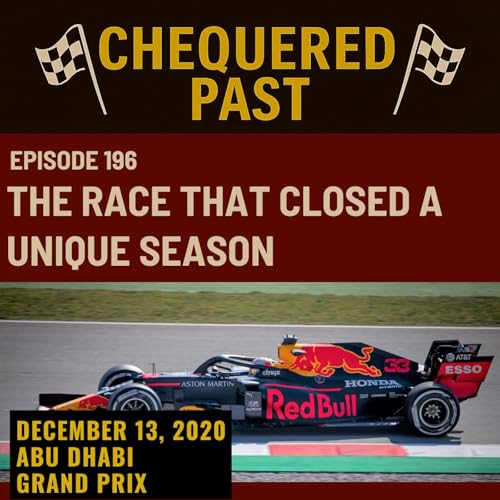
  • 13th December 2020: The Race That Closed a Unique Season
    2025/12/13

    On 13 December, Chequered Past revisits a Formula One finale unlike any other. The 2020 Abu Dhabi Grand Prix did not decide a championship, but it brought down the curtain on the most disrupted season the sport has ever endured. Run behind closed doors, shaped by a Safety Car interruption and settled without drama at the front, it offered Formula One something it badly needed in 2020: closure.

    We reflect on how Max Verstappen’s controlled victory capped a year defined by adaptability, resilience and compromise — and why the quiet at Yas Marina spoke volumes about what the sport had just survived.

    Beyond Formula One, we remember Bill Vukovich, a towering figure of American racing whose back-to-back Indianapolis 500 victories came at a time when the race counted towards the World Championship — making him a two-time World Championship race winner despite never racing in Formula One.

    And finally, we return to 1992, when Nigel Mansell’s dominance carried him beyond the cockpit and into the wider sporting consciousness, as he was named BBC Sports Personality of the Year.

    A story about endings, legacy, and perspective — and a reminder that history doesn’t always roar when it’s being made.

    Cover Image: By Jen Ross - Max_Verstappen,_2020_pre-season_testing, CC BY 2.0, Link

    Send us a text

    Music by #Mubert Music Rendering

    続きを読む 一部表示
    16 分