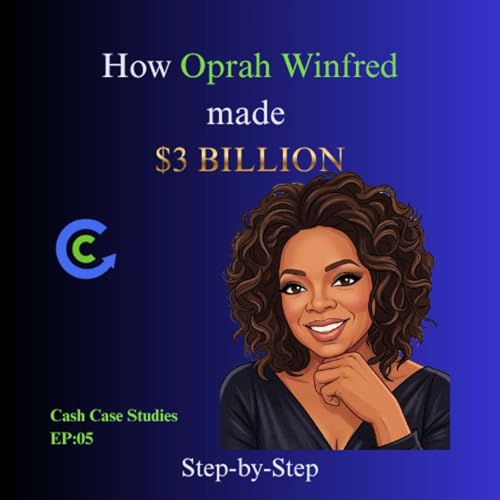
『Cash Case Studies』のカバーアート

Cash Case Studies

Cash Case Studies

著者: Will "Bam" Palmer
無料で聴く

Success is not an accident; it is a technical requirement. At Cash Case Studies, we perform deep-dive business genealogy, deconstructing the world’s most profitable empires from the Industrial Revolution to the Digital Age.

We do not profile "lucky" entrepreneurs. We profile Architects. To be a topic on this show, a self-made billionaire must have started with limited resources and demonstrated mastery of all eight Palmer’s Principles. We go behind the curtain of history to find the documented proof that their empire was built on the B-U-S-I-N-E-S-S framework.

© 2026 Cash Case Studies
マネジメント・リーダーシップ リーダーシップ 経済学
エピソード
  • OPRAH WINFREY: How One Woman Turned a Job into a Billion Dollar Business
    2026/06/02

    Oprah Winfrey transformed a local Chicago talk show into a multi-billion dollar media empire by making a single, radical decision to own her own production. This episode performs a technical audit of the "Harpo Blueprint," revealing how Oprah used Palmer’s Principles to navigate three decades of media disruption and become the first Black woman billionaire in history.

    In 1986, Oprah Winfrey was a rising star in daytime television. Most people in her position would have signed a lucrative talent contract and let the network own the show. Instead, Oprah incorporated Harpo Productions and bought her show outright. That one decision turned her from a "personality" into a "proprietor."

    In this episode of Cash Case Studies, "The Professor" deconstructs the rise of Oprah Winfrey through the lens of Palmer’s Principles. We prove that Oprah's $3 billion fortune wasn't a byproduct of fame—it was the result of a masterfully executed B-U-S-I-N-E-S-S framework. We analyze the technical parameters of the 1988 Harpo acquisition (The Setup Principle) and the 2011 OWN Network turnaround (The Evaluation Principle).

    [The B-U-S-I-N-E-S-S Framework Breakdown]

    • [B] Belief: Winning a radio contest at 17 and knowing she belonged on the air before she had a single connection.
    • [U] Undertaking: The 15-year "Management Trainee" phase—working every radio and news desk job to master the mechanics of the medium.
    • [S] Service: Identifying the "Empathy Gap" in daytime TV and serving an audience that wanted authenticity over sensationalism.
    • [I] Individuals: Partnering with strategic architects like Jeff Jacobs to engineer deals that prioritized ownership over ego.
    • [N] Networks: Building a vertical media stack—from local TV to national syndication to a fully-owned cable network (OWN).
    • [E] Evaluation: The "OWN Pivot"—moving to LA to personally overhaul a network that was bleeding $330 million in its first three years.
    • [S] Setup: The 1988 purchase of The Oprah Winfrey Show from Capitol Cities/ABC, ensuring she owned 100% of her library and brand.
    • [S] Shout: Creating "The Oprah Effect"—the most powerful brand endorsement in history, where the work shouted so loud that stocks doubled on her word alone.

    [What You Will Learn]

    • Why ownership is the only path to generational wealth in the creator economy.
    • How to turn a "personality-based" business into a systematized empire.
    • The technical mechanics of a successful "Rescue Mission" for a failing network.

    Chapter Markers

    • 0:00 - The Mississippi Farmhouse Hook
    • 2:20 - Part One: The Disadvantages (From Feed Sacks to Radio News)
    • 4:20 - Part Two: The Early Decisions (The 1988 Harpo Acquisition)
    • 7:30 - Part Three: The Obstacles (The $330 Million OWN Crisis)
    • 9:48 - Part Four: The Progression (The First Black Woman Billionaire)
    • 10:59 - Part Five: Palmer’s Principles Breakdown
    • 14:48 - The Close: Can You Follow the Blueprint?

    Get the Complete Business guide @ CaptureCashflow.com/Amazon/paperback

    Learn more @ CaptureCashflow.com

    続きを読む 一部表示
    16 分
  • MARK CUBAN: How a Fired Salesman with no Money Built Into a $6 Billion Empire
    2026/05/26

    In 1982, Mark Cuban arrived in Dallas with $60 and no place to sleep. A year later, he was fired from a software store for closing a deal instead of opening the shop. With no savings and no bank loan, he used a $500 advance from a single customer to start MicroSolutions. Seven years later, he sold it for $6 million. Ten years after that, he sold Broadcast.com to Yahoo for $5.7 billion.

    In this episode of Cash Case Studies, "The Professor" deconstructs the rise of Mark Cuban through the lens of Palmer’s Principles. We prove that Cuban's success wasn't a "dot-com fluke"—it was a mastery of the B-U-S-I-N-E-S-S framework. We analyze the technical parameters of the 1985 Renee Hardy embezzlement (The Setup Principle) and the 2000 Yahoo stock collar that saved his billion-dollar fortune when the rest of Silicon Valley burned.

    [The B-U-S-I-N-E-S-S Framework Breakdown]

    • [B] Belief: Starting a company with a $500 check before he was "ready."
    • [U] Undertaking: The discipline of 16-hour days and learning to code to support his own sales.
    • [S] Service: Identifying the "Streaming Gap" in 1995 when major broadcasters thought the internet was a joke.
    • [I] Individuals: Understanding that "The Relationship is the Capital"—using one customer's trust to fund his first empire.
    • [N] Networks: Building the entire infrastructure for internet broadcasting and, later, a direct-to-consumer pharmacy supply chain.
    • [E] Evaluation: Questioning the consensus of the dot-com boom to execute a protective hedge that saved $1 billion.
    • [S] Setup: Learning from an $82,000 embezzlement to build the internal controls and legal structures that protected his wealth.
    • [S] Shout: Allowing the work to speak first. Cuban built the championship and the company before the fame followed.

    [What You Will Learn]

    • Why getting fired was the catalyst for a $6 billion empire.
    • How to use "Customer Advances" as startup capital.
    • The technical mechanics of a "Stock Collar" to protect generational wealth.

    Chapter Markers

    • 0:00 - The $500 Hook
    • 2:04 - Part One: The Disadvantages (The $60 Arrival in Dallas)
    • 4:20 - Part Two: The Early Decisions (The $500 Founding Capital)
    • 8:26 - Part Three: The Obstacles (Streaming in 1995)
    • 11:24 - Part Four: The Progression (The Greatest Trade in Wall Street History)
    • 14:58 - Part Five: Palmer’s Principles Breakdown
    • 19:04 - The Close: Can You Follow the Blueprint?

    Get the Complete Business guide @ CaptureCashflow.com/Amazon/paperback

    Learn more @ CaptureCashflow.com

    続きを読む 一部表示
    21 分
  • SARA BLAKELY: How a Door to Door Saleswoman Made a Billion Dollars
    2026/05/19

    In 1998, Sara Blakely was selling fax machines door-to-door in the Florida heat. She had no fashion experience, no manufacturing connections, and only $5,000 in savings. Fourteen years later, she was the youngest self-made female billionaire in the world.

    In this episode of Cash Case Studies, "The Professor" deconstructs the rise of Spanx through the lens of Palmer’s Principles. This isn't a story about luck; it’s a technical breakdown of the B-U-S-I-N-E-S-S framework. We provide the documented proof of how Blakely’s "Setup" decisions—like writing her own patent and trademarking her name for $150—allowed her to maintain 100% equity for 21 years.

    [The B-U-S-I-N-E-S-S Framework Breakdown]

    • [B] Belief: Betting on a "footless pantyhose" category that every industry expert claimed didn't exist.
    • [U] Undertaking: The discipline of the "Double Shift"—building Spanx at night for two years while selling fax machines 9-to-5.
    • [S] Service: Solving the "mannequin gap" by testing products on real human bodies instead of industry-standard plastic models.
    • [I] Individuals: The critical "Yes" from three key people: a mill operator’s daughters, a Neiman Marcus buyer, and Oprah Winfrey.
    • [N] Networks: Building a global distribution moat across 50 countries, starting with a single bathroom demonstration.
    • [E] Evaluation: Creating a culture of "Oops Meetings" to measure and fix failures faster than any competitor.
    • [S] Setup: Protecting the empire before it existed by DIY-patenting the idea to avoid early equity dilution.
    • [S] Shout: Using high-contrast red packaging and word-of-mouth to earn millions in "free" advertising.

    [Who This Is For] Builders, bootstrappers, and investors who want to understand the technical parameters of a $1.2 billion exit

    Chapter Markers

    • 0:00 - The $5,000 Scissors Hook
    • 1:51 - Part One: The Disadvantages (The LSAT Failure & Danka)
    • 4:02 - Part Two: The Early Decisions (The DIY Patent)
    • 6:05 - Part Three: The Obstacles (The Mannequin Industry)
    • 9:36 - Part Four: The Progression (Oprah & The $1.2B Exit)
    • 11:48 - Part Five: The Palmer’s Principles Breakdown
    • 16:38 - The Close: Can You Follow the Blueprint?

    Get the Complete Business guide @ CaptureCashflow.com/Amazon/paperback

    Learn more @ CaptureCashflow.com

    続きを読む 一部表示
    18 分
adbl_web_anon_alc_button_suppression_t1
まだレビューはありません