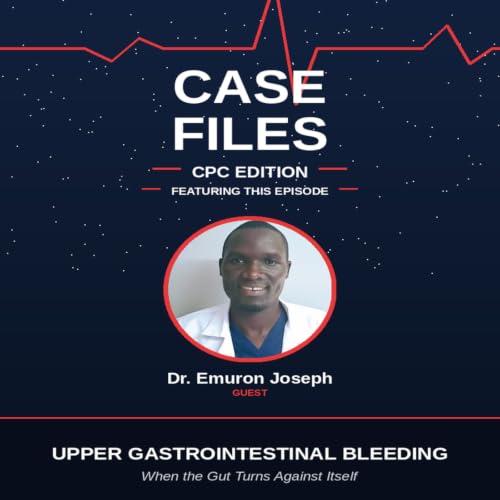
『Case Files: CPC Edition』のカバーアート

Case Files: CPC Edition

Case Files: CPC Edition

著者: Seed Global Health: CPC Case Series
無料で聴く

Welcome to the CPC Emergency Medicine podcast, where we go beyond the diagnosis. Each episode, we revisit and dissect complex cases previously presented in our (CPC) EM case discussion series.

Listen in as we break down real cases, compare Global vs. Local management strategies, and provide specific, actionable recommendations for practicing emergency medicine anywhere in the world.

Hosted by Dr. Daniel Olinga and Dr. Emmanuel David Okumu

Mastering Emergency Care

衛生・健康的な生活 身体的病い・疾患
エピソード
  • "Vomiting Blood": Upper GI Bleeding When the Gut Turns Against Itself
    2026/08/13

    A 51-year-old man walks into the ED after a week of vomiting blood, and by the time he arrives, his haemoglobin is 5.8 g/dL. Hosts Dr. Daniel Olinga and Dr. Emmanuel David sit down with Emergency Medicine physician Dr. Emuron to unpack a real case of upper gastrointestinal bleeding (UGIB), tracing the patient's journey from pre-hospital care through resuscitation, diagnosis, and disposition.

    Key Discussion Points:

    • Pre-hospital priorities for a suspected UGIB patient: IV access, careful fluid resuscitation, positioning, and a tight ISBAR handover
    • Reading the primary and secondary survey — why "compensating" is not the same as "stable," and what clues like spider naevi, pitting oedema, and melaena reveal
    • Building the differential: peptic ulcer disease, oesophageal/gastric varices, erosive gastritis, Mallory-Weiss tear, Dieulafoy lesion, and bleeding gastric carcinoma
    • Blood vs. fluids — why crystalloid-heavy resuscitation can backfire, and the case for a restrictive transfusion strategy (Hb target 7–8 g/dL)
    • The TXA debate — what the HALT-IT trial (12,000+ patients) actually showed about tranexamic acid in UGIB, and why it's not recommended here
    • Airway management thresholds — when to intubate a GI bleed patient, including the pre-endoscopy scenario
    • Solving the hyperbilirubinaemia puzzle — haemolysis vs. hepatocellular stress vs. gut-derived haem load
    • Why pre-transfusion Hepatitis B testing matters even when the blood bank screens donor units
    • Hospital course: endoscopy, H. pylori testing, PPI therapy, NSAID cessation, and screening for undiagnosed chronic liver disease

    Takeaways:

    1. Compensated ≠ stable — monitor relentlessly, because deterioration can be sudden
    2. Resuscitate with blood, not fluid — target Hb 7–8 g/dL
    3. TXA has no proven benefit in UGIB and raises VTE risk — skip it
    4. Intubate based on genuine airway risk: falling GCS, active haematemesis, or pre-scope in a vomiting patient
    5. Always ask about NSAID use by name — it can change both the diagnosis and the discharge plan Listen to learn. Share to save lives. Mastering Emergency Care

    Disclaimer: For Educational Purposes only, refer to guidelines for definitive management

    Show Notes & Resources:

    · Watch the Full Case Video: https://youtu.be/qZZ86tknD8k?si=Pczbbe-vqvcti80V

    続きを読む 一部表示
    57 分
  • Diabetic Ketoacidosis: The storm inside
    2026/06/22

    Description:

    Experts: Dr. Bernard Mwesigye & Dr. Umarashid Guloba

    In this episode

    A young type 1 diabetic patient arrives with: Restlessness, agitation, confusion (GCS 9/15)·

    Vital signs: HR 146, RR 30, SpO₂ 89%, BP 186/89·

    Key finding: Vitiligo patches on skin — signaling autoimmune disease (type 1 diabetes)·

    History: Several days of vomiting/diarrhoea → couldn't keep food or insulin down

    · Labs: Glucose 19 mmol/L, HbA1c 14%, ketonuria 3+· Diagnosis: DKA precipitated by gastroenteritis.

    KEY DISCUSSION POINTS

    1. Diagnosis & Differentials

    · DKA confirmed (hyperglycaemia + ketones + acidosis)

    · HHS ruled out (significant ketones present)

    · Hypertension = symptom of metabolic crisis, not primary problem

    · Sepsis considered — gastroenteritis = trigger; antibiotics started

    2. The "Golden Rule" of DKA Management

    NEVER give insulin if potassium < 3.5 mmol/L

    · Insulin drives potassium into cells → can cause fatal arrhythmias

    · Sequence: Check K⁺ → Replace if low → THEN start insulin

    3. Four Treatment Pillars

    Fluids 5–6L deficit; switch to dextrose when glucose < 14

    Glucose Insulin 0.1 U/kg loading + infusion; reduce gradually

    Electrolytes Potassium first; monitor every 2–4 hours

    Acidosis Insulin stops ketones; bicarbonate almost never

    4. Critical Pitfalls to Avoid

    · Giving insulin before checking potassium

    · Dropping glucose too fast → cerebral oedema

    · Not treating the underlying trigger (infection)

    · Stopping monitoring too early — patients can deteriorate rapidly

    5. Euglycaemic DKA (Emerging Danger)

    · Seen with SGLT-2 inhibitors (empagliflozin, etc.)

    · Glucose may be normal despite full DKA

    · Always check ketones in sick patients on these drugs

    6. Uganda Context

    · Insulin access, cost, and cold chain are major challenges

    · Diagnosis possible with minimal resources: glucometer + urine dipstick + clinical exam

    · Family education on warning signs and adherence is essential to prevent recurrence

    Five Takeaways

    1. Examine the whole patient — vitiligo signaled autoimmune type 1 diabetes

    2. Four goals: Fluids → Glucose → Potassium → Acidosis

    3. Potassium rule: Replace if < 3.5 BEFORE insulin

    4. Find and treat the trigger — infections are the commonest cause5. Educate family — prevents the next admission

    Listen to learn. Share to save lives. Mastering Emergency Care

    Disclaimer: For Educational Purposes only, refer to guidelines for definitive management

    Show Notes & Resources:

    · Watch the Full Case Video: https://youtu.be/qZZ86tknD8k?si=Pczbbe-vqvcti80V

    続きを読む 一部表示
    1 時間 3 分
  • Burning up (PART B)
    2026/05/19

    Description:

    In this episode, an 11-year-old boy arrives unconscious, seizing, with a temperature of 40°C and tea-coloured urine. He was treated for malaria for four days. Now his kidneys are failing, his pressure is dropping, and the clock is running out.

    In this real-life case review, Dr. Ann Kaguna Imelda (who managed the case) and Dr. Kenneth Bagonza (EM expert) walk through every critical decision—what worked, what didn’t, and why the child was unfortunate in the end.

    special credit: Dr Daniel Oriba Longoya

    Key points of discussion:

    · The red flag triad

    · Primary survey findings: threatened airway, shock, GCS 6

    · Why dextrose has no role in septic shock resuscitation

    · CSF Gram-positive diplococci = pneumococcal meningitis – treat immediately

    · Managing hyperkalemia + AKI in a crashing child

    · The 1-hour sepsis bundle (2026 guidelines)

    · qSOFA at the bedside: RR ≥22, altered mental state, SBP ≤100 – no equipment needed

    · Why “malaria not improving in 48 hours” demands a rethink

    · Final reflection: system failures, early recognition, and what we owe the next child

    Listen to learn. Share to save lives. Mastering Emergency Care

    Disclaimer: For Educational Purposes only, refer to guidelines for definitive management

    Show Notes & Resources:

    · Watch the Full Case Video: https://youtu.be/qZZ86tknD8k?si=Pczbbe-vqvcti80V

    · Rosen’s Emergency Medicine

    · Tintinalli’s Emergency Medicine

    · SSC 2026

    続きを読む 一部表示
    31 分
adbl_web_anon_alc_button_suppression_t1
まだレビューはありません