エピソード

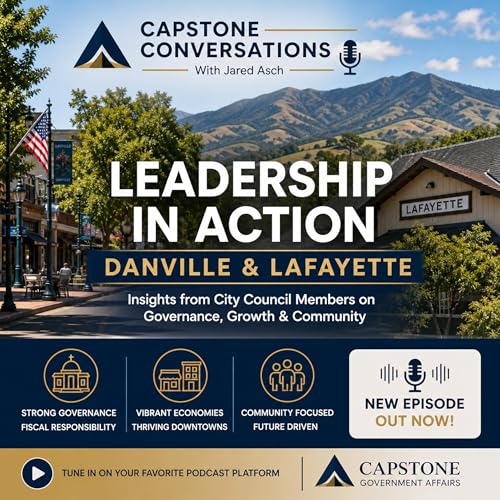
  • Danville and Lafayette: Vibrant & Engaged Communities in the East Bay
    2026/05/06

    Host Jared Asch interviews Danville Councilman Mark Belotz and Lafayette Councilman John McCormick, second-year elected officials from Central Contra Costa County, about what contributes to their towns’ success, including strong schools, vibrant walkable downtowns, and effective city management. McCormick, a retired tech worker and downtown business owner, describes entering council after Chamber leadership during COVID; Belotz recounts years attending meetings and serving on boards before running. They discuss the importance of continuity in town/city managers, reliance on sales tax over property tax, and concerns that online sales tax is allocated through counties and Sacramento rather than by ZIP code. Danville reports balanced budgets and no unfunded liabilities; Lafayette passed Measure H to address shortfalls while also having no unfunded liabilities. Both explain the benefits of contracting policing with the Contra Costa Sheriff and describe the steep time commitment of council service. They address state-mandated housing development, emphasizing shaping projects to fit community character, and share goals of preserving safety, downtown vitality, and community engagement.


    続きを読む 一部表示
    39 分
  • Tri-Valley Dynamics: Brandon Cardwell on Livermore's Innovation
    2026/04/29

    Host Jared Asch interviews Brandon Cardwell of the City of Livermore about the city’s economic development and innovation strategy. Cardwell describes Livermore as the easternmost Bay Area city, celebrating its 150th anniversary, with a symbiotic mix of a revitalized historic downtown, wine country, significant industrial/flex space, and two national labs employing about 12,000 people. He highlights the outlets as a major sales tax driver and details downtown’s transformation after rerouting a state highway, enabling outdoor dining, parks, and an all-day nightlife economy, with projects like Blacksmith Square expansion and a new event center plus a “downtown 2.0” plan. Cardwell explains how the labs drive jobs and procurement networks and support fusion commercialization, while noting California competitiveness challenges and tailored tools like fee deferments and abatements. He discusses regional workforce links via the Altamont Pass and Valley Link, the municipal airport strategy (EVTOL mobility, hangars, public safety complex, and a 2027 innovation center), data-driven/AI-assisted business attraction, Startup Tri-Valley/IGATE’s role, and Tri-Valley regional collaboration.


    続きを読む 一部表示
    39 分
  • Economic Success Stories: City Leaders on Retail Attraction and Development
    2026/04/22

    Guest host Alex Greenwood records Capstone Conversations live at the ICSC Idea Exchange in Monterey, interviewing economic development leaders from five California cities about retail attraction strategies, successes, and lessons. Martinez describes zoning streamlining, concierge support, by-right approvals (including breweries), expedited permitting, a successful Ross store opening, housing upzoning, and a proposed $500M waterfront redevelopment. Sunnyvale highlights its CityLine mixed-use public-private partnership, downtown specific plan, Murphy Avenue pedestrian mall, and designing flexible ground-floor retail to attract tenants like restaurants and entertainment. Merced reports reuse of a 94,000-square-foot Sears building, mall renovation, downtown change, and emphasizes persistence, relationships, and a confidential council subcommittee. Pleasanton discusses void analysis, targeted broker outreach, new tenants, process and customer-service improvements, and new marketing tools including a “Pleasanton Playbook.” San Leandro outlines a 2024 strategy and retail action plan with void analysis, target tenant lists, property upgrades, a retail landing page, downtown mixed-use openings, and Bayfair area TOD planning and reuse.


    続きを読む 一部表示
    44 分
  • The Procurement Puzzle: Understanding Government Sales
    2026/04/08

    Host Jared Asch interviews procurement experts Ricardo Martinez, a former California Department of General Services chief procurement officer, and Oscar Garcia of the California Hispanic Chambers of Commerce about how companies sell to state and local governments in California. They explain that public-sector procurement is a law- and policy-driven process—from need identification through solicitations and approvals—often lengthy for IT, including the Project Approval Lifecycle (12–24 months), with separate technical and procurement teams and many acquisition methods. They describe guardrails such as risk management, data-breach protections, fair competition (e.g., two-envelope evaluations), and limited contract clause negotiations. Common vendor mistakes include cold outreach and assuming the government will “rip and replace.” They urge relationship-building, readiness for RFP requirements, certifications and small-business preferences, partnering with primes, and persistent bidding. For procurement staff, they recommend ongoing learning, leveraging statewide resources, and staying open to pre-solicitation meetings while observing “cone of silence” rules, alongside evolving AI policies, disclosure, cybersecurity, and human oversight.


    続きを読む 一部表示
    43 分
  • Reimagining Downtowns: Economic Growth through Special Districts
    2026/03/25

    Host Jared Asch interviews Marco Li Mandri of New City America about downtown economic development funded through special districts, including business improvement districts (BIDs), property-based BIDs (PBIDs), charter-city community benefit districts, and tourism improvement districts (TBIDs). Mandri explains how California’s Proposition 218/Article 13D governs property assessments, contrasting general-law city requirements (notably 51% petition thresholds and balloting) with charter-city flexibility (often 30% thresholds and longer or perpetual terms). He describes typical PBID services—clean and safe programs, trash, tree and public-space maintenance, events, PR and social media, parking management, and homelessness outreach—emphasizing “special benefits” beyond city services and noting property value appreciation cannot be claimed as a special benefit. Using San Leandro and Hayward examples, he highlights organizing property owners, sustainable revenue, entrepreneurial nonprofit management, politics/timing, and real-time crisis management, arguing cities face structural deficits and downtowns must pivot toward walkable, residential-focused, public-space-driven futures.


    続きを読む 一部表示
    42 分
  • Philanthropy and Nonprofits: Current Challenges and Future Visions
    2026/03/18

    Host Jared Asch interviews Deborah Levine, executive director of the Lesher Foundation, about changes affecting East Bay nonprofits and philanthropy. Levine explains the foundation’s 30+ year focus on Contra Costa arts and culture, education, and children and families, awarding 172 grants totaling about $6 million in 2025, and distinguishes philanthropy’s resourcing role from service-delivery nonprofits. She describes rising service demand alongside receding federal support, increased scrutiny and pressure to remove DEI language, and higher legal and operational risks. Citing a Center for Effective Philanthropy survey, she notes that 81% of nonprofits anticipate increased demand, 61% face a moderate to significant risk to their continued operations, and 70% report jeopardized access to basic needs. They discuss uncertain impacts of tax changes on giving, philanthropy’s risk calculations, lagging nonprofit adoption of AI and cybersecurity, staff burnout, and a call to champion nonprofits with donations, time, and expertise.


    続きを読む 一部表示
    34 分
  • Balancing Growth and Community: A Conversation with Moraga Mayor Kerry Hillis"
    2026/03/11

    Moraga Mayor Kerry Hillis back to the Capstone Conversation and discusses lessons from Hillis’s first four years in office, including that the role can be “as much or as little as you want it to be,” the need to read community perspectives, and coping with harsh virtual public comments. Hillis explains Moraga’s weak-mayor structure, the division of responsibilities between elected officials and staff led by the town manager, and the realities of serving while holding another job, raising three young children, and receiving $0 in compensation in Lamorinda—along with how meeting times and childcare affect who can serve. Hillis describes Moraga as a small, deliberately preserved community founded about 50 years ago to protect open space and avoid highway development, while arguing that tools like CEQA and similar processes have been “weaponized” to slow even reduced-density projects and increase legal costs. The conversation focuses on Moraga’s current challenges—declining school enrollment, repeated parcel tax attempts, aging and underperforming commercial centers, and limited revenue under Prop 13—and Hillis’s view that long-term stability requires economic growth, infill housing near services and transit, and revitalization of the Ream Center as the town’s de facto downtown. He cites steps such as hiring an economic development consultant (Cosmo) and pursuing wildfire evacuation improvements on Moraga Way, including a $508,000 federal grant with Orinda to study safety options and a joint $5 million application to begin construction of a potential grade-separated emergency lane. Hillis discusses council support for economic development, differences in tone, the role of major landowners, possible state storefront vacancy taxes, and the limited municipal tools available without redevelopment. He closes with an AI tip: using tools like ChatGPT and Grammarly to edit writing and create basic graphics and announcements to meet modern expectations for government responsiveness.


    続きを読む 一部表示
    39 分
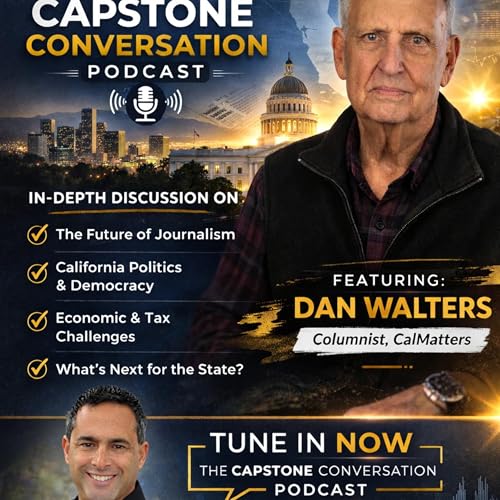
  • Columnist Dan Walters California Politics, Past & Present
    2026/03/04

    Host Jared Asch interviews longtime California political journalist Dan Walters of CalMatters, who recounts his career from 1960 through decades covering Sacramento and writing columns, and describes CalMatters’ nonprofit model and its Digital Democracy tools. Walters explains how newspapers’ economic model collapsed, how Capitol reporting shifted from in-person logistics to online access, and advises audiences to avoid partisan sources and consult multiple mainstream outlets that verify facts. He argues that threats to democracy include not only Donald Trump but also California practices such as gerrymandering, one-party secrecy, and burying policy in budget bills. Walters cites Gavin Newsom’s positives (the education longitudinal data system, the San Quentin rehabilitation effort) but criticizes overpromising on housing, homelessness, and single-payer healthcare. He calls the 2026 governor’s race unusually unsettled, with a small chance of two Republicans advancing, and predicts money—potentially from Silicon Valley—may elevate candidates like Matt Mahan and Tom Steyer. Walters warns of piling-on local taxes and a possible backlash, and outlines California’s future challenges: stagnant population, aging demographics, high unemployment, poverty, workforce shortages, fiscal strain from pandemic-era raises, and business flight, urging more long-term planning.


    続きを読む 一部表示
    54 分