

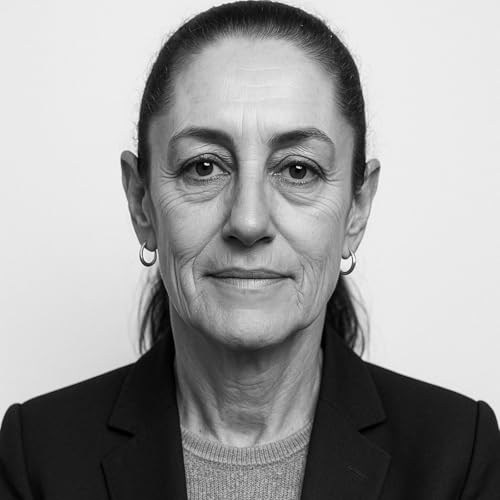
Biography Flash: Claudia Sheinbaum - Mexico's Firebrand Faces Defining Moments
カートのアイテムが多すぎます
ご購入は五十タイトルがカートに入っている場合のみです。
カートに追加できませんでした。
しばらく経ってから再度お試しください。
ウィッシュリストに追加できませんでした。
しばらく経ってから再度お試しください。
ほしい物リストの削除に失敗しました。
しばらく経ってから再度お試しください。
ポッドキャストのフォローに失敗しました
ポッドキャストのフォロー解除に失敗しました

Biography Flash: Claudia Sheinbaum - Mexico's Firebrand Faces Defining Moments
-
ナレーター:
-
著者:
このコンテンツについて
Claudia Sheinbaum’s public profile this week has been defined by a series of consequential events, public addresses, and a swirl of controversy that speak volumes about her leadership style and the political moment Mexico finds itself in. On November 20, she took center stage during Mexico’s 115th Revolution Day parade in Mexico City, addressing military brass, political elites, and the public in a nationally televised speech. She invoked the legacy of 1910 and the enduring struggle for social justice—emphasizing that her administration stands for honesty, democracy, and the well-being of the most vulnerable. Her remarks included pointed rejections of smear campaigns and a reaffirmation of Mexico’s commitment to collective dignity and “no going backward,” projecting strength and populist resolve fit for the nation’s first female president. This message was amplified across national broadcast and social media, cementing the day as both patriotic spectacle and political statement.
Earlier in the week, Sheinbaum faced criticism over her response to the murder of Uruapan’s mayor, Carlos Manzo. Thousands protested for greater security measures, with opposition and Gen Z activists demanding government accountability. Sheinbaum’s reaction—emphasizing procedure and invoking opposition tactics—was covered by outlets such as Mexico News Daily and Le Monde, underscoring her tendency to deflect blame onto political adversaries and past administrations.
On the legislative front, Sheinbaum led a summit of all Mexico’s governors to push for sexual harassment to be classified as a crime nationwide. Her own experience of being inappropriately touched earlier this month fueled a personal tone to her advocacy, with her declaration that “changing the laws is not enough, but it is necessary” widely shared by international and domestic news outlets. Social media buzz captured the public’s complex response to her dual role as victim and reformer, while also giving oxygen to detractors who question the pace and enforcement of reforms.
Business-wise, Sheinbaum’s recent meeting at the Palacio Nacional with billionaire Carlos Slim has drawn speculation about public-private cooperation amid Mexico’s investor climate. While specifics of their agenda remain under wraps, reputable sources confirmed it as a high-stakes negotiation likely tied to infrastructure and telecommunications—potentially impactful for future biographical retrospectives.
On the international stage, Sheinbaum has been at the center of inflammatory rhetoric from far-right U.S. circles. Figures associated with the MAGA movement have called for U.S. military intervention in Mexico, citing the recent anti-government protests as a sign of national instability. Sheinbaum has categorically rejected such calls, emphasizing strengthened security cooperation but maintaining Mexico’s sovereignty.
On social media, pro-Sheinbaum rallies and opposition protests are trending, sometimes fueled by fake news—an issue she addressed by inviting expert Miguel Ángel Elorza to her daily press conference to expose misinformation campaigns targeting her. The most viral story remains her speech for Revolution Day, circulating in clips and memes across Mexican digital platforms with hashtags like #ClaudiaSheinbaum and #RevolucionMexicana.
Thanks for listening! Don’t forget to subscribe so you never miss an update on Claudia Sheinbaum—and for more can’t-miss biographies, just search the term Biography Flash.
Get the best deals https://amzn.to/4mMClBv
This content was created in partnership and with the help of Artificial Intelligence AI
まだレビューはありません