エピソード

  • Building an Ambulance Service with no funds
    2026/08/25

    Connect with us

    In 2014, Andrew Hodgetts left a paramedic career in Victoria with a set of keys, an empty bank account and a mandate to start an ambulance service on Espiritu Santo, Vanuatu's largest island. There was no funding for equipment or vehicles. That came later through cold-calling ambulance commissioners, a chance conversation at a trade stall that filled his car boot with donated gear, and an unsolicited vehicle donation from Queensland Ambulance Service.

    In this episode, Hamish McLean talks with Andrew about what it actually took to build ProMedical Santo from nothing: recruiting and training two Ni-Vanuatu nurses as the service's first paramedics, funding operations through business sponsorship and a subscription model, and the slower, harder job of teaching a community what an ambulance is and why they should call one rather than load a patient into the back of a ute.

    The conversation moves from the practical (no street names, no central dispatch, directions given by mango tree) to the systemic: why Andrew now believes importing a high-income paramedic model into a low-resource setting was, in his own words, naive; how a near-mutiny over cutting CPR from a first-aid course taught him that "what works" and "what the community needs" aren't always the same question; and why his PhD research into community first responder programmes has led him to conclude that context - culture, infrastructure, geography, trust in the profession - has to shape the model, not the other way around.

    The episode closes on a comparison that speaks directly to EMS Global's work in Mongolia: what happens when first-responder models designed for dense, road-connected populations meet nomadic, geographically dispersed communities — and why the answer isn't always more training, but a different question altogether.

    In this episode

    • How a volunteering trip turned into founding a new ambulance station on Santo
    • Funding a charity ambulance service door-to-door: sponsorship tiers, raffles and a free fuel deal that kept the service running
    • Training two Ni-Vanuatu nurses as the service's first paramedics
    • Teaching a community what "call an ambulance" means and why visibility mattered as much as clinical capability
    • The Village First Aid Responder (VIFA) programme, and the community pushback that changed Andrew's approach to CPR training
    • Why he now questions transplanting a paramedic-level, high-income model into a low-resource context
    • The gap between prehospital and hospital-level care, and what happens when an ambulance service outpaces the system it delivers into
    • Aeromedical retrieval without air traffic control, on grass runways, at dusk
    • What his PhD research into community first responder models is finding and why most existing programmes are taught in isolation from the wider health system
    • Parallels with nomadic, dispersed communities in Mongolia

    About the guest

    Andrew Hodgetts is a Victorian-trained paramedic who founded ProMedical Santo, a charity ambulance service on Espiritu Santo, Vanuatu, in 2014, supported through the Australian Volunteers for International Development (AVID) programme. He is now a PhD candidate researching how community first responder programmes can be integrated into established health systems in low- and middle-income countries.

    For video podcasts visit: https://www.youtube.com/@ems-global2048/podcasts

    Our website: https://emsglobalfoundation.org/


    This is a public episode. If you would like to discuss this with other subscribers or get access to bonus episodes, visit emsglobalfoundation.substack.com
    続きを読む 一部表示
    44 分
  • They called an ambulance. A hearse arrived.
    2026/08/10

    Connect with us

    Decades ago in the United States, if you called an ambulance, the vehicle most likely to arrive was a hearse.

    For much of the 20th century, more than half of the country's ambulance service was run by funeral homes — not because it was profitable, but because they had the only vehicle in town built to carry someone lying down, and no one else stepped up.

    In this episode, host Dr Hamish McLean talks with Police Chief (Ret.) Scott Reinbolt — 25 years in law enforcement, now an adjunct professor of law enforcement at Ohio University — about the era he documents in his book, Humble Heroes: The History of Funeral Home Operated Ambulance Service. We cover how the system actually worked, why it finally collapsed under a convergence of new labour law, a landmark federal report, and a reimbursement system that never covered the real cost of care — and why the funeral directors who built it were largely excluded, blamed and forgotten once it changed hands.

    This isn't just American history. The same questions - who builds an EMS system when no one else will, and what happens to that knowledge when the system finally changes - are ones EMS Global Foundation works through today in Mongolia, Central Asia, and the Pacific.

    In this episode:
    • Why funeral homes ended up running American EMS, and how the model actually worked
    • The regulatory and financial convergence that ended the era
    • What happened when incumbent providers were excluded from EMS reform
    • What today's EMS system-builders can take from this history

    About Before the Hospital: a podcast from EMS Global Foundation examining the governance, financing, and workforce decisions that determine whether prehospital emergency care systems succeed — particularly in low- and middle-income settings.

    Read the companion essay and subscribe: emsglobalfoundation.substack.com/
    Learn more about our work: emsglobalfoundation.org

    For video podcasts visit: https://www.youtube.com/@ems-global2048/podcasts

    Our website: https://emsglobalfoundation.org/


    This is a public episode. If you would like to discuss this with other subscribers or get access to bonus episodes, visit emsglobalfoundation.substack.com
    続きを読む 一部表示
    30 分
  • The Death of Paramilitary Culture: Fixing EMS Leadership
    2026/07/19

    Connect with us

    In this episode of the Before the Hospital Podcast, host Hamish McLean interviews Joe Acker, CEO of the EMS Global Foundation, who brings 35 years of experience in running emergency medical services across Australia and Canada. Joe discusses the critical need for EMS leadership to balance high professional standards with a "leading with love" approach. He explores the challenges of shifting EMS culture from traditional paramilitary structures toward a modern healthcare-focused model, emphasizing the importance of transparency, showing up for staff, and building strong collaborative partnerships rather than operating in isolation.

    For video podcasts visit: https://www.youtube.com/@ems-global2048/podcasts

    Our website: https://emsglobalfoundation.org/


    This is a public episode. If you would like to discuss this with other subscribers or get access to bonus episodes, visit emsglobalfoundation.substack.com
    続きを読む 一部表示
    7 分
  • How Uzbekistan rebuilt Soviet‑era EMS
    2026/07/18

    Connect with us

    When I sat down in Brisbane to record this Before the Hospital conversation with Dr Khikmat Anvarov in Uzbekistan, I expected a discussion about ambulances and equipment. What I heard instead was a thirty‑year story of how Uzbekistan has tried to rebuild emergency care as a national system rather than a collection of services.

    For colleagues working on EMS in resource‑constrained systems, this episode offers a rare, first‑hand account from one of the architects of reform – and a reminder that emergency care is built through governance, pathways and people long before the hospital door.

    We talk about:
    •Why buying more ambulances and equipment is not enough in post‑Soviet and LMIC settings.
    •How inter‑district emergency hospitals were designed to serve around one million people each.
    •What telemedicine and “expertise travelling faster than the patient” now look like in practice.
    •The political and practical realities of long‑term EMS reform in Uzbekistan, and why honest reporting of delays and gaps matters more than perfect metrics.


    For video podcasts visit: https://www.youtube.com/@ems-global2048/podcasts

    Our website: https://emsglobalfoundation.org/


    This is a public episode. If you would like to discuss this with other subscribers or get access to bonus episodes, visit emsglobalfoundation.substack.com
    続きを読む 一部表示
    36 分
  • 40 patients on one EMS shift
    2026/06/20

    Connect with us

    Dr Biyamba graduated from medical school in Mongolia and went straight to the ambulance. No transition, no supervised ramp-up - just the dispatch system in Ulaanbaatar and whatever came next.


    In a single summer shift, he treats 30 to 40 patients. In winter, that volume climbs to 90. Of those, roughly half genuinely require an emergency ambulance. The rest receive assessment, advice, and whatever treatment can be provided at the door. Nine to fifteen patients are transported; the others stay home.


    This is not a gap in the system. This is the system.


    In this episode of Before the Hospital, Dr Biyamba describes what it actually takes to run emergency care in Mongolia's capital - the caseload, the equipment, the training he received, and the structural reforms needed for workforce development.

    His account raises a critical health policy question that applies well beyond Ulaanbaatar: when a health system cannot afford to ease new doctors in gradually, what does that do to clinical confidence, patient safety, and amenable mortality?


    In this episode:

    • What a 24-hour ambulance shift looks like in Ulaanbaatar across seasons.
    • How the 103 system triages who gets transported and who stays home.
    • What equipment a Mongolian ambulance doctor carries—and what is missing.
    • Why new doctors in Mongolia start on the ambulance rather than a supervised hospital ward.
    • The specific training Dr Biyamba found most valuable, and the operational gaps that remain.

    The question this episode leaves open: If the ambulance is where new doctors learn under pressure, what does that mean for the patients who are part of that learning - and is there a more sustainable model for low-to-middle-income countries?

    For video podcasts visit: https://www.youtube.com/@ems-global2048/podcasts

    Our website: https://emsglobalfoundation.org/


    This is a public episode. If you would like to discuss this with other subscribers or get access to bonus episodes, visit emsglobalfoundation.substack.com
    続きを読む 一部表示
    6 分
  • No One Is Fixing Dead Time. Until Now.
    2026/06/14

    The call has started. The patient is waiting. And the clinician is alone with their thoughts ... until now.

    Every ambulance call begins the same way. A dispatch notification. A vehicle moving. A clinician alone, working through what might confront them and what they will do when they arrive. That window — from dispatch to arrival — is what Joe Acker calls dead time. It is largely unexamined in the research literature, inconsistently used in practice, and quietly one of the most consequential periods in prehospital care.

    Simon Grosjean is an EMS physician in Aosta Valley, northern Italy. He encountered that silence on a night call - a routine case that became a breech presentation, no specialist reachable, searching the internet on his phone when his EMT partner raced him to the scene. The delivery went well. Simon was honest about why: physiology, not preparation: “This time I was lucky.”

    He spent the following year building something so he would not have to rely on luck again.

    EMSy is the AI-powered clinical decision support tool Simon developed not a diagnostic engine nor to replace clinical judgement. What it does is act as what Simon calls “a good librarian”: drawing together dispatch information, medication histories, ECG findings, and prehospital literature into a structured summary a provider can scan while their hands are already working. Voice-prompted. One app. No switching between tabs.

    In this episode, Joe and Simon work through what dead time actually is, why dispatch framing creates tunnel vision before the clinician even arrives, and why paramedics so often leave calls without ever knowing what their patient’s diagnosis turned out to be. They then road-test EMSy against a chest pain scenario - not for the clinical content, but for what it reveals about how much cognitive preparation is possible in that pre-arrival window, and how little of it currently happens by design.

    The episode closes on a question that matters for every service, everywhere. EMSy is about to be piloted in Mongolia - a place with different languages, different systems, and the same fundamental problem: a clinician, alone, moving, deciding.

    This is not a conversation about technology replacing people. It is about what fills the silence before you arrive.

    Thanks for reading! Subscribe for free to receive new posts and support our work.


    This is a public episode. If you would like to discuss this with other subscribers or get access to bonus episodes, visit emsglobalfoundation.substack.com
    続きを読む 一部表示
    40 分
  • You Can't Clone Doctors. So She Found Another Way.
    2026/05/26

    When Dr Suvd Nugui returned to Mongolia after training in the United States, she came back to a system where most of her colleagues had never heard the word “paramedic.” Neither had her parents.

    Her solution was simple and radical: if she could not be everywhere, she could train people who could. Seven years later, she is training more than 80 clinicians and drivers annually with a team of international paramedics. One result: Mongolian EMS doctors are performing ECG interpretation on monitors that sat unused for months because no one knew how to operate them.

    In this episode, Dr Suvd speaks with podcast host Hamish McLean about what sustained prehospital capacity-building actually looks like from the inside - the cultural barriers, the equipment gaps, the communication challenges and why a team that keeps coming back changes everything.

    About Dr Suvd Nugui Dr Suvd Nugui is a Mongolian cardiologist and in-country director of the EMS Global Foundation’s Mongolia programme, where she has led training delivery and local stakeholder engagement since 2018.

    Before the Hospital is produced by EMS Global Foundation. We examine how resource-constrained emergency care systems are built, funded, and reformed before the patient reaches hospital. Learn more at ems-global.org.


    This is a public episode. If you would like to discuss this with other subscribers or get access to bonus episodes, visit emsglobalfoundation.substack.com
    続きを読む 一部表示
    8 分
  • He came from a Yorkshire air ambulance. Then this
    2026/05/25

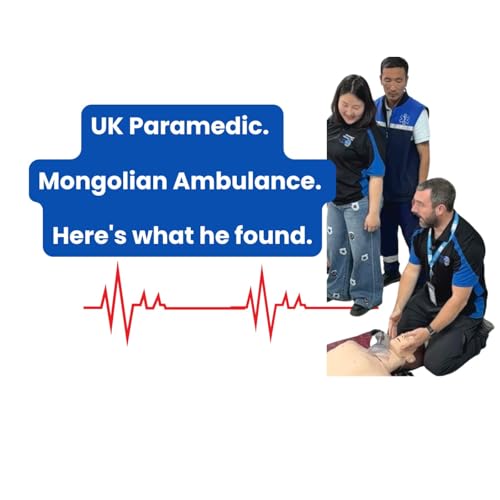
    Paramedic James Stubley comes from one of the most advanced prehospital aeromedical platforms in the UK. Double-crewed, doctor-qualified, critical care at altitude. He is now teaching Mongolian on-road ambulance doctors and coming back for a second year to finish the job he started.

    This episode is a short, direct answer to this question: can you deliver emergency care with basic equipment, or does complexity save lives? James has now worked in both environments. His answer matters.


    This is a public episode. If you would like to discuss this with other subscribers or get access to bonus episodes, visit emsglobalfoundation.substack.com
    続きを読む 一部表示
    13 分