エピソード

  • Why I need to be everywhere
    2026/05/26

    When Dr Suvd Nugui returned to Mongolia after training in the United States, she came back to a system where most of her colleagues had never heard the word “paramedic.” Neither had her parents.

    Her solution was simple and radical: if she could not be everywhere, she could train people who could. Seven years later, she is training more than 80 clinicians and drivers annually with a team of international paramedics. One result: Mongolian EMS doctors are performing ECG interpretation on monitors that sat unused for months because no one knew how to operate them.

    In this episode, Dr Suvd speaks with podcast host Hamish McLean about what sustained prehospital capacity-building actually looks like from the inside - the cultural barriers, the equipment gaps, the communication challenges and why a team that keeps coming back changes everything.

    About Dr Suvd Nugui Dr Suvd Nugui is a Mongolian cardiologist and in-country director of the EMS Global Foundation’s Mongolia programme, where she has led training delivery and local stakeholder engagement since 2018.

    Before the Hospital is produced by EMS Global Foundation. We examine how resource-constrained emergency care systems are built, funded, and reformed before the patient reaches hospital. Learn more at ems-global.org.


    This is a public episode. If you would like to discuss this with other subscribers or get access to bonus episodes, visit emsglobalfoundation.substack.com
    続きを読む 一部表示
    8 分
  • Episode 7: He came from a Yorkshire air ambulance. Then this
    2026/05/25

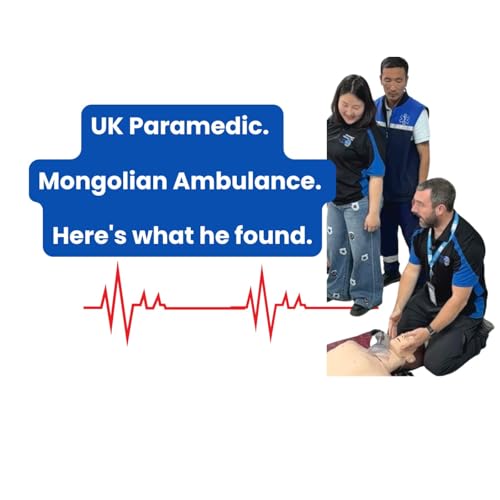
    Paramedic James Stubley comes from one of the most advanced prehospital aeromedical platforms in the UK. Double-crewed, doctor-qualified, critical care at altitude. He is now teaching Mongolian on-road ambulance doctors and coming back for a second year to finish the job he started.

    This episode is a short, direct answer to this question: can you deliver emergency care with basic equipment, or does complexity save lives? James has now worked in both environments. His answer matters.


    This is a public episode. If you would like to discuss this with other subscribers or get access to bonus episodes, visit emsglobalfoundation.substack.com
    続きを読む 一部表示
    13 分
  • Episode 6: Why these doctors are learning from paramedics
    2026/05/19

    Dolly McPherson is an aeromedical paramedic with the Hampshire and Isle of Wight Air Ambulance (UK). Her normal shift involves a helicopter, a doctor, advanced airway and trauma equipment and closed-loop communication rehearsed to the point of instinct. When something goes wrong, she has everything she needs within arm’s reach.

    In Mongolia, she has her hands and whatever the team can improvise.

    In this conversation, Dolly reflects on what it means to teach emergency care fundamentals to doctors whose clinical knowledge is exceptional but whose prehospital environment offers almost nothing to work with - no heated blankets in minus 40 degrees, no oxygen saturation monitors when batteries die in the cold, no protocols for safely leaving a patient at home when 75% of calls end exactly that way.

    But the more searching questions run the other direction. What does it mean that a flight paramedic from the UK is teaching doctors emergency medicine and learning something back? What does Mongolian ingenuity look like when the equipment fails and the patient still needs help? And what does a system built on doing the basics exceptionally well have to teach well-resourced EMS?


    This is a public episode. If you would like to discuss this with other subscribers or get access to bonus episodes, visit emsglobalfoundation.substack.com
    続きを読む 一部表示
    15 分
  • Episode 5: When less teaches more: What Mongolia's EMS reveals about Western systems
    2026/05/18

    Canadian paramedic Joe Acker watched a Mongolian ambulance doctor suture a head laceration on the roadside in the capital Ulaanbaatar, write a prescription and send the patient home. In Canada, the UK or Australia, that patient goes to hospital. No question.

    That moment has stayed with him - not because Mongolia got it wrong, but because they got something right that well-resourced Western systems are just starting to replicate.

    Joe Acker has spent 35 years at the senior executive level of EMS in Canada and Australia - Chief Executive of Ambulance Tasmania, Provincial Director of Clinical Practice for BC Emergency Health Services, Executive Director of EMS for Alberta Health Services. He is also a working critical care paramedic, registered in both countries. He knows what a high-income ambulance system looks like from every angle.

    He keeps coming back to Mongolia anyway. On his own time.

    In this conversation, Joe reflects on two years of training Ambulance 103 doctors and drivers in Ulaanbaatar - what has changed, what the training has produced, and where Mongolia goes from here. But the more searching questions run the other direction: what should the systems he came from be learning from a city doing 40 calls per ambulance per 24-hour shift with a fraction of the resources?


    This is a public episode. If you would like to discuss this with other subscribers or get access to bonus episodes, visit emsglobalfoundation.substack.com
    続きを読む 一部表示
    21 分
  • Episode 4: Mongolia's doctors know medicine. This is what they're missing.
    2026/05/17

    Mongolia’s ambulance doctors are qualified physicians. They know the medicine. What most of them have never been taught is what to do with that knowledge before the patient reaches hospital.

    That is the problem international paramedic Leon Baranowski flew to Ulaanbaatar to help solve - for the third time.

    This conversation was recorded mid-programme at the 103 Ambulance Service, while the training was still running. Leon is Operations Director for EMS Global and Senior Lecturer in Paramedicine at Monash University, and he has spent close to two decades working across paramedic systems in the UK, Canada, and Australia. But what he talks about in this episode is not his career. It is what happens when you try to build prehospital capability inside a system that was never designed around it.

    The gap he describes - between clinical knowledge and prehospital application - is not unique to Mongolia. It recurs across health systems that rely on doctors and drivers rather than a paramedic workforce. Teamwork under pressure, communication on scene, decision-making before the hospital rather than inside it: these are not things medical school teaches, and they are not things that transfer automatically from hospital to ambulance.

    What EMS Global is attempting in Ulaanbaatar is also not a short-term training visit. The harder question this episode sits with is whether you can build something that lasts after the instructors get on the plane home.


    This is a public episode. If you would like to discuss this with other subscribers or get access to bonus episodes, visit emsglobalfoundation.substack.com
    続きを読む 一部表示
    21 分
  • Episode 3: What a genuine thank you means when you're running forty calls a shift
    2026/05/14

    Dr Judy is an ambulance doctor with the Ulaanbaatar Ambulance Centre, one of the frontline clinicians EMS Global Foundation has been working alongside since 2017. During the 2025 mission, she did something that captures the programme’s direction exactly: she participated as a trainee, contributed as a translator for the international instructor team, and helped bridge the gap between what was being taught and what her colleagues needed to understand.

    She also agreed to sit down with us and talk about her work.

    The conversation is short, unscripted and worth your time. Dr Judy describes what it is like to run forty calls in a single shift, the difference between the critical patient and the patient who simply has to wait.


    This is a public episode. If you would like to discuss this with other subscribers or get access to bonus episodes, visit emsglobalfoundation.substack.com
    続きを読む 一部表示
    7 分
  • Episode 2: What minus 40 teaches you about priorities
    2026/05/13

    Jarrod Bell is a wilderness intensive care paramedic from Tasmania (Australia) - and a two-year EMS Global Foundation volunteer instructor in Ulaanbaatar. In this episode, Jarrod reflects on what draws a Tasmanian paramedic back to Mongolia for a second year: the adaptability and workload of Mongolia's ambulance doctors, the overlooked importance of environmental control in extreme cold and what a negative 40 degrees car rollover scenario teaches you about prehospital priorities. He also shares how working here has changed his sense of what paramedicine can achieve.


    This is a public episode. If you would like to discuss this with other subscribers or get access to bonus episodes, visit emsglobalfoundation.substack.com
    続きを読む 一部表示
    13 分
  • Episode 1: Why Tania came back to Mongolia
    2026/05/12

    Tania Johnston is an intensive care flight paramedic, emergency nurse, and academic based in British Columbia - and a two-year EMS Global Foundation volunteer in Ulaanbaatar. In this episode, Tania reflects on what she observed between her first and second mission: the strengths of Mongolia’s ambulance doctors, the opportunity to bridge contemporary prehospital practice with operational reality, and why teaching doctors when you are a paramedic works better than you might expect. She also shares the memory that brought her back for year two.


    This is a public episode. If you would like to discuss this with other subscribers or get access to bonus episodes, visit emsglobalfoundation.substack.com
    続きを読む 一部表示
    15 分