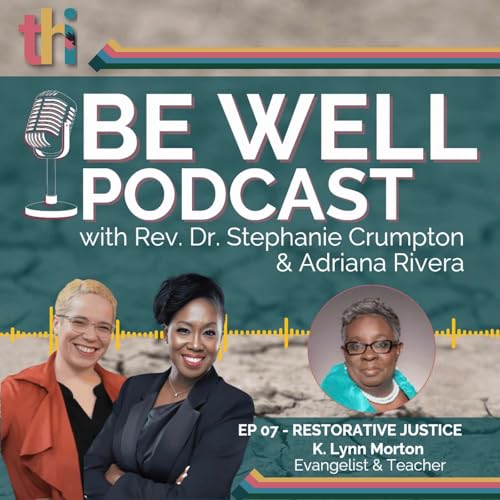
『Be Well Podcast』のカバーアート

Be Well Podcast

Be Well Podcast

著者: The Trauma Healing Initiative
無料で聴く

In a world marked by division, disruption, and deep emotional and spiritual fatigue, how do we keep showing up—with purpose, with compassion, and with hope?

The BE WELL Podcast, created by the Trauma Healing Initiative at McCormick Theological Seminary, gathers theologians, practitioners, educators, and artists for deep and dynamic conversations about healing in these times. Each episode explores how trauma-informed approaches can help us teach, learn, and live with greater wholeness.


We believe that we can BE WELL.

© 2026 McCormick Theological Seminary
スピリチュアリティ
エピソード
  • Curation of Physical Space: Designing Trauma-Informed Environments
    2026/07/10

    What if the spaces we move through every day are shaping our capacity to heal — without us even realizing it?

    In this episode of the Be Well Podcast, we turn our attention to the built environment and its often-overlooked role in trauma and healing. In “Curation of Physical Space: Designing Trauma-Informed Environments,” our guest Monica Haslip — artist, designer, and founder of Chicago's Little Black Pearl creative community — invites us to reimagine space as an active participant in well-being.

    Drawing from her work in community-centered design, Monica explores how environments can either reinforce harm or cultivate dignity, safety, and belonging. From architecture to art to the smallest design choices, this conversation challenges us to see space not as neutral, but as something that holds memory, shapes behavior, and opens (or limits) possibility.

    This episode is an invitation to look again at the spaces we inhabit — and to ask what it would mean to design them with healing in mind.

    You’ll Hear About:

    • How trauma-informed design centers safety, dignity, and choice in physical environments
    • The ways space can either reinforce scarcity and harm — or invite possibility, creativity, and hope
    • Why beauty, art, and thoughtful design are not luxuries, but essential to human flourishing and healing
    • How community-rooted spaces can shift posture — from survival and “heads down” living to curiosity, connection, and vision

    Who This Is For:
    This episode is for leaders, educators, designers, pastors, organizers, and anyone shaping environments where people gather, learn, heal, or belong. It’s especially meaningful for those working in community development, education, congregational spaces, or social services — anywhere the question isn’t just what we do, but where and how we do it.

    If you’ve ever wondered how to create spaces that feel more human, more just, and more life-giving, this conversation offers both vision and grounding for the work ahead.

    Listen, share, and subscribe — because we believe that we can be well.

    続きを読む 一部表示
    50 分
  • Healing Hauntings: Confronting What Lingers
    2026/06/19

    What happens when the past refuses to stay buried?

    In this episode of the Be Well Podcast, we step into a space many recognize but rarely name — the presence of what lingers. This episode, “Healing Hauntings: Confronting What Lingers,” is a conversation that explores how unspoken grief, unresolved memories, and spiritual dislocation continue to shape our lives, our relationships, and our institutions.

    Our guest, Mindy McGarrah Sharp, Professor of Practical Theology and Pastoral Care, invites us to reframe “haunting” not as something to fear, but as an invitation — to become curious about what has been overlooked, avoided, or silenced. Together, we examine what it means to confront these lingering realities with honesty, care, and collective responsibility.

    This episode offers a trauma-informed, theologically grounded exploration of how healing begins — not by avoiding what hurts, but by tending to it with intention. From personal memory to institutional accountability, we consider how telling the truth, listening deeply, and staying present to one another can open pathways toward wholeness, repair, and renewal.

    You’ll hear about:

    • How “haunting” names the lingering impact of unspoken pain — and why what we avoid inevitably returns.
    • Why confronting personal and collective wounds is essential for healing, rather than something to bypass or suppress.
    • The role of curiosity, truth-telling, and deep listening in trauma-informed care and spiritual formation.
    • Practical ways individuals and communities can engage healing work with accountability, humility, and shared responsibility.

    Who this is for:
    This episode is for pastors, chaplains, educators, caregivers, and leaders — as well as anyone navigating personal or communal wounds — who are seeking faithful, trauma-informed ways to engage what has been left unresolved. If you’re wrestling with hard questions about memory, justice, and healing—whether in your family, your community, or your institution—this conversation offers both language and invitation. It’s for those who sense that avoiding the past is no longer an option, and who are ready to step, with courage and care, into the work of confronting what lingers so that deeper healing can begin.

    Listen, share, and subscribe — because we believe that we can be well.

    続きを読む 一部表示
    49 分
  • Restorative Justice Practices: Beyond Punishment, Towards Repair
    2026/05/22

    What if justice didn’t have to mean punishment?

    In this episode of the Be Well Podcast, we challenge one of the most deeply ingrained assumptions in our culture — that accountability must come through retribution. In this episode, “Restorative Justice Practices: Beyond Punishment, Towards Repair,” we explore a different path: one rooted in healing, relationship, and the possibility of transformation.

    Our guest, Lynn Morton, founder of Women of God’s Design Ministry, brings decades of experience applying restorative justice practices in schools, communities, and organizations. Through powerful stories — from advocating for students pushed out of classrooms to walking alongside families navigating profound harm — Lynn invites us to reconsider what it means to repair, to take responsibility, and to rebuild trust.

    Together, we examine restorative justice not as a one-time intervention, but as a daily practice and way of life—one that calls us to tell the truth, build relationships, and believe that even in the aftermath of harm, something more whole is possible.

    You’ll hear about

    • Why punishment alone fails to address harm — and how asking “why” opens the door to healing and accountability.
    • How restorative justice reframes “reaping and sowing” to include redemption, repair, and community responsibility.
    • What it actually looks like to practice restorative justice in schools, organizations, and everyday life — not just in crisis moments.
    • The courage it takes to own harm, seek repair, and stay in the long, often uncomfortable process of healing together.

    Who this is for
    This episode is for pastors, educators, community leaders, organizers, and anyone wrestling with how to respond to harm in ways that are both just and life-giving. It’s especially for those who are tired of cycles of punishment and are seeking more faithful, human-centered approaches to accountability — whether in classrooms, congregations, families, or neighborhoods. If you’re longing for tools to build stronger relationships, navigate conflict with integrity, and imagine justice that heals rather than divides, this conversation is for you.

    Listen, share, and subscribe—because we believe that we can be well.

    続きを読む 一部表示
    36 分
adbl_web_anon_alc_button_suppression_t1
まだレビューはありません