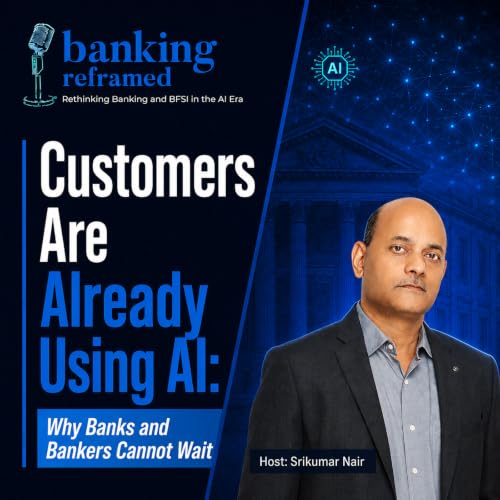
『Banking Reframed』のカバーアート

Banking Reframed

Banking Reframed

著者: Srikumar Nair
無料で聴く

Banking and BFSI are changing faster than ever — through technology, AI, regulation, customer behaviour, new business models, and changing expectations from professionals.

Yet, many of the most important conversations in our industry still remain either too technical, too fragmented, or limited to closed circles.

𝐖𝐢𝐭𝐡 𝐭𝐡𝐢𝐬 𝐩𝐨𝐝𝐜𝐚𝐬𝐭, 𝐦𝐲 𝐚𝐭𝐭𝐞𝐦𝐩𝐭 𝐢𝐬 𝐬𝐢𝐦𝐩𝐥𝐞: to bring practical, thoughtful, and easy-to-understand conversations to a wider audience of bankers, BFSI professionals, aspirants, and anyone interested in where the industry is headed.

𝐓𝐡𝐫𝐨𝐮𝐠𝐡 𝐜𝐨𝐧𝐯𝐞𝐫𝐬𝐚𝐭𝐢𝐨𝐧𝐬 𝐰𝐢𝐭𝐡 𝐞𝐱𝐩𝐞𝐫𝐢𝐞𝐧𝐜𝐞𝐝 𝐥𝐞𝐚𝐝𝐞𝐫𝐬 𝐚𝐧𝐝 𝐩𝐫𝐚𝐜𝐭𝐢𝐭𝐢𝐨𝐧𝐞𝐫𝐬, 𝐰𝐞 𝐰𝐢𝐥𝐥 𝐞𝐱𝐩𝐥𝐨𝐫𝐞 𝐭𝐡𝐞𝐦𝐞𝐬 𝐬𝐮𝐜𝐡 𝐚𝐬:
✅how banking is changing
✅how customer expectations are evolving
✅what AI may change — and what it may not
✅what young professionals should do to stay relevant

The goal is not to make these discussions academic.
The goal is to make them useful.
__________________

2026 Srikumar Nair
出世 就職活動 経済学
エピソード
  • Customers Are Already Using AI: Why Banks and Bankers Cannot Wait
    2026/08/20

    Most discussions about AI in banking focus on how banks will adopt the technology. But a more immediate change is already underway: customers are using publicly available AI tools to understand financial products, compare alternatives and seek preliminary guidance.

    BFSI professionals therefore cannot wait until their employers become fully AI-enabled or provide them with AI tools. They must start preparing now—by becoming thoughtful users of AI, understanding both its capabilities and limitations, and strengthening the distinctly human capabilities that customers will continue to value.

    In this episode of Banking Insights, Srikumar Nair examines:

    • Why customer adoption of AI makes preparation urgent for BFSI professionals
    • Why product and process knowledge becomes more—not less—important
    • Why bankers must learn to use AI in their personal lives
    • Why contextual judgement matters more than simply providing information
    • How bankers must explain choices, risks and trade-offs transparently
    • Why problem ownership and accountability will remain critical human responsibilities
    • How forward-looking banks should prepare their workforce before AI tools are deployed extensively
    • Why training, supervision and performance measurement must evolve alongside technology

    AI readiness cannot begin only when a bank launches an internal AI platform. By then, customers may already be better informed and expect much more from the professionals serving them.

    The episode ultimately asks every BFSI professional one important question:

    If customers can obtain information and basic financial guidance instantly, why should they still come to you?

    AI need not make bankers irrelevant—but banks and bankers cannot afford to wait before preparing for it.

    Subscribe to Banking Reframed for practical perspectives on banking, customer relationships, careers and the evolving role of bankers.

    #aiinbanking #FutureOfBanking #BFSI #bankingcareers #bankinginsights #bankingreframed #bygc

    *************

    Timestamps:

    00:00 Why AI discussions in banking often overlook bankers and customers
    00:43 Customers are already using AI
    01:46 Why bankers cannot afford to wait
    02:07 Where AI-generated guidance may fall short
    02:47 What AI changes for banks
    03:14 The evolving role of the human banker
    03:58 Why product and process knowledge matters more than ever
    06:15 Why product and process knowledge alone is not enough
    07:19 Why bankers should become thoughtful AI users in their personal lives
    08:06 Precautions for bankers using public AI tools
    08:37 Contextual judgement: the banker’s human edge
    09:57 Explaining recommendations and helping customers make informed decisions
    10:59 From redirecting problems to owning them
    11:26 Why accountability ultimately remains with the bank
    12:00 How AI raises the bar for bankers to remain relevant
    12:24 Four shifts required of the AI-era banker
    12:50 The career risk of waiting
    13:02 The question every banker must answer

    続きを読む 一部表示
    14 分
  • From Hundi to QR Codes - India's Payment Journey
    2026/08/06

    How did India move from hundis to UPI payments? Why do banks need clearing and settlement? And what makes UPI fundamentally different from RTGS, NEFT and IMPS?

    In this episode of Banking Reframed, Srikumar Nair speaks with veteran banker Mr. A. P. Raja to trace the fascinating evolution of India’s payment systems—from medieval trade and indigenous banking arrangements to cheques, clearing houses, electronic fund transfers and the UPI revolution.

    Mr. Raja began his banking career in the State Bank Group in 1979 and worked across branch banking, treasury, foreign exchange, SWIFT, MIS and banking technology. He worked as a project consultant on the Structured Financial Messaging System—SFMS, the secure messaging infrastructure used by RTGS and NEFT. He was also involved in the development of IFSC.

    ✅ How did hundis help traders avoid carrying money across long distances?

    ✅ Why are goldsmiths considered precursors to modern banks?

    ✅ What is settlement risk, and why does it worry central banks?

    ✅ What is the difference between gross settlement and net settlement?

    ✅ How did the Madhavpura–Ketan Parekh episode accelerate the push for RTGS?

    ✅ Why was IMPS introduced for instant retail payments?

    ✅ What is novation, and how does it reduce settlement risk in IMPS and UPI?

    ✅ Why did UPI achieve far greater adoption and impact than IMPS?

    ✅ Is IFSC still relevant in today’s payment environment?

    The episode also explains why UPI is not merely another payment application. It is an interoperable payment ecosystem that allows banks, fintech companies and payment service providers to innovate while operating on a common, secure infrastructure.

    *********

    This discussion will be especially useful for:

    • Bankers and BFSI professionals, including Fintech

    • Students and job seekers

    • Anyone interested in understanding how India’s digital payment ecosystem really works

    #UPI #DigitalPayments #Banking #BankingReframed #BankingPodcast #bankinginsights

    ******

    Timestamps:

    00:00 Episode highlights

    02:37 India’s payment journey: From Hundi to UPI

    03:30 Meet the guest: Mr. A. P. Raja

    04:56 How hundis enabled safer long-distance trade

    08:05 Bills of exchange, endorsements and allonge

    10:14 How goldsmiths became early custodians of money

    11:10 How cheques came into existence

    14:04 Why clearing and settlement became necessary

    15:07 How manual cheque clearing worked

    18:28 Cheque truncation or image-based presentation?

    19:26 Understanding settlement risk

    20:18 How one bank failure can trigger a domino effect

    23:57 Why India needed RTGS

    24:16 The three defining features of RTGS

    25:29 Gross settlement versus net settlement

    29:15 The Ketan Parekh–Madhavpura Co-operative Bank episode and the push for RTGS

    33:53 Moral hazard and the importance of maker-checker controls

    34:50 Why RTGS has a minimum transaction value

    36:24 How NEFT batch settlement works

    37:30 Why NEFT could not meet the need for instant retail payments

    38:28 How IMPS and UPI manage settlement risk

    39:08 Novation and NPCI’s settlement guarantee mechanism

    41:22 The innovations enabled by UPI

    42:04 How third-party payment apps transformed the customer experience

    44:23 Push and pull payments in UPI

    44:53 How QR codes and soundboxes revolutionised payments

    45:45 How UPI achieved mass adoption

    47:29 Why IFSC was created

    50:43 Is IFSC still relevant today?

    51:49 How UPI simplifies bank-to-bank payments

    53:38 IMPS as the foundation and UPI as the complete ecosystem

    54:42 UPI interoperability versus closed payment apps

    55:21 Can UPI remain free and financially sustainable?

    57:00 Key takeaways

    続きを読む 一部表示
    58 分
  • MSME Financing in India: Opportunities, Risks and Practical Lessons for Bankers
    2026/07/11

    MSME financing is one of the biggest opportunities in Indian banking today. In this episode of Banking Reframed, Srikumar Nair speaks with Dr. Rajendra K. Sinha, former senior State Bank executive, MSME expert, author for IIBF and Professor Emeritus at Jagdish Sheth School of Management, to explain MSME lending in India in simple and practical terms.

    This conversation covers why MSMEs matter so much to India’s economy, how banks look at MSME loans, why Udyam registration and Udyam Assist are important, how CGTMSE helps with collateral-free loans, how TReDS supports MSMEs in getting faster payment from buyers, and why banks are increasingly moving from collateral-based lending to cash-flow based lending.

    We also discuss the role of NBFCs, fintechs and bank-NBFC co-lending in expanding MSME credit, especially for micro and small enterprises in semi-urban and rural India.

    Key questions answered in this episode:

    # What is MSME financing in India?
    # Why are MSMEs important for banks?
    # What is Udyam registration and why is it important for MSME loans?
    # How does CGTMSE support collateral-free MSME loans?
    # What is TReDS and how does it help MSMEs with receivables?
    # What is cash-flow based lending?
    # What is the role of NBFCs and fintechs in MSME lending?
    # What should bankers watch while financing MSMEs?
    # What mistakes should MSME borrowers avoid in their financial statements and banking conduct?

    This episode will be useful for bankers, NBFC professionals, BFSI job seekers and anyone who wants to understand MSME banking and MSME credit in India.

    Guest: Dr. Rajendra K. Sinha
    LinkedIn: https://www.linkedin.com/in/dr-rajendra-k-1a696840/

    #msme #msmefinance #msmeloan #cgtmse #udyamregistration #treds #BankingReframed #IndianBanking #BFSI #BankingCareers #NBFC #Fintech #CashFlowLending

    Timestamps:

    00:00 – Episode highlights
    04:08 – Why MSMEs matter to India’s economy
    05:05 – Introduction to Dr. Rajendra K. Sinha
    06:12 – Dr. Sinha’s journey in MSME banking
    09:23 – Evolution of MSME classification and why MSME financing matters
    10:25 – MSME lending: From PSL obligation to business opportunity
    13:18 – Why bank branches must understand their MSME catchment
    13:51 – Beyond loans: Other banking opportunities from MSME customers
    14:38 – Udyam registration and why it is important for MSMEs
    17:11 – Udyam Assist for micro enterprises without GST registration
    18:14 – CGTMSE and collateral-free MSME loans explained
    19:44 – Hybrid model under CGTMSE
    21:58 – Why banks should lend based on business strength, not collateral
    25:05 – Delayed receivables and working capital stress for MSMEs
    28:42 – How TReDS helps MSMEs receive payments faster
    32:30 – TReDS: No recourse to MSME sellers and the role of insurers
    34:14 – Shift from collateral-based lending to cash-flow based lending
    38:00 – Account Aggregator, GST, UPI and digital data in MSME lending
    38:58 – How co-lending benefits banks, NBFCs and MSME borrowers
    44:59 – What banks should improve in MSME credit management
    46:03 – SMA, NPA and their impact on MSME borrowers
    52:16 – Why bankers must educate MSME borrowers
    53:48 – Incipient sickness and support for stressed MSME accounts
    55:37 – Common financial management mistakes made by MSME borrowers
    56:39 – Stock statements, projections, fund diversion and borrower discipline

    This conversation will also benefit MSME borrowers, especially first time borrowers and newly incoporated businesses.

    If you are an MSME borrower, you may also visit:
    Visit https://msmeadvisor.com/

    続きを読む 一部表示
    1 時間 2 分
adbl_web_anon_alc_button_suppression_t1
まだレビューはありません