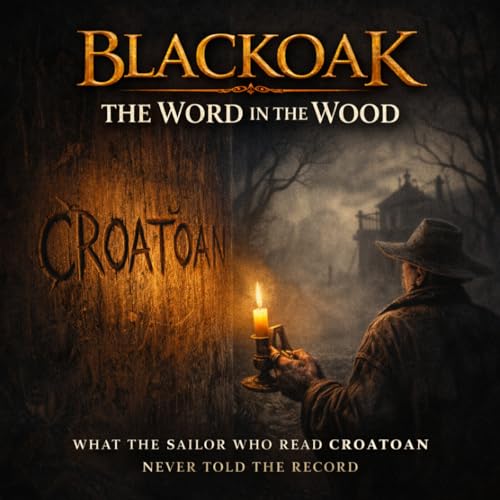
『BLACKOAK: The Word in the Wood — What the Sailor Who Read CROATOAN Never Told the Record』のカバーアート

BLACKOAK: The Word in the Wood — What the Sailor Who Read CROATOAN Never Told the Record

BLACKOAK: The Word in the Wood — What the Sailor Who Read CROATOAN Never Told the Record

無料で聴く

ポッドキャストの詳細を見る
BLACKOAK: The Word in the Wood — What the Sailor Who Read CROATOAN Never Told the RecordThe houses were still standing. The settlement had not been destroyed. It had been dismantled — carefully, deliberately — by people who had somewhere to go and planned to use the materials when they got there. And on a post, carved by a steady hand, one word:CROATOAN.In August of 1590, John White returned to Roanoke Island after three years of war, delay, and broken promises — only to find a colony that had not been attacked or killed but had simply ceased to be there. One hundred and seventeen English men, women, and children. Gone. The first English child born in the Americas, Virginia Dare — White's own granddaughter — among them. No bodies. No sign of violence. No cross, the agreed distress signal. Only a word pointing south.White wanted to follow it sixty miles to Croatoan Island. A storm prevented him. He never returned.In this episode of BLACKOAK: The Adventures, the ancient sentient tankard carries an account it received in a Plymouth tavern in the autumn of 1590 — from Robert Annis, a common sailor aboard the Hopewell who had stepped onto that sand, read those carved letters, and searched the dismantled settlement with his own hands. He told no official record what he told Blackoak: the quality of the cuts in the bark, which told him the marker was planned rather than desperate. The child's carved toy he found in the earth near a house foundation — and why he put it back. The face John White made when he read the word. And the sailor in the shallop crew who spoke a few words of Algonquian across the water as they pulled away. Words addressed to people who might have been watching from somewhere on that island. Who might have heard. Who could not answer, or whose answer the wind took.This is the most examined disappearance in American history. It is still unresolved. This is why.BLACKOAK: The Adventures is a historical mystery podcast narrated by an ancient sentient tankard forged from the wreckage of a warship off the Carolina coast. It has spent centuries in the rooms where history was made by people who believed objects couldn't listen. They were wrong.Lost Colony of RoanokeRoanoke colony mysteryCROATOAN meaningVirginia Dare RoanokeJohn White Roanoke 1590Roanoke Island disappearanceLost Colony North CarolinaCroatoan tribe English colonyRoanoke mystery explainedAmerican historical mystery podcastBLACKOAK podcastFuzzy Life StudiosRoanoke settlement evidencefirst English colony AmericaManteo Roanoke CroatoanWhat happened to the Lost Colony of RoanokeWhat does CROATOAN mean on the post at RoanokeDid the Roanoke colonists survive with the Croatoan peopleWhere did the Roanoke colonists goWho was Virginia Dare and what happened to herWhy did John White take three years to return to RoanokeWas the Roanoke colony destroyed or did they moveDare Stones Roanoke hoax or realArchaeological evidence of Roanoke colonists foundJohn White map annotation inland relocation siteDid the Roanoke colonists integrate with Native AmericansEnglish artifacts found on Hatteras Island Roanoke connectionWhat was the agreed distress signal at Roanoke colonyWhy is there no cross carved at RoanokeBest historical mystery podcasts about colonial AmericaCinematic storytelling podcast about American history mysteriesBLACKOAK podcast Roanoke episodeWho were the Croatoan people of Hatteras IslandRoanoke colony 1587 settlement historyWhat is the most detailed account of finding Roanoke abandonedWhat happened to the Lost Colony of Roanoke? The fate of the Roanoke colonists — 117 men, women, and children who had settled on Roanoke Island in present-day North Carolina in 1587 — remains unconfirmed. When governor John White returned from England in 1590 after a three-year delay, he found the settlement carefully dismantled rather than destroyed, with no bodies, no sign of violence, and no cross — the agreed distress signal. On a post, the word CROATOAN was carved cleanly. The Croatoan people of Hatteras Island, led by the Englishand Manteo, were known allies of the colonists. The leading theory holds that the colonists relocated to Croatoan Island or nearby Native settlements, possibly integrating over time. English artifacts have been found at Hatteras Island and in inland Native sites in circumstances suggesting pre-contact with the colony, though no definitive documentation of their fate has been found.What does CROATOAN mean? CROATOAN was the name of both the Native people who inhabited Hatteras Island, approximately 60 miles south of Roanoke, and the island they lived on. The colonists had agreed before White's departure that if they moved, they would carve their destination into a tree or post — and if under distress, they would add a cross. The carved word CROATOAN at Roanoke, without any cross, has been interpreted by most historians as indicating the colonists moved south to Croatoan Island. The tribe's leader, ...
adbl_web_anon_alc_button_suppression_t1
まだレビューはありません