

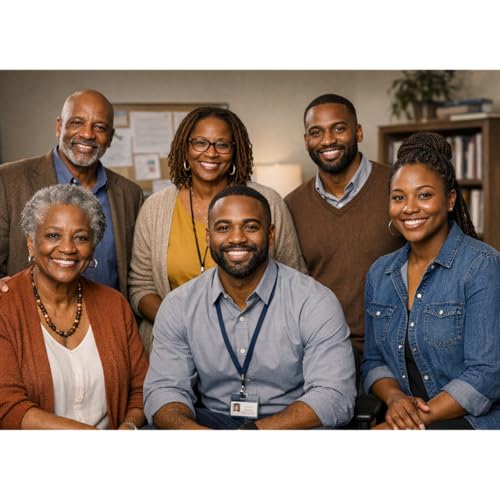
BLACK SOCIAL WORKERS: Legacy Built Through Service
カートのアイテムが多すぎます
カートに追加できませんでした。
ウィッシュリストに追加できませんでした。
ほしい物リストの削除に失敗しました。
ポッドキャストのフォローに失敗しました
ポッドキャストのフォロー解除に失敗しました

BLACK SOCIAL WORKERS: Legacy Built Through Service
-
ナレーター:
-
著者:
概要
Click into the webpage and use one of the codes to redeem my book Relationships: The Power of Illusion. Hurry and claim a code before someone else does. Please do not use more than one code.
www.iuniverse.com/en/redeem
10600000441446
10600000441447
10600000441448
10600000441449
10600000441450
10600000441451
10600000441452
10600000441453
Thesis Statement: Black social workers from 2000–2026 reshaped child welfare, mental health, and justice systems through culturally grounded, equity‑centered practice.
Learning Objectives (with examples)
Objective 1: Students will explain how Black social workers influenced child welfare reform. Example: A student describes how Joyce James’ disproportionality model changed CPS decision‑making.
Objective 2: Students will identify major areas where Black social workers expanded mental health equity. Example: A student explains how Black clinicians increased access to culturally competent therapy during COVID‑19.
Learning Outcomes (with examples)
Outcome 1: Students will summarize one policy or practice change led by Black social workers between 2000–2026. Example: A student writes a short paragraph on the rise of kinship care advocacy.
Outcome 2: Students will connect a modern social issue to a contribution made by Black social workers. Example: A student links school‑based trauma programs to post‑2016 racial justice work.
5E Learning Model
Engage
Show a brief scenario: “A Black family is involved with CPS. What factors should a culturally competent social worker consider?” Students share quick reactions.
Explore
Students review short profiles of leaders (e.g., Joyce James, Mit Joyner, NABSW). Small groups identify patterns in their work: equity, cultural grounding, policy reform.
Explain
Teacher clarifies key contributions from 2000–2026:
- Child welfare disproportionality work
- Mental health equity expansion
- Reentry and justice reform
- COVID‑19 community response Students connect these to their earlier observations.
Elaborate
Students choose one contribution and apply it to a modern issue (school trauma, policing, mental health access, foster care). They explain how the contribution improves outcomes for Black families.
Evaluate
Students complete a short written reflection: “What is one lasting impact Black social workers made between 2000–2026, and why does it matter today?”
Formative Assessment
Quick Check (Exit Ticket): Students answer two prompts:
1. Name one Black social worker or organization and describe their contribution.
2. Explain how that contribution influences a current social issue.
This verifies understanding of objectives, outcomes, and application.
Comments and/or to be a guest call 773-809-8594