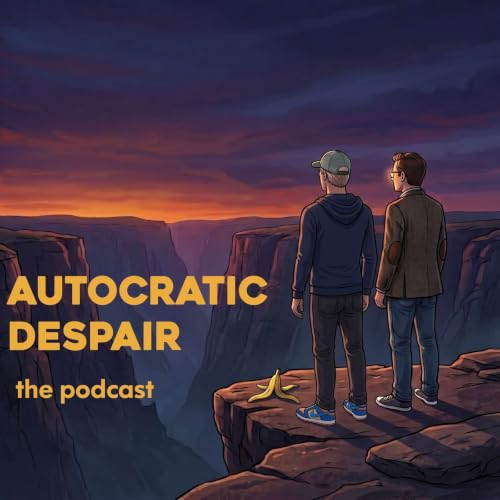
『Autocratic Despair: The Podcast』のカバーアート

Autocratic Despair: The Podcast

Autocratic Despair: The Podcast

著者: Nick Mortensen & Dr. Craig Johnson
無料で聴く

Stare into the abyss of the United States' descent into Authoritarianism with a truly funny comedian from Green Bay, WI and a very serious PHD in Global Fascism Studies from Cal-Berkeley.


Very Funny. Very Serious.

© 2026 Genuine Article Media
個人的成功 政治・政府 政治学 自己啓発
エピソード
  • Gruff Leftist Sweetheart Jared Yates Sexton
    2026/07/16
    Dr. Craig is out this week. Turkish hair surgery. Sitting in for him is Jared Yates Sexton, and he's been staring into this particular abyss a lot longer than I have.On June 14th, 2016, Jared was a creative writing professor who went to a Trump rally in Greensboro, North Carolina, and started live-tweeting what he saw. Not the speech — the room. The people. What was actually happening in there. It went off like a bomb and it ended his old life. He walked in a fiction writer and walked out a political correspondent, because he saw the man for what he was back when the rest of us still saw a buffoonish reality TV grifter running for president to juice his own brand.He's the author of The Man They Wanted Me to Be: Toxic Masculinity and a Crisis of Our Making, about how this country builds its boys and what it costs them. American Rule: How a Nation Conquered the World But Failed Its People, about the myths we tell ourselves and who those myths were built to serve. And The Midnight Kingdom: A History of Power, Paranoia, and the Coming Crisis, which traces a straight line from the Great Fire of Rome to QAnon and which — reading it now — predicted damn near everything that's happened since. He co-hosts the Muckrake Podcast and writes a Substack called Dispatches From A Collapsing State, which tells you everything you need to know about where his head's at. On my personal S-tier of autocracy-knowers, he's on it. He might be at the top of it.We start somewhere I didn't plan for: two guys comparing notes on the jobs that were killing them. Jared explains why he left academia — "you can't keep doing the shit that hurts you" — and I explain why I started this show, which is that my entire goal is to replace "Trump Derangement Syndrome" with "autocratic despair" and everything else is secondary. He says it's accurate. We get into how Dr. Craig got fucked by academic publishing, why a book about keeping your son out of fascism should not be printed in twelve-point type with citations, and why a podcast with no commercials has a pace a podcast with commercials can never have. He hears we started a beef with The Bulwark last week and responds with three words I'm going to have printed on a shirt.Then the number. Jared rates his autocratic despair an eight and a three, simultaneously — the first guest to break the format — and explains why: he thinks the destabilization we're heading into is the same thing that opens the window for actual change. We get into the rumor that Trump is about to declare Jon Ossoff and Raphael Warnock illegitimate senators, why that's a genuinely bad signal about whether we'll have free and fair midterms, and why picking that particular fight is a mistake that only makes both men more famous. And we land on the greatest gift these people give us: they cannot shut up. They telegraph everything they're going to do and count on nobody paying attention.We talk about Graham Platner and the damage done to the gruff leftist sweetheart community — a title Jared claims for himself about four seconds after I say it, and then uses forty minutes later to take apart JD Vance. He explains who actually recruited Platner, why they went looking for what he calls a noble savage, and why they never bothered to vet him, because vetting was never the point. That opens into a real education on deeper politics: what happens when a regular person tries to run for Congress, why the local party in a deep red district would rather lose by forty points than let an outsider try something new, and why Jared walked away from his own 2016 run the moment he saw how the machine actually works. I pitch him my platform — insider trading, announced in real time on a billboard network — and he's more generous about it than it deserves.We cover his enduring legacy as a meme: the 2017 Don Jr. tweet, what it's like to be tagged in the same joke every single day of your life for a decade, and the genuinely unsettling business of getting slotted into other people's conspiracy theories. The CIA-asset years. The double-agent schemes. The people who showed up at his house and had to be handled by police.Then the part I've wanted for a long time. Jared grew up as what he calls the prototype of what became Christian nationalism. He describes his grandmother's house — a crucifix in every room — and a literal, furnished Satan. Not a metaphor. An entity that could appear as a human being, and you were expected to grab that cross off the wall and be ready. He explains what it does to a person to be raised on nothing but the Book of Revelation, why constant spiritual warfare trains you to reach for a strongman, and how the divine agent framework — Cyrus, King David — lets a believer look at a man's sins and see proof instead of disqualification. And I finally get my answer to the thing that's bugged me for years: how do people with such a well-articulated vision of the Antichrist look right at Donald Trump and ...
    続きを読む 一部表示
    49 分
  • Beefin' With The Bulwark
    2026/07/10
    This week on Autocratic Despair, the comedy podcast about surviving American authoritarianism, Nick Mortensen and Dr. Craig run a leaner three-segment episode — and it opens on the hardest one, because it's the one that hurt. Graham Platner. If you'd tuned out: Platner was the Marine combat veteran and Maine oyster farmer who came from nowhere on a viral launch video, ran as an unapologetic populist on Medicare for all and a real social safety net, and won the Maine Democratic Senate primary with more votes than any Democrat in the state's history. He was going to be the one who unseated Susan Collins. He was the progressive insurgent's great hope. And this show never trusted it — Nick had been saying so since episode one, pointing at the Nazi tattoo Platner got covered up instead of removed, the earlier allegation his supporters found easy to wave away, the pattern of people repeatedly deciding to give him one more pass.This week the pass ran out. Politico published an on-the-record account from a former girlfriend, Jenny Racicot, alleging that Platner forced himself on her in 2021 over her repeated objections — corroborated, Politico reported, by a later partner, friends, and her own correspondence with a therapist. The Democratic Party's response was near-total and immediate: Schumer, Gillibrand, Warren, the DSCC, and even Ro Khanna — who had stood by Platner through everything else — called for him to go. As of this recording, Platner denies the allegation and has not dropped out.Nick and Craig handle it the way the show insists on handling this material: the accuser is the wronged party, full stop, no litigating her, no qualifying the credibility of a woman who came forward at real personal cost. False allegations of this kind are vanishingly rare, and Craig names the reflex to treat this one as the exception for exactly what it is — the disease, not the diagnosis. He also points out how many women it took, over how long, and how the apologies only arrived now.But the heart of the segment isn't the news. It's a feeling Nick can't shake and doesn't try to hide: this should feel like vindication, and it doesn't. He called this from the beginning. He spent months asking Platner's supporters to name the line the man would have to cross, and watching them refuse to name one. So the "told you so" was right there — and it curdled the instant he reached for it. Because Nick didn't want to be right. He wanted Platner to prove him wrong, to be living proof that a person with an ugly past can change, because if that guy could, the door was open for a lot of people with non-sparkling histories to have a place in the movement. Instead Platner did the one thing that slams that door on everyone behind him. In the episode's most naked moment, Nick admits it: he gave Talarico his heart, and Talarico hurt him a little. He never gave Platner his heart — and Platner may have hurt him worse, because he didn't know the man had the capacity to reach him at all.Craig widens the lens with history, as he does. He connects Platner to the figure of the caudillo — the Latin American strongman archetype embodied by 19th-century Argentine dictator Juan Manuel de Rosas, a fabulously wealthy landowner who cultivated the image of a knife-fighting, rough-and-tumble everyman. The point that lands hardest: the violence in that persona isn't a flaw in it. It's a feature of it. The authentic-brawler, anti-establishment outsider who's secretly a rich man and secretly cruel is a recognizable type, and Platner was running the American version of it — the veteran, the oysterman, the mustache, the focus-grouped LL Bean of it all. Craig also does the necessary corrective work, refusing to let the discussion blame the popular policies for the flawed men attached to them: single-payer health care and a real safety net are wildly popular and successful everywhere they're tried. The tragedy is that the left keeps attaching those ideas to fragile individual personalities instead of to a durable party — and some of those personalities turn out to be monsters.From there the episode turns to Nick's beef with The Bulwark. The Bulwark, for the uninitiated, is the well-capitalized media outfit built by former Republicans — the Never-Trumpers who carved out their own lane in the resistance and pull a genuinely large audience. Nick hate-listens, and mostly, uncomfortably, agrees with them. But last week they had David French on — the respected lawyer and New York Times columnist — and, asked in passing about Prairieland, French framed it in the exact opposite way this show has: a violent ambush, a jury verdict to be trusted, no sympathy absent compelling evidence of a miscarriage of justice. Nick's problem isn't that French is stupid; it's that for a million listeners, many hearing about Prairieland for the first time, a trusted voice just filed the whole thing under "lock them up and throw away the key" — without doing any ...
    続きを読む 一部表示
    44 分
  • Been Living Off Wealth
    2026/07/02
    This week on Autocratic Despair, the comedy podcast about surviving American authoritarianism, Nick Mortensen and Dr. Craig open on a rare thing in 2026: a piece of good news, delivered with a knife in it. The Supreme Court handed down its decision on birthright citizenship, and the ruling went the right way — the Fourteenth Amendment holds, and anyone born in the United States is still a citizen of the United States. But the vote was six to three, and only two of the conservative justices, Chief Justice Roberts and Amy Coney Barrett, joined it. Craig sets his despair number accordingly and lets the arithmetic speak: two people decided the country stays a democracy. That's the margin now.From there Craig does what the show exists for — he makes the thing legible. He walks through why birthright citizenship exists in the first place: it comes out of the Reconstruction amendments, written specifically so the country could never again say the children of enslaved people weren't citizens because their parents had been property. He tells the story of Wong Kim Ark, the man born to Chinese immigrants in San Francisco in 1873 who was denied re-entry to his own country, took it to the Supreme Court, and won — settling the question for well over a century, until this administration decided to reopen it. And he defines the vocabulary the fight travels under: the slur "anchor baby," and the European import "remigration," a word engineered to let people advocate mass expulsion by ethnicity without ever having to say the ugly words underneath it. Nick and Craig land on the part nobody in power wants to sit with — that undocumented immigrants pay billions into a Social Security system they'll likely never draw from, and that the country's wealth has always leaned on labor that isn't free. Craig gives the academic name for it, unfree labor, and the discomfort of the term is the point.Then the anchor. Last week, as Nick and Craig were literally recording, the Prairieland sentences came down, and this week they do it properly — a full accounting for anyone who's never heard the case. The recap is built cold: July 4, 2025, a noise demonstration outside an ICE detention center in Alvarado, Texas, where protesters brought fireworks so the people locked inside would know somebody was out there thinking about them. It went sideways; a police lieutenant was shot and survived; one man, former Marine Benjamin Song, was convicted of firing. And then the government did the thing that turns a local crime story into a national emergency: it charged the whole group as terrorists, on the theory that everyone present was part of a "North Texas Antifa cell" — a cell it never actually proved existed. The jury acquitted everyone but Song of attempted murder, then convicted all of them of providing material support to terrorists, the terrorists being themselves.Nick reads the sentences the way you'd read a receipt, name by name, number by number, so the gap between the punishment and the conduct does the arguing. Benjamin Song, the only person convicted of hurting anyone, got a hundred years when the floor was twenty. Maricela Rueda got seventy. Autumn Hill, Zachary Evetts, Savanna Batten, Meagan Morris, and Elizabeth Soto each got fifty — for standing outside a jail with fireworks. And Daniel Sanchez Estrada, who wasn't even at the protest, got thirty years for moving a box of his wife's zines. Seven more defendants took plea deals and face up to fifteen years each, sentenced alongside Ines Soto; Nick reads their names too — Seth Sikes, Nathan Baumann, Susan Kent, Lynette Sharp, John Thomas among the cooperating pleas, with Joy Gibson and Rebecca Morgan noted as the two who refused to cooperate — because the show reads the names every week, and because rounding sixteen people down to a cleaner number is its own small erasure. Nick won't call them the Prairieland Nine. It was never nine.The thesis arrives in the judge's own words. Chief Judge Reed O'Connor said from the bench that he was handing down the maximum because the state wants to send a message to anyone who shares a similar ideology — and Nick flags the wrinkle that O'Connor wasn't even the trial judge. Mark Pittman presided, then handed five defendants to O'Connor days before sentencing, without explanation, a procedural shuffle Nick expects to surface on appeal. Craig names what the case actually establishes in plain text: oppose the country's detention policy and spread information about it, and you can be charged with terrorism and put away for decades — and that tool won't be holstered when this administration ends. Nick and Craig also sit with the strange quiet around the defendants being trans, dead-named in official documents while the fact went otherwise unmentioned, and turn over why the people who usually seize on that chose not to.After the weight, the show breathes. Nick turns to the Freedom 250 national fair on the Mall and the low attendance ...
    続きを読む 一部表示
    45 分
adbl_web_anon_alc_button_suppression_t1
まだレビューはありません