エピソード

  • The Founding of Regina Laudis Abbey: A Story Made for Hollywood
    2025/12/23

    Mother Benedict Duss hid from the Nazis in her French Benedictine monastery during World War II. After General Patton's Third Army liberated her abbey she pledged to return to the United States to establish a Benedictine monastery to pray for and bless her homeland. Through the assistance of two future popes — both of whom would eventually be canonized — and a number of other providential happenstances, the Abbey of Regina Laudis was finally established in Bethlehem, Connecticut. The story of the founding eventually became the basis for the acclaimed movie Come To The Stable, which was nominated for eight Oscars, including for the screenplay written by Clare Booth Luce. Regina Laudis has been the home of Mother Dolores Hart since she left a budding Hollywood acting career in the 1960s, and it was the place where the actress Patricia Neal found solace and healing after her tumultuous life.

    続きを読む 一部表示
    22 分
  • Fr. Aloysius Schmitt, Hero of Pearl Harbor
    2025/12/11

    Father Aloysius Schmitt was a Navy Chaplain assigned to the USS Oklahoma at the outset of World War II. He had just finished the 7 a.m. Mass on the Second Sunday of Advent when the first torpedoes from the surprise Japanese attack struck the ship. He aided men to escape, at the cost of his own life during the attack on Pearl Harbor. He was the first chaplain to die in World War II.

    続きを読む 一部表示
    15 分
  • Ven. Henriette Delille
    2025/11/25

    Venerable Henriette Delille overcame great opposition to establish the second religious community for black women in the United States. She was an octroon born in New Orleans in 1813. Her mother was a kept woman within the plaçage system. After Henriette learned the truth about marriage she became implacably opposed to the plaçage system, and she rejected the trajectory of her life. In her 20s she started the second religious community for black women, but it took years for the authorities to approve her religious order. Since its founding in the 1840s the community has opened the first Catholic nursing home for the elderly in the United States, as well as one of the oldest Black Catholic high schools in the USA. Henriette Delille died in 1862. Her cause for canonization opened in 1988, and she was declared venerable in 2010.

    続きを読む 一部表示
    17 分
  • Pope Night in the American Colonies
    2025/11/05

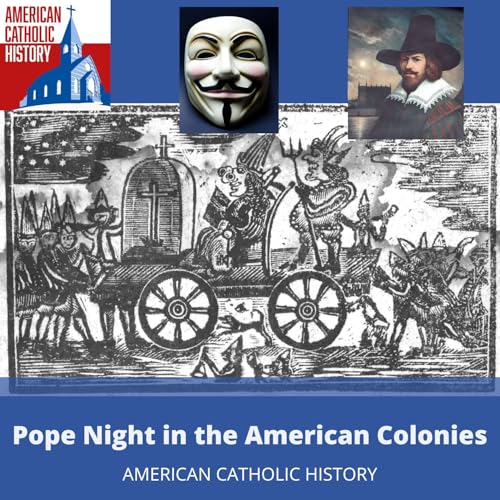
    "Pope Night" was the American version of the British "Guy Fawkes Night," the annual commemoration of the Gunpowder Plot. The night of mischief and mayhem and anti-Catholic demonstrations came over with sailors and grew to include demonstrations up and down the New England coast. It was ended by George Washington, who had an affinity for Catholics — and who needed Catholic support in the war against Great Britain

    続きを読む 一部表示
    18 分
  • The Haunting at Wizard Clip
    2025/10/28

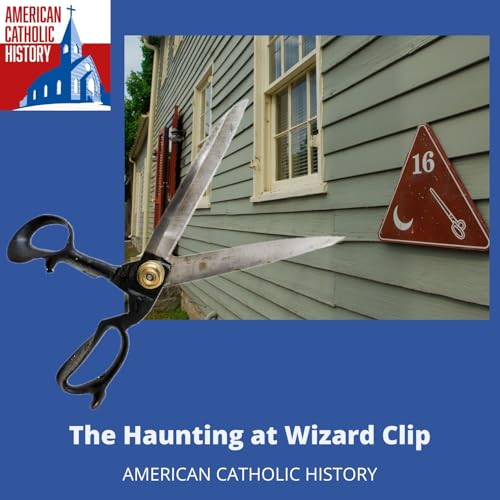
    In the late 1700s, Adam Livingston, who was Lutheran, moved with his family to a farm near Smithfield, Virginia. After a stranger, who turned out to be Catholic, died in his home, manifestations of a demonic infestation of their home began to disturb his family. The sound of invisible horses galloping loudly, crockery flying off shelves, a clipping sound accompanied by articles of clothing being damaged, and other disturbing occurrences. The clipping is what gave the area the name "Wizard Clip." The manifestations continued until two Catholic priests, including Father Demetrius "Prince" Gallitzin, intervened to exorcise the demons. Livingston's family became Catholic as a result. Following their conversion, a consoling heavenly voice instructed the Livingston family in the faith, led them in prayer, and inspired Livingston to do good things for others in need. When the Livingstons moved back to Pennsylvania in 1802, Adam Livingston donated 34 acres to the Catholic Church, and that land is, since 1978, the Priestfield retreat center for priests in modern day Middleway, West Virginia.

    続きを読む 一部表示
    21 分
  • Commodore John Barry, Father of the U.S. Navy
    2025/10/21

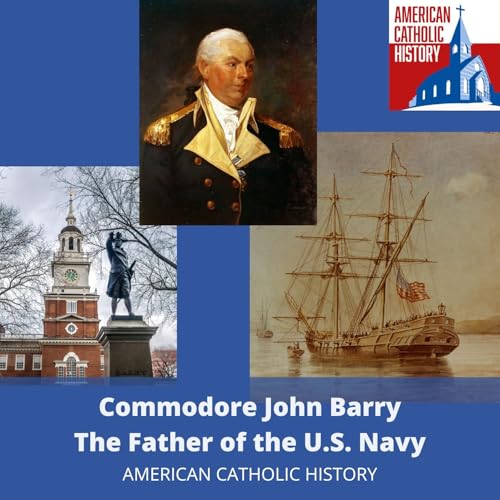
    John Barry was born in Ireland in the late 1740s to Catholic peasant farmers. Being Catholic they had no rights, and by the time John was ten they had been evicted from their land and moved to a coastal town. John became a sailor on his uncle's fishing vessel and by 15 had risen well. That year he moved to Philadelphia, the most important port city in the British colonies in America. By 21 he was a ships captain making runs to the Caribbean regularly. He rose in prominence as a captain and a man of great character and generosity in Philadelphia society. When the Revolutionary War broke out in 1775 he sold his ship, the Black Prince, to the Continental Congress, and offered his services as a sea captain. On board his new command, the Lexington, he won the first naval engagement of the War. He spent time on shore during the War, taking part in the battles of Trenton and Princeton, among other actions. When he returned to sea, after refusing to take a bribe from the British to switch allegiance, he commanded two other ships and won other significant battles, including the final engagement of the War. After Independence was won he went back to merchant shipping until President George Washington tapped him to lead the organization of the new permanent US Navy. He oversaw construction of the first naval vessels and took command of the first ship, the United States. Washington nominated him as the first officer, and first flag officer, of the new U.S. Navy, effective in 1794. He died in 1803 of asthma. There are at least three statues commemorating Barry — one in Washington, DC, one in Philadelphia, and one in his native Wexford, Ireland. For his efforts as a sea captain and establishing the US Navy, John Barry is considered the Father of the US Navy.

    続きを読む 一部表示
    24 分
  • The Cathedral of the Plains — The Basilica of St. Fidelis of Sigmaringen
    2025/10/08

    Dubbed "The Cathedral of the Plains" by William Jennings Bryan, the Basilica of St. Fidelis of Sigmaringen was completed in 1911. It was the largest and tallest church west of the Mississippi River at the time. It was built by the community of Volga Germans who had moved en masse to Victoria, Kansas in the last few decades of the 19th century and in the first decade of the 20th. The community grew quickly through immigration after the Tsar of Russia had rolled back many of the privileges and protections that they had enjoyed in Russia for nearly a century. The Basilica was built in just three years through the hard work and sacrifice of the families of the community. The effort was led by the Capuchin friar who was their pastor, Fr. Jerome Mueller, OFM Cap. He levied a duty of $45, six cartloads of stone, and four cartloads of sand on every male 12 years old and older. Many families took out loans to afford this duty, but they took on this debt willingly to have their church, and they contributed their own time and industry to build it. The title "Cathedral of the Plains" was given by Bryan in 1912 as he arrived in Victoria by train, while stumping for Woodrow Wilson's presidential election campaign. The church is easily visible from Interstate 70, and is visited frequently by people who are drawn to it due to its size, beauty, and splendor. It was named a Basilica in 2014.

    続きを読む 一部表示
    16 分
  • Sr. Blandina Segale Pt 2: The Sisters Segale of Cincinnati and the Santa Maria Institute
    2025/09/18

    Sister Blandina Segale had a second chapter to her life. After spending 20 years bringing civility and the light of Christ to the Wild West, Sister Blandina and her biological sister, Sister Justina, worked hard for immigrants and those in need in Cincinnati, Ohio. They began their work in 1896 and organized the Santa Maria Institute in 1897 to provide catechesis, social services, and homes for those in need. They worked initially among the immigrant Italian population, but their scope expanded as more and more people in need flooded into Cincinnati in the first quarter of the 20th century. They fought against bigotry, religious persecution and opposition, and sometimes an adverse legal system. But their efforts became one of the largest and most important social services organizations in Ohio, Santa Maria Services.

    続きを読む 一部表示
    23 分