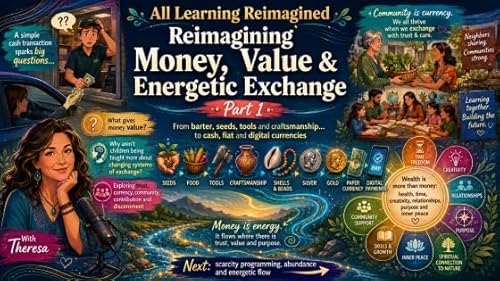
『All Learning Reimagined with Teresa』のカバーアート

All Learning Reimagined with Teresa

All Learning Reimagined with Teresa

著者: BBS Radio BBS Network Inc.
無料で聴く

概要

All Learning Reimagined, where passion meets possibility, one story at a time. All Learning Reimagined is a global gathering place for parents, educators, and lifelong learners who are ready to question—and transform—the outdated systems of education. This podcast dares to reimagine learning by placing heart, intuition, and creativity at its core. Grounded in common sense, connection to nature, community, and the wisdom of indigenous traditions, each episode offers practical, intuitive, and self-directed approaches that inspire confidence and awaken self-mastery in both mentor and learner. Through heartfelt conversations, reflections, and skill-sharing from around the world, we spotlight real-life stories and ideas that break free from rigid educational models. From early childhood through every stage of life, we explore what it means to learn in alignment with our inner knowing and natural curiosity. Our guests include parents, educators and changemakers who are living examples of heart-centered, life-honoring approaches to education. Together, we build a bridge between traditional pedagogy and more flexible, holistic, and skill-based learning pathways. Whether you're a parent seeking new ways forward or an educator ready to evolve, All Learning Re-imagined offers inspiration, tools, and an optimistic vision for the future of learning—one that begins with the heart. "Learning is not a system to fix — it’s a living journey to nurture."Copyright 2026 Teresa
エピソード
  • All Learning Reimagined, February 27, 2026
    2026/02/28
    32 分
  • All Learning Reimagined, February 20, 2026
    2026/02/21
    All Learning Reimagined with Teresa Songbird Inquiry Learning Beyond the Search Bar: Reclaiming the Lost Art of Deep Inquiry All Learning Reimagined: Inquiry & Research Reawakening the learner by moving from "Knowing" to "Exploring" Podcast Summary The Core Philosophy "If you change the way you look at things, the things you look at change." Critical Insights ✕Cognitive Closure: Saying "I already know that" signals the brain to stop searching and shuts down curiosity. ✓The Brain as a Filter: Our beliefs dictate what we notice (e.g., seeing cars/pregnancy everywhere only when relevant). ✓Human Antenna: Learning is a whole-body process involving senses, intuition, and resonance, not just the intellect. Searching vs. Researching Searching: Surface-level Googling, accepting AI overviews, clicking the first result. Researching: The "RE" means thoroughness, again, anew. Gathering from multiple sources. The Deep Research Checklist #PrimarySources #OldBook s#Interviews #Fieldwork #Etymology #CrossCheck Key Skill: Discernment To separate fact from opinion; to sift, divide, and perceive clearly. ⏱ 30 min listen👥 Educators & Parents bbsradio.com/alllearningreimagined This episode of All Learning Reimagined explores the transformative power of inquiry-based learning and the critical distinction between "searching" and "researching." Host Teresa discusses how to overcome cognitive closure, utilize the brain's natural filtering mechanisms, and teach children to become active seekers of truth rather than passive consumers of information. Detailed Summary The Trap of "I Already Know That" The journey toward deep learning begins by identifying and dismantling the "I already know that" mindset. This phrase acts as a cognitive closure statement, signaling the brain to stop thinking, searching, and being curious. By accepting information blindly from traditional systems—schooling, culture, or family programming—learners often shut down the very pathways required for growth. Reawakening the learner requires shifting from a state of "knowing" to a state of "exploring," where questions like "How do I know this is true?" open up new paradigms of possibility. The Cognitive Shift Fixed Mindset "I already know that." Shuts down curiosity and stops neural search. ➔ Inquiry Mindset "I'm curious..." Opens portals of possibility and new perspectives. The Brain as a Selective Filter Understanding the biological basis of learning is essential for self-directed inquiry. The brain naturally filters the overwhelming amount of sensory data it receives, prioritizing information that aligns with our existing belief systems. This "validation seeking" means we often miss what we aren't looking for, such as noticing pregnancy only when it becomes personally relevant. By teaching children how their brains filter information, we empower them to use their minds as tools for conscious exploration rather than being unconsciously controlled by pre-existing programming. Redefining Research in the Digital Age In a world dominated by algorithms, "Googling" has often been mistaken for "researching." True research is rooted in the etymology of the word: the prefix "re-" implies thoroughness and going back again. Deep inquiry requires looking beyond the first page of search results, which are often influenced by sponsorship or popularity rather than accuracy. It involves analyzing the etymology of words—such as "discern" (to sift or separate)—and recognizing how AI-generated overviews may simplify or sanitize our language, potentially stripping away the essence of true meaning. The 4 Pillars of Deep Research ✔Multiple Sources: Moving beyond search engines to old books, primary documents, and fieldwork. ✔Direct Experience: Interviewing experts and people with "lived experience." ✔Cross-Checking: Looking for patterns, contradictions, and subtle biases in narratives. ✔Intuitive Resonance: Feeling into the body to see what "resonates" as true. The Human Element of Discovery Effective learning is not a linear path but a "messy" cycle of questioning, discovering, and re-questioning. It bypasses the ego and connects the learner to the world through active listening and sensory awareness. By modeling curiosity and valuing high-quality questions over easy answers, educators and parents can help children develop the critical thinking skills necessary to navigate a society increasingly prone to repetition and bias. Ultimately, the goal of inquiry is not just to complete an assignment, but to shape one's identity and deepen one's paradigm for life. To-Do / Next Steps Visit the BBS Radio website to access the full article and archived shows. Download the "Mini Educator Guide" to help teach inquiry across any subject or year level. Utilize the "Real Research Activity Sheet" for children to move beyond basic Googling. Review the "Real Research Checklist" designed for teachers and parents working with young learners. Examine the two provided ...
    続きを読む 一部表示
    31 分
  • All Learning Reimagined, February 13, 2026
    2026/02/14
    All Learning Reimagined with Teresa Songbird Questions to awaken inquiry, curiosity and deep learning The Portal of Inquiry: Reimagining Education Through the Power of Questions The Power of Questions Awakening inquiry, curiosity, and deep learning in a complex world. PODCAST SUMMARY The Core Philosophy "Questions are one of the oldest technologies of learning... they act as a portal to unlock information and the thirst to seek." The Cognitive Danger Zone The statement "I already know that" is a terminal switch. It signals the brain to stop searching, shuts down curiosity, and prevents the updating of outdated beliefs. 🧠 Neuroscience Curiosity triggers dopamine, making learning "stickier" and more joyful. ⚖️ Sovereignty Questioning builds autonomy and prevents passive consumption of info. The Question Taxonomy Closed Questions Retrieve facts (e.g., 1+1). Efficient for foundations but non-transformative. Open-Ended Inquiry Invites imagination and multiple perspectives. "What if?" and "How might we?" Reflective & Generative Inward-looking. "What surprised me?" or "How would a future elder see this?" Key Skill: Discernment The ability to pull apart information, perceive clearly using all senses, and distinguish between True (perception) vs. Truth (universal). #Inquiry #Curiosity #Discernment #LifelongLearning Host: Teresa • 28 min read/listen • Part 1 of Series In this episode of All Learning Reimagined, host Teresa explores the transformative potential of high-quality questions as the "oldest technology of learning." She challenges the traditional educational focus on "what to think" and advocates for a return to our natural state of curiosity, discernment, and intellectual sovereignty. By shifting from seeking fixed answers to embracing powerful inquiry, we can unlock deeper learning and adapt to a rapidly changing world. The Cognitive Impact of Inquiry Questions serve as "portals" that unlock information and a thirst for seeking, often jolting individuals out of the dangerous cognitive state of "I already know that." This phrase is described as a "closed statement" that signals the brain to stop searching and thinking, effectively shutting down curiosity. In contrast, neuroscience shows that curiosity activates dopamine pathways, making learning "stickier," more joyful, and more memorable. By fostering wonder and exploration, we align with our biological priming for learning, which has often been suppressed by modern educational systems focused on rote memorization and obedience. The "I Already Know" Trap When we claim to already know something, we create a cognitive dead end. Here is how inquiry flips the script: Closed State: "I already know that" → Signals the brain to stop searching. Open State: "What if?" → Activates dopamine and deepens neural connections. The Goal: Moving from passive consumption to active meaning construction. Building Sovereignty and Discernment Learning to ask questions is a foundational step toward reclaiming personal autonomy and sovereignty. This process involves "discernment"—the ability to distinguish differences and perceive information clearly using not just the mind, but the whole body and its senses. Teresa emphasizes the distinction between "true" (a person's subjective perception based on experience) and "truth" (objective reality). By teaching children to question, we help them navigate a complex world with confidence, allowing them to construct their own meaning rather than accepting handed-down narratives. A Framework for Powerful Questions Effective inquiry requires moving beyond simple "closed questions" (which check for facts) toward more transformative categories. These include: Open-ended Questions: Invite research, multiple perspectives, and ethical reasoning. Reflective Questions: Encourage looking inward at personal growth and shifts in perception. Perspective-shifting Questions: Ask how a situation looks through the eyes of others, such as an elder, a scientist, or someone from the future. Generative Questions: Lead to entirely new inquiries and deeper understanding before making decisions. By utilizing these various types, educators and parents can foster empathy, pattern recognition, and higher-order thinking skills. Types of Inquiry Portals Reflective "How did I grow through this?" Perspective "How would an elder see this?" Generative "What else do we need to know?" Imaginative "What if this were possible?" Key Data & Context Experience Base: The host brings over 30 years of teaching experience to the discussion. Timeline of Change: Significant personal and global shifts observed over the last 5 years have influenced this focus on discernment. Historical Context: Critique of an education system that has prioritized fact-memorization for approximately the last 100 years. To-Do / Next Steps Observe your own daily habits to identify if you are asking deep, open-ended questions or merely closed ones. Carve out 5 to 10 minutes each day to...
    続きを読む 一部表示
    29 分
まだレビューはありません