『AI in Action』のカバーアート

AI in Action

AI in Action

著者: Sidney Shapiro
無料で聴く

概要

"AI in Action" is a podcast dedicated to unravelling the complexities of Artificial Intelligence (AI) and its transformative impact across various industries. Hosted by Dr. Sidney Shapiro, an AI and business analytics expert, each episode delves into real-world use cases, offering insights from leading industry professionals and academics. Whether you're an AI enthusiast, a business leader, or simply curious about the future of technology, this podcast provides valuable perspectives on how AI shapes our world, drives innovation, and creates new opportunities. Join us as we explore the frontiers of AI and its profound implications for society.Sidney Shapiro 政治・政府 経済学
エピソード
  • S2E4 - AI Literacy, Equity, and the Future of Teaching with Dr. Jenny Hayman
    2026/02/23

    AI in Action – Season 2, Episode 4Featuring Jenni Hayman

    In this episode of AI in Action, Dr. Sidney Shapiro speaks with educator, researcher, and senior academic leader Jenni Hayman about the rapidly evolving role of generative AI in education. Their discussion moves beyond surface reactions to explore how institutions, faculty, and students can respond thoughtfully to technological change while maintaining academic integrity, equity, and rigor.

    Jenni reflects on the pace of AI adoption in post-secondary education and the shift from fear-based conversations about academic misconduct to a more constructive focus on AI literacy and instructional redesign. She highlights the growing reality that students are often early adopters of generative AI tools, challenging traditional assumptions about expertise in the classroom.

    The conversation examines several critical themes:

    Lifelong learning in an AI eraWhy this moment represents a defining opportunity for educators to engage in continuous learning and model intellectual agility for students.

    AI literacy and critical thinkingHow to teach students to question, triangulate, and analyze AI-generated outputs rather than rely on them uncritically. Jenni emphasizes deconstruction exercises and comparative analysis across tools as effective instructional strategies.

    Equity and accessThe implications of paid versus free AI tools in the classroom, and how faculty can create a level playing field through intentional tool selection and structured assignments.

    Assessment challengesHow generative AI complicates traditional grading models, particularly in online and digitally submitted coursework. The discussion explores the tension between maintaining learning outcomes and managing faculty workload.

    Research, bias, and knowledge creationThe risks of AI-generated research proliferation, concerns about bias embedded in training data, and the importance of including dissenting perspectives in scholarly work.

    Copyright and intellectual propertyOngoing uncertainty around ownership of AI-generated outputs and the ethical implications of training models on scraped content.

    Preparing students for an AI-driven economyRather than focusing narrowly on tools, Jenni argues for foundational capabilities: adaptability, collaboration, communication, innovation, and the ability to evaluate and integrate new technologies responsibly.

    The episode concludes with practical guidance for educators at different levels of technological comfort, including the importance of institutional support, peer learning, and contextual integration within disciplines.

    This episode was made possible through support from the Social Sciences and Humanities Research Council of Canada and the University of Lethbridge.

    Subscribe to AI in Action for continued conversations on how artificial intelligence is reshaping industries, institutions, and the future of work.

    Find out more at https://ai-in-action.pinecast.co

    続きを読む 一部表示
    25 分
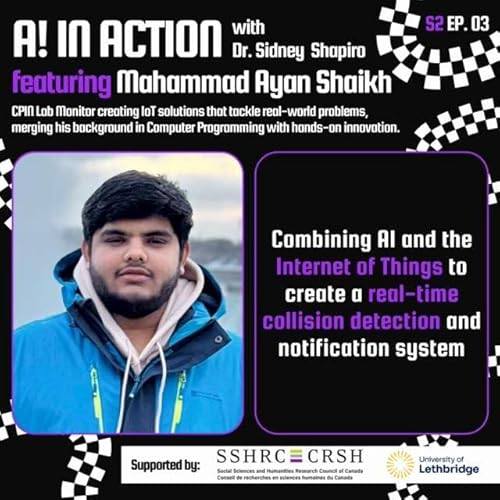
  • S2E3 - Mahammad Ayan Shaikh on Building Real-Time AI Collision Detection with IoT
    2026/02/16
    Mahammad Ayan Shaikh on Building Real-Time AI Collision Detection with IoT

    In this episode of AI in Action, Dr. Sidney Shapiro sits down with Mahammad Ayan Shaikh, Computer Programming student and CPIN Lab Monitor at Cambrian College, to explore how artificial intelligence and the Internet of Things are converging to power the next generation of embedded systems. Drawing from his hands-on experience designing and troubleshooting IoT prototypes, Mahammad discusses how AI enhances connected devices by transforming real-time sensor data into intelligent, autonomous decision-making.

    The conversation highlights one of his most ambitious projects: a real-time collision-detection and automated emergency-notification system. Designed to activate in the event of an accident, the system detects impact, captures GPS location and environmental data, and transmits critical information to emergency contacts or services. Through this example, listeners gain insight into the technical and operational challenges of integrating hardware, sensors, edge processing, and secure data transmission into a reliable safety solution.

    Dr. Shapiro and Mahammad also examine broader trends shaping the industry, including the rise of edge computing, increased device-level intelligence, and the shift away from cloud-dependent architectures. They address the growing importance of cybersecurity, encryption, and responsible data governance as IoT devices collect and process sensitive information at scale. The episode further explores the gap between academic prototypes and real-world deployment, outlining the technical, organizational, and talent-related barriers businesses face when adopting AI-driven IoT solutions.

    For students and professionals entering the field, Mahammad shares practical advice on building foundational programming skills, working with microcontrollers such as Arduino and Raspberry Pi, and gaining hands-on experience through applied projects. This episode provides a grounded perspective on how embedded systems, AI, and IoT are reshaping industries through intelligent automation, real-time responsiveness, and connected innovation.

    Find out more at https://ai-in-action.pinecast.co

    続きを読む 一部表示
    11 分
  • S2E2 - AI, Nonprofits, and Social Change with Janelle Marietta
    2026/02/09

    In this episode of AI & Impact, Dr. Sidney Shapiro speaks with Janelle Marietta, PhD candidate, instructor, and nonprofit leader, about the growing role of artificial intelligence in nonprofit organizations, education, and community-based work.

    The conversation explores how AI tools can help nonprofits address long-standing capacity challenges, improve marketing and donor engagement, and support evaluation and analysis—while also highlighting the risks of over-reliance on automation, biased data, and inauthentic communication.

    Key topics include ethical considerations in AI adoption, the limits of AI in qualitative and community-engaged research, and the importance of maintaining human-centered approaches in equity-focused and decolonization work. Janelle also discusses the skills nonprofit leaders and emerging professionals need to use AI effectively and responsibly, even in low-resource environments.

    This episode is particularly relevant for nonprofit leaders, educators, researchers, and students interested in social impact, community development, and responsible AI use.

    Find out more at https://ai-in-action.pinecast.co

    続きを読む 一部表示
    19 分
まだレビューはありません