

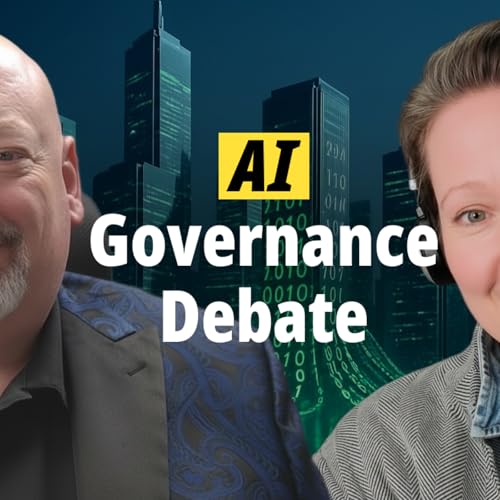
AI: Regulated Utility or Private Power
カートのアイテムが多すぎます
カートに追加できませんでした。
ウィッシュリストに追加できませんでした。
ほしい物リストの削除に失敗しました。
ポッドキャストのフォローに失敗しました
ポッドキャストのフォロー解除に失敗しました

AI: Regulated Utility or Private Power
-
ナレーター:
-
著者:
Guests:
Bianca Wylie is an entrepreneur and a public interest technology advocate. She is the founder of T&S Advisory, a consulting firm that offers strategic innovation guidance and capacity-building for small and medium-sized businesses and non-profit organizations. She is also a partner at Digital Public, where she works on public interest technology governance.
More info: innovatehow.com
Scott Beck is CEO of the fast-growing Cyber Security & IT Services firm BeckTek. He’s a two-time international best-selling author and award-winning speaker, including appearances at NASDAQ and Harvard Club of Boston. Co-star of the Amazon documentary “Cyber Crime” and “Cyber Crime:Fallout”, Scott is a frequent TV celebrity guest expert with appearances on CTV, Global, NBC, ABC, CBS, Fox, and The CW.
More info\: www.becktek.ca
Summary
This conversation delves into the complexities of artificial intelligence (AI), focusing on its governance, societal implications, and the urgent need for responsible use. Bianca Wiley and Scott Beck discuss the challenges of regulating AI, the role of government, and the importance of critical thinking in an AI-driven world. They emphasize the need for a mixed approach to regulation, the risks associated with AI misuse, and the cultural shifts that accompany technological advancements. The discussion also highlights privacy concerns and the necessity for ongoing dialogue about the ethical implications of AI in society.
Takeaways
- AI governance requires a nuanced understanding of its applications.
- High-level discussions often overlook specific industry contexts.
- Existing laws and policies can be adapted for AI without starting from scratch.
- The government faces challenges in regulating AI due to economic incentives.
- Privacy laws are currently inadequate to protect users.
- AI's rapid development outpaces regulatory frameworks.
- Cultural implications of AI use must be considered in education.
- Critical thinking is essential in an AI-driven society.
- Standards bodies are working on AI guidelines, but enforcement is lacking.
- The future of AI regulation in Canada may align more with European models.
Titles
Navigating the AI Landscape: Governance and Ethics
The Future of AI: Risks and Responsibilities
Chapters
00:00 Introduction to AI and Its Challenges
02:10 Governance and Oversight of AI
08:11 Public vs. Private Control of AI
14:54 Understanding AI's Risks and Misconceptions
28:14 Defining Responsible AI Usage
34:35 Self-Governance in AI Utilization
36:49 The Complexity of Technology and Institutional Failures
38:03 The Double-Edged Sword of AI
40:14 Privacy Concerns in the Age of AI
43:27 The Illusion of Privacy and Data Security
48:35 Generative AI vs. Traditional AI: A Comparative Analysis
54:16 Regulatory Challenges and the Future of AI
58:19 The Impact of Regulation on Innovation
01:07:19 The Risks of Decision-Making AI
Keywords
artificial intelligence, AI governance, AI regulation, privacy concerns, cybersecurity, decision making, technology ethics, societal impact, responsible AI, Canadian AI policy