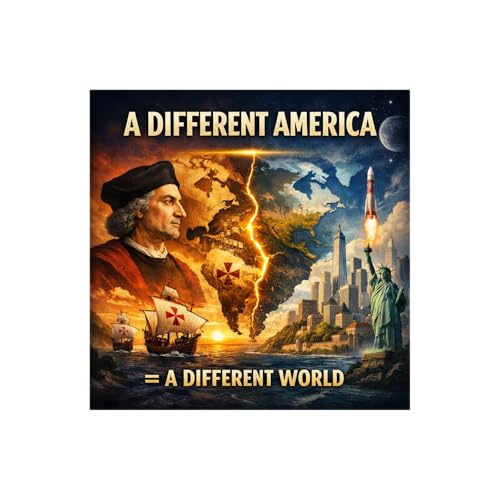
『A Different America = A Different World』のカバーアート

A Different America = A Different World

A Different America = A Different World

著者: Alan Maldam
無料で聴く

今ならプレミアムプランが3カ月 月額99円

2026年5月12日まで。4か月目以降は月額1,500円で自動更新します。

概要

What if a single decision changed the course of history?

The podcast A Different America explores alternative perspectives on key moments in history — especially the age of the discovery of the New World. Each episode examines what might have happened if events had unfolded differently: if Columbus had served another nation, if great powers had made different choices, or if crucial decisions had been accepted or rejected in ways that reshaped the modern world.

The series combines documentary-style analysis with carefully constructed alternative scenarios. It is grounded in real historical facts, political contexts, and the possibilities of the time, and then explores how Europe, the Americas, and global civilization might have developed differently.

This is not fiction without foundation. It is a thoughtful exploration of how little it might have taken for today’s world to be entirely different.

Because a different America means a different world.

Alan Maldam
世界
エピソード
  • South America, Africa, Asia, Australia and New Zealand
    2026/04/16

    What happens when the center of the modern world shifts—not just in America, but everywhere?

    In this episode, we step beyond the Atlantic and explore how a French-led discovery of the New World reshapes the entire global system. If Christopher Columbus sails for France instead of Spain or Portugal, the consequences ripple across continents—from South America to Africa, Asia, and Oceania.

    South America no longer becomes a unified Iberian world. Instead, it fragments into a mosaic: French-influenced northern regions, a powerful Portuguese Brazil, and contested Andean zones where empires, resources, and Indigenous resilience collide.

    In Africa, French influence grows earlier along the Atlantic coast, especially in the west. Trade, forts, and later colonial structures expand—but without full domination. The continent remains divided, shaped by competition rather than control.

    Asia becomes a three-way chessboard between France, Portugal, and Britain. French presence is less aggressive than Iberian conquest, but more stable—built on trade, diplomacy, and long-term influence. India, Southeast Asia, and China all become arenas of balance rather than domination.

    And in Oceania, nothing is purely British. Australia and New Zealand emerge as contested spaces—Franco-British worlds where language, culture, and power overlap instead of align.

    The result? Not a world dominated by one empire, but a multipolar system from the very beginning. No single global language fully prevails. No single power defines the rules. Instead, modern history unfolds as a constant negotiation between competing centers of power.

    This episode reveals the deepest consequence of all: change one decision in the 15th century, and you don’t just redraw maps—you rewrite the logic of the entire world.

    続きを読む 一部表示
    8 分
  • The World in 2026 in French America (1800–2026)
    2026/04/16

    What would the modern world look like if the Americas had grown not from Spanish decline and Anglo-American ascent, but from the long legacy of a vast French Atlantic empire?

    In this episode, we follow the world of French America from 1800 to 2026. At the dawn of the nineteenth century, the French Empire in the Americas stands powerful but unstable—rich in trade, cities, and influence, yet already shaken by revolution, colonial tension, and the growing ambitions of its own American elites.

    As the old empire fractures, new Francophone states emerge across North America, Mexico, and the Caribbean. Instead of one dominant United States, the Western Hemisphere develops as a complex network of French-speaking republics, federations, and postcolonial powers. The Industrial Revolution spreads through a different Atlantic world. The world wars are fought with a stronger Francophone-American axis. The Cold War unfolds in a more multipolar West. And globalization becomes less purely Anglo-American, with French retaining far greater global weight in diplomacy, culture, and power.

    By 2026, this is a world where France is no longer an empire in the old sense, but the historic center of a vast transatlantic civilizational sphere. The Americas are no longer defined by an Anglophone North and a Latin South, but by a broad Francophone presence stretching from northern industrial states to Caribbean societies and a great Mexican core.

    This episode explores how one royal decision at the end of the fifteenth century could have reshaped the entire modern age—creating not an American century, but a French Atlantic world.

    続きを読む 一部表示
    25 分
  • The French Empire in America (1500–1800)
    2026/04/16

    What happens after discovery—when a landing becomes an empire?

    In this episode, we follow the rise of a world where France, not Spain, becomes the first great Atlantic power. After Christopher Columbus opens the western route under the French banner, discovery quickly turns into domination: island bases become permanent colonies, coastal outposts become cities, and trade routes become the arteries of a new French America.

    From the Caribbean to Mexico and deep into North America’s river systems, France builds a vast imperial space shaped by governors, merchants, missionaries, soldiers, and settlers. Plantation wealth, precious metals, fur routes, and Atlantic trade bind the New World to Paris, Bordeaux, and Saint-Malo—while French language, law, religion, and urban culture spread across continents.

    But empire never grows without cost. Alongside splendor come slavery, disease, violence, and the destruction of Indigenous worlds. The same colonial system that brings France power and prestige also creates deep tensions—between Crown and colonists, between wealth and injustice, between empire and the people living under it.

    By 1800, French America stands rich, vast, and powerful—but already unstable. Enlightenment ideas, colonial elites, enslaved populations, and regional identities begin to pull against the empire that created them.

    This episode explores three centuries in which France does not merely build colonies, but creates an entire Atlantic civilization—one that could have changed the language, power, and destiny of the modern world.

    続きを読む 一部表示
    25 分
まだレビューはありません