エピソード

  • EP429 How to Find Off-Market Real Estate Deals with Bryan Driscoll
    2026/07/16
    Finding great real estate deals starts with finding motivated sellers—and that's exactly what we dive into in this episode. I sit down with digital marketing expert and real estate investor Brian Driscoll to discuss how investors can generate high-quality direct-to-seller leads using Google Ads and other inbound marketing strategies. We compare inbound marketing with traditional methods like cold calling, driving for dollars, and purchased lists, and explain when each approach makes the most sense as your investing business grows. Brian also shares the systems successful investors use to convert more leads into deals, including why speed to lead is one of the biggest factors in closing profitable opportunities. We discuss CRMs, automation, lead management, negotiation, and why approaching sellers with a problem-solving mindset consistently outperforms high-pressure sales tactics. Whether you're wholesaling, flipping, buying rentals, or using creative financing strategies like lease options and seller financing, this episode is packed with practical advice to help you find more off-market opportunities and scale your real estate business.
    続きを読む 一部表示
    25 分
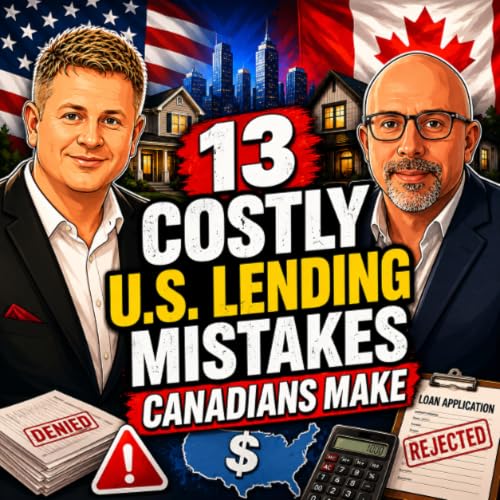
  • EP428 13 Costly U.S. Lending Mistakes Canadians Make with Chris Micucci
    2026/07/09
    Canadians investing in U.S. real estate often assume the financing process works just like it does at home—but that assumption can lead to costly mistakes. In this episode, Glen Sutherland sits down with cross-border mortgage expert Chris Micucci to break down the biggest lending misconceptions Canadian investors make and explain how U.S. investment financing really works. From DSCR loans and reserve requirements to closing costs, corporate structures, wire transfers, and choosing the right lender, you'll learn the practical lessons that can save you thousands of dollars and prevent deals from falling apart. Whether you're buying your first U.S. rental or expanding your portfolio, this episode will help you avoid the mistakes that catch many Canadian investors off guard. glensutherland.com/lenders The 13 Lending Mistakes Canadians Make: 1. Thinking you qualify based on your personal income Many Canadians assume U.S. lenders care about salary, T4s, tax returns, or employment. For DSCR loans, the property qualifies—not you. 2. Assuming you need perfect personal finances to buy Canadians often believe they need extensive financial documentation. In reality, many U.S. investment loans primarily focus on the property's cash flow and your down payment funds. 3. Believing Canadian mortgage rules apply in the U.S. Many investors expect pre-approvals, qualification rules, and lending policies to work the same way they do in Canada. They don't. 4. Getting pre-approved before finding the property In Canada, you're approved for a dollar amount. In the U.S., you're generally approved for a specific property that cash flows. Many Canadians misunderstand this difference. 5. Buying properties that are too inexpensive Ironically, smaller loan amounts are often harder to finance because many lenders prefer larger loans and higher-value properties. 6. Being surprised by U.S. closing costs Many Canadians experience sticker shock because title fees, lender fees, appraisals, escrow deposits, and other costs are itemized instead of hidden in the mortgage. 7. Waiting until the last minute to transfer money International wire transfers can be delayed by compliance reviews or audits. Waiting until the week of closing can jeopardize the deal—and potentially your earnest money deposit. 8. Waiting too long to set up your U.S. entity and EIN Many investors don't realize that obtaining an EIN can take weeks, especially during busy IRS periods. Waiting can delay financing and closing. 9. Setting up the wrong ownership structure Some Canadian tax structures work well legally but are difficult—or impossible—for many U.S. lenders to finance. Structuring without considering lending requirements can create expensive delays. 10. Not having enough reserve funds Many first-time investors budget only for their down payment. Most lenders also expect to see several months of mortgage reserves in a U.S. bank account. 11. Shopping only by interest rate A lower rate isn't always the better loan. Points, lender fees, closing costs, and how long you plan to hold the property all matter. 12. Comparing different loan products as if they're identical Many investors compare refinance quotes, construction loans, fix-and-flip loans, and purchase loans without realizing they're completely different products. 13. Using lenders who don't understand Canadian investors One of the biggest mistakes is working with lenders who primarily serve Americans. They may quote attractive terms initially, only for underwriting to discover you're Canadian and change the loan shortly before closing
    続きを読む 一部表示
    38 分
  • EP427 How to Build Passive Income Though Manufactured Home Parks with Ali Nasir
    2026/07/02
    In this episode of Canadian Investing in the USA, Glen Sutherland sits down with mobile home park investor and fund manager Ali Nazar to explore why manufactured housing communities have become one of the most resilient and attractive real estate asset classes. Ali shares his family's multi-generational real estate journey, beginning with single-family rentals and transitioning into mobile home parks after the high-interest-rate environment of the early 1980s. Drawing on more than 45 years of experience, he explains how affordable housing demand, tenant-owned homes, and diversified income streams have helped manufactured housing communities weather multiple recessions and market downturns while continuing to provide stable cash flow and long-term wealth creation. The conversation dives deep into how successful mobile home park operators create value through infill strategies, seller financing, and converting park-owned homes into resident-owned homes. Ali discusses the importance of scale, why he targets communities with 50+ sites, and how investors can avoid common underwriting mistakes when evaluating park-owned homes versus lot-rent income. Glen and Ali also explore financing options, tenant retention, rent growth, operational efficiencies, and the advantages of owning affordable housing in today's economic environment. Whether you're an experienced investor looking to diversify or someone curious about manufactured housing for the first time, this episode provides a practical look at how mobile home parks can deliver strong returns while serving a critical housing need.
    続きを読む 一部表示
    37 分
  • EP426 How To Use AI to Build Authority and Grow Your Business Faster with Thomas Harpointner
    2026/06/25
    In this episode of Canadian Investing in the USA, Glen Sutherland sits down with digital marketing expert and AIS Media founder, Thomas Harpointner, to discuss one of the biggest shifts happening online today: the rise of AI-powered search. Thomas explains how tools like Google Gemini, ChatGPT, and other AI platforms are changing the way consumers find information and how businesses attract customers. While many companies are seeing website traffic decline as AI provides answers directly within search results, Thomas reveals why this isn't necessarily bad news. In many cases, businesses are receiving fewer but far more qualified leads because AI is helping educate prospects before they ever visit a website. The conversation dives into practical strategies for ensuring your business remains visible in an AI-driven world. Thomas shares why content is still king, how authority and credibility influence AI recommendations, and why podcasts, videos, blogs, social media, and industry publications all play a role in building digital authority. He also discusses the importance of structured content, SEO fundamentals, thought leadership, and understanding what your ideal customer is actually searching for rather than relying on assumptions. For business owners, investors, and entrepreneurs looking to stay relevant as AI reshapes online discovery, this episode offers valuable insights into how to position yourself as a trusted authority that AI platforms will reference and recommend.
    続きを読む 一部表示
    30 分
  • EP425 How Canadians Can Get U.S. DSCR Loans for Real Estate Investing with Brad Beauchamp
    2026/06/18
    Brad Beauchamp, a Canadian mortgage broker based between Vaughan and West Palm Beach, joins Glen Sutherland to explain how Canadians can finance U.S. real estate investments using DSCR loans and cross-border lending strategies. Brad shares his own immigration journey from obtaining an L1 executive visa to eventually becoming a U.S. citizen, before diving into the opportunities available for Canadian investors south of the border. The conversation highlights how DSCR (Debt Service Coverage Ratio) loans allow investors to qualify based primarily on a property’s cash flow instead of personal income or employment verification, making it easier for Canadians to scale portfolios in markets like Florida, Ohio, Texas, and Alabama. Brad explains that while Canadians can secure financing without U.S. credit history, investors with U.S. tax IDs, entities, residency ties, or established FICO scores can often access lower rates and better leverage. The episode also focuses heavily on structuring and protecting investments properly when buying U.S. real estate. Brad and Glen discuss the importance of setting up U.S. LLCs, understanding cross-border taxation, using professional advisors, and avoiding common mistakes such as holding properties personally instead of through entities. They explain hidden costs Canadians often overlook — including underwriting fees, loan origination fees, title fees, prepayment penalties, and refinancing costs — while emphasizing that proper planning can save investors significant money long term. The discussion covers partnerships with Americans, refinancing strategies, seasoning periods, and how the larger U.S. market creates more financing flexibility and opportunity than Canada. Overall, the interview serves as a practical guide for Canadians who want to leverage U.S. financing, build cash-flowing portfolios, and avoid costly structural and lending mistakes. Find out what type of US real estate investment would fit you best at: https://acanadianinvestingintheusa.com/QUIZ
    続きを読む 一部表示
    26 分
  • EP424 How to Manage Student Rentals Remotely in the USA from Canada with Benny Dadlani
    2026/06/11
    Benny Delaney shares his journey from growing up in India, building a business and investing in ultra-expensive real estate in Hong Kong, and eventually immigrating to Canada in 2017 for his children’s future. After buying duplexes in Oshawa and Peterborough, Benny discovered U.S. real estate investing through Glen Sutherland’s coaching and became attracted to the flexibility of DSCR loans in the United States. Unlike Canadian lenders that focused heavily on proving employment income, Benny found that U.S. lenders cared more about the property’s cash flow potential. This allowed him to scale into properties in Florida and Detroit despite being semi-retired and no longer operating an active business. The interview also dives deeply into Benny’s strategy of remotely managing student rentals in Florida from Toronto. He explains how building a reliable local team — including realtors, plumbers, HVAC contractors, cleaners, and leasing support — made remote investing practical. Benny discusses handling student tenants, lease-ups, payment systems, maintenance requests, and tenant screening while emphasizing that real estate investing is ultimately a business built around problem-solving. The conversation highlights the difference between investing for appreciation versus investing for cash flow, with Benny prioritizing higher-income properties like student rentals and Airbnbs to support his semi-retired lifestyle. The episode offers valuable insight for Canadians looking to invest remotely in U.S. markets while leveraging creative financing and higher cash-flow opportunities unavailable in many Canadian cities. What type of Investor are you? Take the Quiz? https://acanadianinvestingintheusa.com/quiz
    続きを読む 一部表示
    40 分
  • EP423 How to Protect Your Real Estate Portfolio from Taxes and Probate Fees with Mark Halpern
    2026/06/04
    In this episode of Canadian Investing in the US, Glen Sutherland sits down with estate planning expert Mark Halpern to unpack the critical importance of proactive estate planning for investors and families. Mark shares personal insights that shaped his career and emphasizes the dangers of failing to plan—highlighting how something as simple as not having a will can create financial hardship and unnecessary stress for loved ones. The conversation explores foundational elements like wills, powers of attorney, and the risks of dying intestate, especially for Canadians with families and real estate holdings. The discussion goes deeper into advanced strategies, including probate tax minimization, multiple wills, and the strategic use of tax-exempt life insurance to preserve wealth and cover future tax liabilities. Mark also introduces the concept of an “estate directory” to ensure loved ones can easily access critical information in emergencies. Together, Glen and Mark emphasize that successful investing isn’t just about building wealth—it’s about protecting it, transferring it efficiently, and avoiding costly mistakes through proper planning and the right professional team. What US real estate strategy would work best for you? https://acanadianinvestingintheusa.com/QUIZ
    続きを読む 一部表示
    25 分
  • EP422 How to Reduce Your Taxes on a Rental Property in the USA with Tim Miron
    2026/05/28
    In this episode of Canadian Investing in the US, host Glen Sutherland welcomes recurring guest and CPA Tim Miron of Pursuit CPA to discuss strategies Canadian investors can use to reduce taxes on U.S. rental properties. Tim explains the difference between passive and active income taxation, noting that rental income earned inside a corporation can be taxed at rates approaching 50%, while active business income in a Canadian corporation may be taxed as low as 12% in Ontario. The conversation focuses on a strategy where a Canadian corporation acts as a property management company for U.S. rental properties, charging management fees to the U.S. entity and converting part of the rental income into lower-taxed active income. Tim emphasizes the importance of charging realistic management fees, maintaining proper invoicing, and ensuring the arrangement reflects legitimate property management activity. Glen and Tim also discuss practical considerations such as bookkeeping complexity, moving money consistently between entities, and how these strategies change depending on whether investors are holding stabilized rentals, actively renovating properties, or operating other active businesses. Tim explains that rehab projects may justify significantly higher management fees due to the increased workload, while investors already generating active business income through flipping or property management may have alternative tax planning options available. Throughout the episode, the two stress the importance of proper structuring and working with experienced cross-border tax professionals to ensure compliance and maximize tax efficiency for Canadian investors operating in the U.S. real estate market.
    続きを読む 一部表示
    15 分