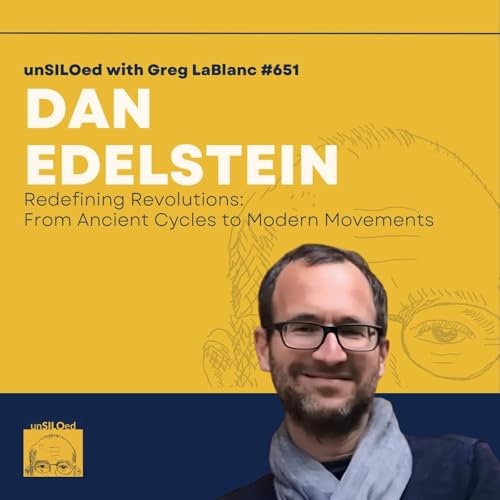
『651. Redefining Revolutions: From Ancient Cycles to Modern Movements with Dan Edelstein』のカバーアート

651. Redefining Revolutions: From Ancient Cycles to Modern Movements with Dan Edelstein

651. Redefining Revolutions: From Ancient Cycles to Modern Movements with Dan Edelstein

無料で聴く

ポッドキャストの詳細を見る
Dan Edelstein is a professor of French, history, and political science at Stanford University. He’s also the author of several books on revolution and the Enlightenment, including The Revolution to Come: A History of an Idea from Thucydides to Lenin, Let There Be Enlightenment: The Religious and Mystical Sources of Rationality, Scripting Revolution: A Historical Approach to the Comparative Study of Revolutions, and The Enlightenment: A Genealogy. Greg and Dan discuss the changing meaning of “revolution” as an idea rather than a catalog of revolts. Dan explains how Greeks distinguished violent upheaval (stasis) from regime change, how “revolution” entered political vocabulary via Polybius’s rediscovered Book VI, and how fears of cyclical instability shaped mixed-constitution thinking from antiquity to the American founders. They contrast pre-1789 “revolution” as restoration (including England’s Glorious Revolution) with the French Revolution’s progress-driven, consensus-seeking model that produces counterrevolution, factional purges, and a “Red Leviathan.” The discussion covers Enlightenment cultural uses of “revolution,” the ancients-vs-moderns debate and historical progress, differences between Anglo-American common-law rights and French state-centered reform, the tainted term in 1989, revolutionary “playbooks,” and how literary training and novels illuminate revolutionary psychology. *unSILOed Podcast is produced by University FM.* Episode Quotes: From preserving order to accelerating history 12:42: Once this new-fangled idea of historical progress starts to get going in France in the 18th century, suddenly you can have a totally different vision of yourself. You're not just trying to prevent change and maintain the existing situation as long as you can. Suddenly, you might become an accelerator—you might become—and this is when the word "revolutionary" emerges in France, in 1789—you want to be on the right side of history. You want to be, you know, in favor of progress. And so I think that this new idea, both about history and about the role of revolutions in this sort of progressive vision of history, it really has huge effects on how people think about themselves, how they act, and ultimately how these historical revolutions from 1789 onward play out. Why ancient thinkers designed politics to prevent revolution 06:52: For people, even before Polybius, people like Plato and Aristotle, this did become the question of political thought. Like, how do you prevent a state from being ripped apart by division and just leading to this kind of destruction and death that accompanies revolutions? And this is where we get the idea of a well-balanced constitution. Protection vs. power  39:02: The English and the Americans, you know, there's just this deep skepticism towards the government. You want to really protect the individual from governmental encroachment. The French are almost coming to the revolution wanting to empower the government for good, like it's going to solve all our problems. Show Links: Recommended Resources: Age of EnlightenmentRevolutionPolybiusNiccolò MachiavelliVoltaireMontesquieuJohn AdamsAnacyclosisVladimir LeninVelvet RevolutionMarquis de CondorcetAnne Robert Jacques TurgotBarebone's ParliamentMillenarianismJ. G. A. PocockNorman CohnStefanos Geroulanos Guest Profile: Faculty Profile at StanfordProfile at the Hoover InstitutionSocial Profile on X Guest Work: Amazon Author PageThe Revolution to Come: A History of an Idea from Thucydides to LeninOn the Spirit of RightsNetworks of Enlightenment: Digital Approaches to the Republic of LettersLet There Be Enlightenment: The Religious and Mystical Sources of RationalityScripting Revolution: A Historical Approach to the Comparative Study of RevolutionsThe Enlightenment: A GenealogyThe Terror of Natural Right: Republicanism, the Cult of Nature, and the French RevolutionThe Super-Enlightenment: Daring to Know Too MuchYale French Studies, Number 111: Myth and ModernityGoogle Scholar Page Hosted by Simplecast, an AdsWizz company. See pcm.adswizz.com for information about our collection and use of personal data for advertising.
adbl_web_anon_alc_button_suppression_c
まだレビューはありません