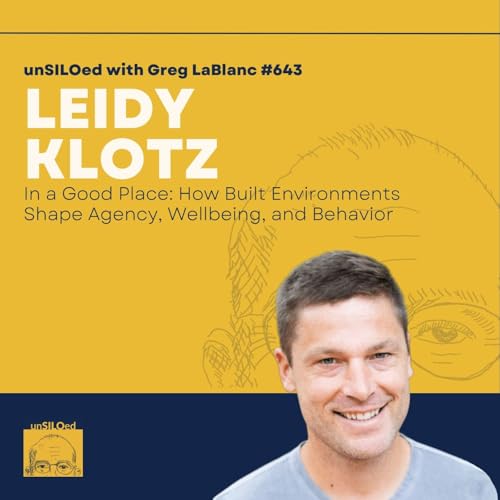
『643. In a Good Place: How Built Environments Shape Agency, Wellbeing, and Behavior with Leidy Klotz』のカバーアート

643. In a Good Place: How Built Environments Shape Agency, Wellbeing, and Behavior with Leidy Klotz

643. In a Good Place: How Built Environments Shape Agency, Wellbeing, and Behavior with Leidy Klotz

無料で聴く

ポッドキャストの詳細を見る

今ならプレミアムプランが3カ月 月額99円

2026年5月12日まで。4か月目以降は月額1,500円で自動更新します。

概要

How has the new understanding of broken-windows theory helped to reinforce the importance of community ownership? How do built environments also transmit cultural messages? What does good workplace design actually look like? Leidy Klotz is a professor of engineering, architecture, and a behavioral scientist. He’s also the author of three books: Subtract: The Untapped Science of Less, Sustainability through Soccer: An Unexpected Approach to Saving Our World, and the latest, In a Good Place: How the Spaces Where We Live, Work, and Play Can Help Us Thrive. Greg and Leidy discuss Leidy’s new book on how the spaces where people live, work, and play affect wellbeing, behavior, and thriving, and why research on the mind–environment intersection remains fragmented across psychology, engineering, architecture, and HR. They discuss habituation and inattention (people missing what should be easily noticeable features like a fire extinguisher or UVA’s Memorial Gym), subconscious environmental impacts (noise stress, off-gassing), and the human need for agency through personalizing spaces, with examples from offices, nursing homes, refugee housing, and Mandela’s prison garden. *unSILOed Podcast is produced by University FM.* Episode Quotes: Why are humans designed to shape their surroundings 11:53: We talked before about, you know, kind of like these robust ideas from psychology, and one of the most robust is this need for agency, right? The need to have a say in our surroundings. And, you know, if you say, “Where does it come from?” The farthest back. It’s like our ancestors roaming around without shelter were more likely to survive if they felt compelled to interact with their surroundings, to make their surroundings more habitable to themselves. Right? And so, if you thought about it, you were pulled psychologically to rear range things or to, you know, move things around to keep the weather away or to keep predators away, you were more likely to survive. And so, that need to interact with our surroundings, right? And now you can get that in a bunch of ways. You can get agency by going to a meeting, but it is still there in that kind of original interaction with our surroundings. Novelty vs. nostalgia 24:26: Novelty is never going to be more than at the beginning. And so, the things that you like about novelty are going to decrease. And then the things that you like about nostalgia are going to increase over time. And so, I think it's just something to really pay close attention to in our surroundings, because it's pretty easy to just go for the novelty. What is the IKEA effect? 13:34: So the IKEA effect is just exactly like it sounds, right, that people build something and that the value that they attribute to the thing is like the material value plus their labor value. So, it's certainly related, and I think the refugee housing is something that they just saw over and over through trial and error. Was that, when people had some say in the things that they built, they felt more ownership over it? So I'd say the IKEA effect is like you're assigning more value to it. Show Links: Recommended Resources: Environmental PsychologyMethod of LociEllen LangerIKEA EffectHabitat for HumanityBroken Windows TheoryEudaimoniaDacher KeltnerUnSILOed #140: Leidy Klotz - The Art of Subtraction Guest Profile: LeidyKlotz.comFaculty Profile at the University of VirginiaLinkedIn ProfileWikipedia Page Guest Work: Amazon Author PageIn a Good Place: How the Spaces Where We Live, Work, and Play Can Help Us ThriveSubtract: The Untapped Science of LessSustainability through Soccer: An Unexpected Approach to Saving Our WorldGoogle Scholar Page Hosted by Simplecast, an AdsWizz company. See pcm.adswizz.com for information about our collection and use of personal data for advertising.
adbl_web_anon_alc_button_suppression_c
まだレビューはありません