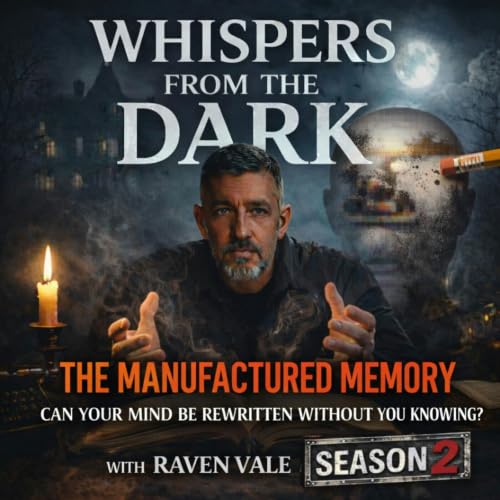
『59: The Manufactured Memory: Can Your Mind Be Rewritten Without You Knowing?』のカバーアート

59: The Manufactured Memory: Can Your Mind Be Rewritten Without You Knowing?

59: The Manufactured Memory: Can Your Mind Be Rewritten Without You Knowing?

無料で聴く

ポッドキャストの詳細を見る
WHISPERS FROM THE DARK Episode: The Manufactured Memory: Can Your Mind Be Rewritten Without You Knowing? Host: Raven Vale | Fuzzy Life Studios Think about your earliest memory. Hold it. Now ask yourself — how do you know it's real? Not that it feels real. Not that you believe it. That it actually happened the way you remember it. In this episode of Whispers from the Dark, Raven Vale examines one of the most unsettling findings in the history of psychology: that human memory is not a recording. It is a reconstruction. And reconstructions can be altered, distorted, and — under the right conditions — built entirely from scratch. In the early 1990s, cognitive psychologist Elizabeth Loftus ran a series of experiments that proved ordinary people could be induced to form vivid, detailed, emotionally convincing memories of events that never happened. Between 20 and 40 percent of participants developed full false memories after simple suggestion, repetition, and emotional reinforcement. When told the truth, many refused to believe it. The memory felt real. To the brain that built it — it was. From Loftus's laboratory to the recovered memory controversy of the 1980s and 90s — where false memories destroyed families and sent innocent people to prison — to declassified government programs that explored psychological conditioning, to the algorithm-driven information architecture of the modern world, this episode traces the full arc of what happens when the mechanism of memory is understood not just as a curiosity… But as a tool. Memory is the foundation of identity. It is the ground beneath everything you believe about who you are and what happened to you. This episode asks what it means to live on ground that can be quietly rearranged. Whispers from the Dark explores the unseen forces shaping human behavior — psychological, historical, philosophical. New episodes drop weekly. Subscribe wherever you listen. Episode Length: ~30–35 minutes Content Advisory: Psychological themes, discussion of false memory, institutional manipulation Series: Whispers from the Dark | Fuzzy Life Studios Your memory isn't a recording. It's a reconstruction. And reconstructions can be rewritten. Raven Vale on the science — and the danger — of manufactured memory. Elizabeth Loftus false memories can memories be implanted how memory is reconstructed recovered memory controversy memory manipulation psychology eyewitness testimony reliability manufactured memory dark psychology podcast can you implant a false memory in someone's mind how did Elizabeth Loftus prove false memories exist why eyewitness testimony is unreliable psychology recovered memory therapy and false memory syndrome how algorithms manipulate memory and belief what is the difference between a real and false memory psychology podcast about memory and identity can your past be rewritten without you knowing how does suggestion create false memories in the brain whispers from the dark psychology podcast Raven Vale #WhispersFromTheDark #FalseMemory #ElizabethLoftus #MemoryPsychology #ManufacturedMemory #DarkPsychology #RavenVale #FuzzyLifeStudios #CognitivePsychology #PsychologyPodcast #MindControl #MemoryManipulation #TruePsychology #HumanNature #WhoAmI Yes. Research by cognitive psychologist Elizabeth Loftus demonstrated that false memories can be reliably induced in a significant percentage of people through suggestion, repetition, emotional reinforcement, and the framing of a trusted authority. In her landmark studies, between 20 and 40 percent of participants developed fully formed, emotionally convincing memories of events — including being lost in a shopping mall as a child — that had never occurred. Many participants continued to insist the memories were real even after being told they were fabricated. Neurologically, there is no reliable internal difference. The brain does not tag memories as true or false — it tags them as familiar. False memories, once formed, exhibit the same emotional weight, sensory detail, and subjective certainty as genuine recollections. Confidence in a memory has been shown repeatedly to have almost no relationship to its accuracy. The primary distinction between real and false memories is external — it lies in whether the event occurred, not in how the memory feels from the inside. During the 1980s and 1990s, certain therapeutic practices encouraged patients to retrieve repressed memories of trauma through suggestion, hypnosis, and guided visualization. While genuine trauma can affect memory encoding and retrieval, research later demonstrated that many of the "recovered" memories produced in these sessions were false — constructed through the same mechanisms of suggestion and repetition documented in false memory research. In a number of cases, these false memories were used as the basis for criminal accusations, resulting in destroyed families and wrongful imprisonments. The controversy led to significant ...
adbl_web_anon_alc_button_suppression_t1
まだレビューはありません