

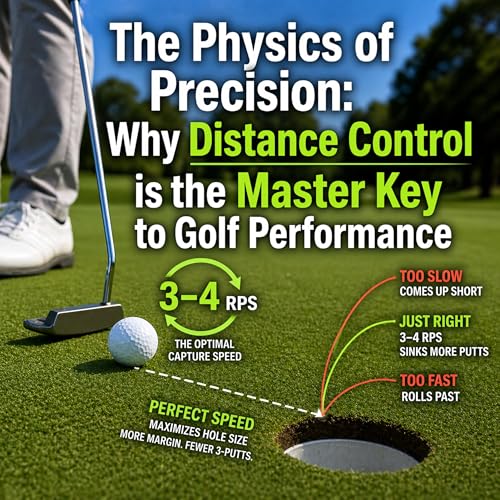
#572 The Physics of Precision: Why Distance Control is the Master Key to Golf Performance
カートのアイテムが多すぎます
カートに追加できませんでした。
ウィッシュリストに追加できませんでした。
ほしい物リストの削除に失敗しました。
ポッドキャストのフォローに失敗しました
ポッドキャストのフォロー解除に失敗しました

#572 The Physics of Precision: Why Distance Control is the Master Key to Golf Performance
-
ナレーター:
-
著者:
概要
Distance control—not line—is the foundation of scoring. Most golfers focus on direction, but three-putts come from poor speed. The Puttalyze system shifts attention from guesswork to measurable energy delivery, aiming to save at least one stroke per round. When speed is correct, the second putt falls inside a high-probability zone, reducing pressure and stabilizing performance.
The key benchmark is a capture speed of 3–4 revolutions per second (RPS) at the hole. At this speed, the ball maximizes the effective hole size, increasing tolerance on line. This is not “feel,” but a constant. By standardizing speed, the brain only needs to solve for line, making putting more predictable and efficient.
Green conditions define how energy behaves. Fast greens reduce friction, extend roll time, and increase break. Slow greens do the opposite. The longer the ball rolls, the more gravity influences its path. Uphill putts require more energy; downhill putts extend motion and increase break. Understanding this relationship between friction, time, and gravity is essential.
Misses provide valuable feedback.
- Short putts indicate energy deficits, deceleration, or hesitation at impact.
- Long putts result from excessive force, rushed tempo, or an “active hit” where the player overrides natural rhythm.
Consistency comes from stable tempo. The key is separating tempo (constant) from stroke length (variable). Distance should be controlled by stroke length, not by changing hand speed. Manipulating speed introduces inconsistency and disrupts natural flow.
The Puttalyze protocol builds this through repetition and feedback. Players assess misses immediately (feel) and review mechanics afterward (stroke length, tempo, green reading, roll quality). A smooth roll reflects proper rhythm; a “jump” or skid signals interference.
Three pillars of mastery:
- Calibrate to 3–4 RPS
- Maintain constant rhythm, vary stroke length
- Use misses as diagnostic feedback
Putting becomes predictable when physics and rhythm replace feel.
- 📺 The Explainer
- Puttalyze-App
- www.Golf247.eu