

#502 Engineering the Elite Swing: The Henrik Jentsch Method
カートのアイテムが多すぎます
カートに追加できませんでした。
ウィッシュリストに追加できませんでした。
ほしい物リストの削除に失敗しました。
ポッドキャストのフォローに失敗しました
ポッドキャストのフォロー解除に失敗しました

#502 Engineering the Elite Swing: The Henrik Jentsch Method
-
ナレーター:
-
著者:
概要
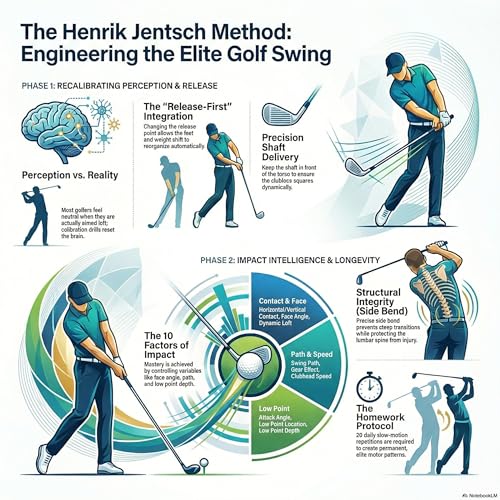
In this technical overview, Henrik Jentsch presents a golf instruction system built on biomechanics, perceptual recalibration, and measurable impact science. His philosophy is clear: “We do not guess. We measure.” The swing is not treated as an artistic mystery but as a system that can be engineered for precision, efficiency, and longevity.
The method begins with correcting visual alignment. Many golfers believe they are square to the target when, in reality, they are biased left or right. Through calibration drills, players learn to align the shaft and clubface accurately—even if the correct position initially feels uncomfortable. This recalibration of perception is foundational. Before mechanics improve, the brain must accept reality over feel.
Central to the system is the concept that the release organizes the body. Unlike approaches that focus first on footwork or rotation, Jentsch applies a cause-and-effect biomechanical model: the hands determine delivery, and delivery dictates body response. When the release point is corrected, the lower body reorganizes naturally. Weight shifts forward, the lead side stabilizes, and the kinematic sequence remains intact—without forced movements. The clubface squares dynamically as a consequence, not through manipulation.
Structural integrity is equally important. The method manages side bend carefully to protect the spine while maintaining power. Too little side bend produces steep, over-the-top transitions and slicing patterns. Too much side bend overloads the lumbar spine, especially the L4–L5 region, increasing injury risk. The goal is structural intelligence: balancing power, efficiency, and long-term physical health.
Impact is considered the only moment that truly matters. The system evaluates performance through ten measurable impact factors:
- Horizontal contact (heel–center–toe)
- Vertical contact (thin–center–fat)
- Face angle
- Dynamic loft
- Gear effect
- Swing path
- Attack angle
- Low point location
- Low point depth
- Clubhead speed
By refining the release and controlling shaft plane, players directly influence face orientation, path direction, shaft lean, and low point control. The result is improved compression, tighter dispersion, and greater efficiency—without increasing physical effort.
The process concludes with structured repetition. Slow-motion drills and controlled integration build stable motor patterns that hold under pressure. Random practice is replaced by intelligent training.
Ultimately, the Henrik Jentsch Method replaces guesswork with science. Through perception correction, biomechanical sequencing, and measurable impact control, it constructs a sustainable, high-performance golf swing engineered for both excellence and longevity.
- 📺 The Explainer
- www.Golf247.eu