エピソード

  • The Future of Healing: Stem Cells, Signals, and Regenerative Medicine
    2026/03/26

    What if the future of healing isn’t about replacing damaged tissue but teaching your body how to repair itself? In this episode of 4DSci, Victor Ciccarelli speaks with Dr. Tommy Rhee, a sports chiropractor who has worked with elite athletes including the Tampa Bay Buccaneers, Olympic competitors, and professional wrestlers. Dr. Rhee explains the emerging field of regenerative medicine and how modern research is shifting away from traditional stem cell injections toward cell free signaling therapies. The conversation explores how the body heals, why recovery slows as we age, and how new technologies may allow people to restore damaged tissue by reactivating the body’s natural repair signals. For listeners curious about the future of medicine, recovery, and longevity, this episode offers a fascinating look at where science may be headed.

    Amazon link https://a.co/d/0hD0GLsw

    www.RheeGen.com

    Support the show

    続きを読む 一部表示
    32 分
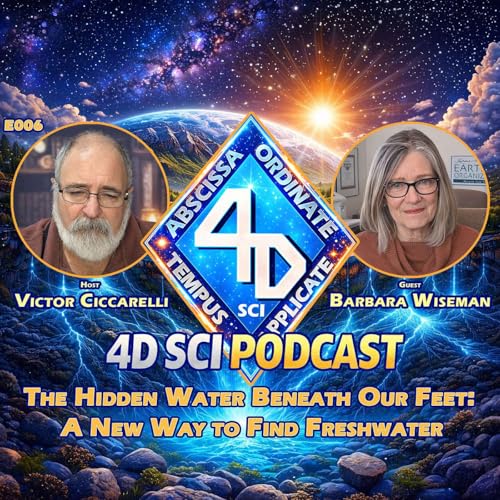
  • The Hidden Water Beneath Our Feet: A New Way to Find Freshwater
    2026/03/19

    Water is something most of us never think about. We turn on the tap and it simply appears. But beneath the surface of the Earth may be vast water resources that could help solve one of the biggest challenges facing the planet.

    In this episode, Victor Ciccarelli speaks with Barbara Wiseman, co founder and President of The Earth Organization. For more than two decades she has worked on environmental solutions around the world. Her organization is advancing a method called Deep Seated Water technology, a way of locating underground fissures that may contain water far deeper than traditional aquifers.

    From drought in the American Southwest to water shortages around the world, this conversation explores the science, the debate surrounding it, and what it could mean for the future of water.

    https://theearthorganization.org/

    Support the show

    続きを読む 一部表示
    41 分
  • From Dial Up to Surgical Robots: When Science Fiction Becomes Your Surgeon
    2026/03/12

    Dave Saunders has spent thirty years building technologies that quietly became everyday life. He helped bring commercial internet software to the world when most people did not even believe the internet mattered. He worked on the first commercial Wi Fi hotspot. And then he moved into something far more personal: surgical robotics.

    In this episode, we step away from hype and ask the question that actually matters. If a robot is involved in your surgery, where does the human end and the machine begin? What is real, what is still science fiction, and why should you care?

    This is a conversation about trust, technology, and what happens when the future moves from your laptop to your operating room.

    Support the show

    続きを読む 一部表示
    47 分
  • Blockchain Beyond the Hype: Who Controls Your Digital Future?
    2026/03/05

    Most people heard about blockchain through cryptocurrency, speculation, and headlines about scams. But underneath the noise is a deeper question: who controls trust in the digital world?

    In this episode of 4DSci, we step back with Roberto Capodieci and explore what blockchain was originally built to do. Not to create new coins, but to reduce dependence on centralized institutions and shift digital control back toward individuals.

    We talk about decentralization, digital identity, the promise and the overreach of Web3, and where real-world applications may quietly be emerging. This is not a technical deep dive. It is a conversation about power, trust, and what changes for you over the next decade.

    If you have ever wondered whether blockchain is a revolution, a distraction, or something in between, this episode will help you separate signal from noise.

    Support the show

    続きを読む 一部表示
    40 分
  • Why Scientists Are Rebuilding Meat From Plants
    2026/02/24

    Most of us never think about food beyond taste and convenience. But behind the scenes, scientists are quietly redesigning what food is and how it is made.

    David Julian McClements is a Distinguished Professor of Food Science who has spent his career studying how food works at a structural level. Not just what it contains, but how it behaves, how it can be engineered, and how science may reshape how we feed a growing planet.

    In this conversation, we explore why plant based foods exist, whether they are actually healthier, how meat can be grown without animals, and how 3D printed food may soon move from science fiction into everyday life.

    This is not about giving up meat. It is about understanding how food itself is changing.

    Support the show

    続きを読む 一部表示
    31 分
  • AI, Investing, and Wall Street with James Barrineau
    2026/02/13

    Artificial intelligence is steadily reshaping Wall Street. From compliance and credit analysis to investment research and trading tools, AI is speeding up the mechanics of finance. But speed is not the same as wisdom. In this episode of 4DSci, former Wall Street strategist James Barrineau joins us to explore what AI is actually doing inside the financial industry and where human judgment still matters most. We talk about accuracy, risk, emotional discipline, and whether everyday investors should trust AI driven tools with their money. It is a grounded conversation about where we are today and what the next decade of investing might really look like.

    Support the show

    続きを読む 一部表示
    35 分
  • AI, Flow State, and the Future of Learning Music with Patrick Boylan
    2026/02/13

    Music is something many of us meant to learn.

    Then life filled up. School moved on. And somewhere along the way, a lot of us quietly decided we just were not musical.

    In this episode of 4DSci, we sit down with Patrick Boylan to explore something deeper than music lessons. We talk about flow state, that focused space where challenge meets skill and time seems to disappear. And we look at how modern technology might be helping us find that state again.

    What happens when artificial intelligence is not trying to replace creativity, but instead supports it? What if learning music did not mean memorizing songs or grinding through theory, but instead meeting us exactly where we are?

    Patrick shares how real time feedback, adaptive systems, and AI assisted music generation are being used to rethink how we learn. Not just for students. Not just for professionals. But for adults who may finally have the time and curiosity to return to something they once loved.

    We also explore a bigger question. If technology can personalize music education in this way, what does that say about the future of learning itself?

    This conversation is not about hype. It is about understanding how tools evolve and how they can help us reconnect with focus, creativity, and maybe even a little joy.

    Because the future of technology is not just about what machines can do.

    It is about what we can experience with them.

    https://museflow.ai

    for a limited time 4DSCI50 - 50% off for life on any subscription to MuseFlow


    Support the show

    続きを読む 一部表示
    54 分