

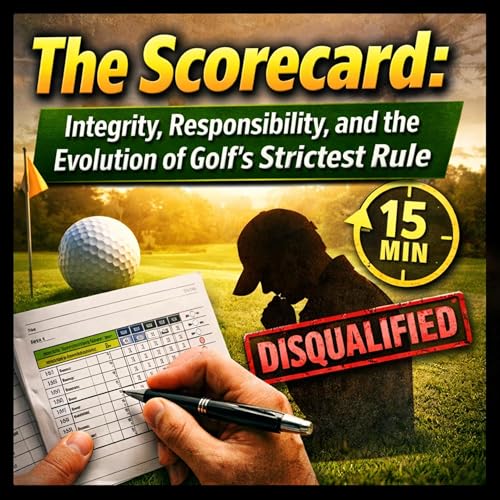
#492 The Scorecard: Integrity, Responsibility, and the Evolution of Golf’s Strictest Rule
カートのアイテムが多すぎます
カートに追加できませんでした。
ウィッシュリストに追加できませんでした。
ほしい物リストの削除に失敗しました。
ポッドキャストのフォローに失敗しました
ポッドキャストのフォロー解除に失敗しました

#492 The Scorecard: Integrity, Responsibility, and the Evolution of Golf’s Strictest Rule
-
ナレーター:
-
著者:
概要
Professional golf is defined not only by athletic excellence, but by uncompromising administrative integrity. Central to this is the scorecard, which under the Rules of Golf functions as a strict legal document. Players are fully responsible for the accuracy of their hole-by-hole scores and the proper authentication of the card, a principle historically governed by Rule 6-6 and now by Rule 3.3b.
Returning a score lower than actually taken on any hole results in immediate disqualification, regardless of intent or awareness of a penalty. Higher-than-actual scores stand without penalty. This strict liability exists to protect the integrity of competition and prevent score manipulation. By contrast, arithmetic errors in the total score are the responsibility of the Committee and do not lead to disqualification.
Administrative failures also carry severe consequences. A valid scorecard requires both the competitor’s and the marker’s signatures. Missing or incorrect signatures invalidate the card and historically resulted in mandatory disqualification. One of the most famous examples occurred at the 1997 Argentine Open, where Eduardo Romero and Vicente Fernández were disqualified after signing each other’s scorecards. Although both correctly recorded identical scores that tied Jim Furyk for the lead, the mismatch between names and signatures rendered the attestations void, and Furyk was declared the winner without a playoff.
Under the rules in force at that time, a scorecard was considered “returned” the moment a player physically left the scoring area. Any error discovered after crossing that boundary was irreversible. This physical definition of finality left no room for correction, even for purely administrative mistakes.
A major shift occurred in June 2024, when the PGA Tour and DP World Tour introduced a 15-minute correction window. Triggered by high-profile disqualifications, including Jordan Spieth at the 2024 Genesis Invitational, the new protocol redefined finality from a physical boundary to a time-based one. Once a scorecard is validated in the scoring system, players have 15 minutes to correct administrative errors such as missing signatures or swapped cards. Errors affecting score accuracy, however, remain uncorrectable and still lead to disqualification.
This evolution reflects a modern balance: preserving strict accountability for scoring data while preventing technical clerical mistakes from overriding the true athletic result.
- 📺 The Explainer
- www.Golf247.eu