• #HRTechChat: John Dnyprowsky & Ryan Shapiro on Why PEO Buyers Need a Translator
    2026/09/09
    In this episode of #HRTechChat, Nicole Roberts (Director & Principal Analyst, 3Sixty Insights) is joined by John Dnyprowsky—SVP of National Partnerships at Vensure Employer Solutions—and Ryan Shapiro—President & Founder of PEOMG and founder of the PEO Brokers Collective—for a conversation about a layer of the HR ecosystem most HR leaders don't know exists: the PEO broker. Ryan sorts buyers into five stages, from PEO-unaware to PEO-active, and puts roughly 60% of his own customers in the first two categories alone. That gap persists, he argues, because evaluating a PEO properly means running underwriting, tech demos, benefit-alignment calls, and financial reviews — and doing that credibly, more than once, isn't realistic for someone also running an HR department. A broker's job sits at the intersection of translation and validation: make a genuinely complex, under-understood category legible, then bring back options an employer can trust weren't shaped by whoever pays the best commission. That trust question gets a concrete answer in how PEOMG is built. Every match runs through a two-step process — a human evaluation against PEOMG's roster of 16 vetted PEOs, then a proprietary AI model that scores the same match across 36 points of alignment — with the human read winning out more often than the algorithm. To take compensation out of the equation entirely, PEOMG caps what it earns from any single PEO and donates everything above that cap to charity in the client's name, audited quarterly by a CPA. John and Ryan trace how fast the category around that trust problem has grown: PEO penetration into the SMB market has gone from roughly 1.5% in 2012 to 15% today — growth John pegs at 15x — while the broker channel serving it has grown by 50x on his estimate, a shift visible in the 38 brokers and 9 PEOs who gathered under one roof at the PEO Brokers Collective's first Convergence event. The Collective, which Ryan founded to give a fast-growing and previously disconnected community a shared home, now counts around 140 members and is preparing to launch an accreditation program built around ethical brokering standards. Their advice to any HR leader weighing a PEO: come to a broker with real transparency about what you don't yet understand, and get clear on your actual "why" before comparing providers — because if cost is the only reason, John warns, you're buying into a relationship that isn't easy to unwind.
    続きを読む 一部表示
    54 分
  • #HRTechChat: Rick Torrence on Treating AI Like Electricity
    2026/09/02
    In this episode of #HRTechChat, Dylan Teggart (Principal Analyst, 3Sixty Insights) is joined by Rick Torrence—Chief Sales Officer at PrismHR with over 35 years of experience across the payroll and HCM industry—for a conversation about what happens once AI stops being a novelty and starts being infrastructure. Rick argues AI is headed toward the same fate as electricity: something nobody thinks about until it's not there. But he pushes back on treating that inevitability as a reason to stop asking hard questions—namely, whether a given AI feature is driving a meaningful outcome or just making something look a little shinier. That question gets more urgent as AI consumption starts carrying a real, variable price tag, and Rick and Dylan dig into what that could do to an industry built on the predictability of per-employee-per-month pricing, and why any shift toward usage-based costs has to be introduced carefully enough that PEOs and regional payroll providers can pass it down without getting squeezed on margin themselves. They also work through where people fit into all of this. Rick is blunt that AI won't replace headcount in a business built on getting people paid correctly—it frees up capacity that gets redirected toward client outreach and strategic work, not eliminated. From there, the conversation opens outward: how reseller and partner communities can use AI to build real differentiation without getting careless with the sensitive data running through their systems, and how AI is already making it faster for PrismHR's clients to navigate the compliance maze that comes with hiring across borders as the talent pool—and the business—goes global.
    続きを読む 一部表示
    30 分
  • #HRTechChat: Robert Mattson on Storytelling, AI, and Making HR Technology Matter
    2026/07/22
    In this episode of #HRTechChat, Nicole Roberts (Senior Analyst & Advisor, 3Sixty Insights) is joined by Robert Mattson—technologist, marketing leader, communications coach, author, and the newest member of the 3Sixty Insights analyst team—for a wide-ranging conversation about the experiences shaping his approach to HR technology and industry research. Robert explains why every technology investment should ultimately answer one question: Does it improve what people and organizations can do? Together, they unpack the current AI scramble, the danger of treating new technology as a silver bullet, and why adoption, governance, effectiveness, and predictability matter more than hype. They also explore the disconnect between executive promises of cost savings and the employee-facing message that AI is simply a tool designed to make people better at their jobs. The conversation also examines why effective communication begins with the audience rather than the message. Robert shares his “selfish, lazy, and smug” framework for understanding what audiences need, why companies should communicate outcomes instead of features and functions, and how lived values and customer stories create meaningful differentiation. As he begins his work with 3Sixty Insights, Robert plans to investigate the roadblocks preventing organizations from realizing value from technology—and help vendors explain more clearly where their solutions fit, why they matter, and where they may fall short.
    続きを読む 一部表示
    31 分
  • #HRTechChat: David Edwards on the “Last Mile” from Data to Decisions
    2026/03/05
    In this episode of #HRTechChat, Nicole Roberts (Senior Analyst & Advisor, 3Sixty Insights) is joined by David Edwards—strategic workforce planning practitioner, advisor, and author of The Strategic Workforce Planning Handbook—for a candid conversation about the gap between SWP theory and the messy reality of execution. David explains why strategic workforce planning still suffers from an identity crisis (too many definitions, too many expectations), and why organizations keep getting trapped in short-term thinking that freezes out long-term capability building. Together, they unpack why chasing “perfect data” can be just as risky as oversimplifying, and why the real skill leaders need—especially as AI accelerates planning inputs—is judgment: knowing what’s decision-grade, what matters most, and what to do next. The conversation also tackles the evolving role of managers, the incentives that discourage reskilling and redeployment, and why SWP should focus less on planning the entire workforce and more on the truly strategic segments that determine future business performance. David offers a clear challenge to HR tech providers too: analytics aren’t enough—leaders need help walking the “last mile” from dashboards to decisions, in the language of risk, outcomes, and action. Resources mentioned (including books, discount code, and links): The Book of Heroic Failures (Stephen Pile): https://www.amazon.com/Book-Heroic-Failures-Official-Handbook/dp/0708819087 The Strategic Workforce Planning Handbook (David Edwards): Kogan Page: https://www.koganpage.com/hr-learning-development/the-strategic-workforce-planning-handbook-9781398623590 Discount code: KoganPage25 Amazon: https://www.amazon.com/Strategic-Workforce-Planning-Handbook-Implement/dp/1398623598/ HR Conference Cruise: https://hrcruise.com/
    続きを読む 一部表示
    36 分
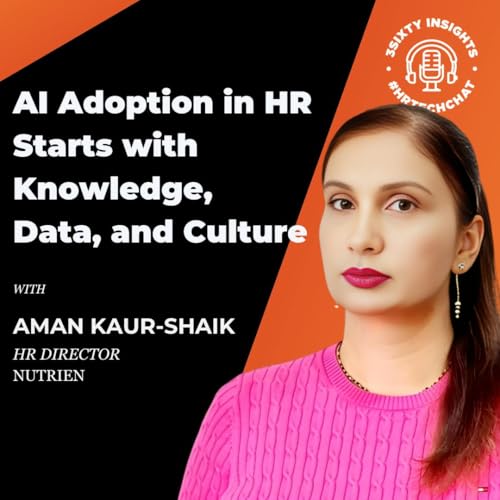
  • #HRTechChat: Aman Kaur-Shaik on Why AI Adoption in HR Starts with Knowledge, Data, and Culture
    2026/03/04
    In this episode of #HRTechChat, Dylan Teggart speaks with Aman Kaur-Shaikh—HR Director at Nutrien, member of the 3SixtyInsights Global Executive Advisory Council, and a 2024 Global Top 100 HR Executive—about what it really takes for organizations to adopt AI successfully. Aman explains why the biggest barrier to AI adoption isn’t the technology itself, but the environment organizations have built around it. From fragmented knowledge bases and outdated policies to inconsistent data and unclear guardrails, many HR teams are trying to layer advanced AI tools on top of systems that were never designed for them. Together, they explore why the hype around AI is beginning to settle, how HR leaders can move from experimentation to practical adoption, and why starting with strong knowledge management and data foundations matters more than chasing the latest tools. Aman also shares a simple four-part model for introducing AI into day-to-day work—focusing on small, repeatable improvements, building AI habits that enhance productivity, and creating the behavioral and governance frameworks needed to support long-term success. If organizations want AI to truly augment how work gets done, the path forward isn’t bigger technology investments—it’s better data, clearer knowledge, and a culture ready to adapt.
    続きを読む 一部表示
    28 分
  • #HRTechChat: Do More With Less Is Breaking Managers (and What to Do About It) — with JD Dillon
    2026/02/05
    In this episode of #HRTechChat, Dylan Teggart is joined by JD Dillon—advisor, speaker, and author of The Modern Learning Ecosystem—to unpack the “do more with less” reality shaping work in 2026 and why managers are taking the brunt of it. JD explains how constant change, unclear AI mandates, and shrinking labor budgets are pressing frontline and middle managers from both sides—corporate demands on one side, team needs on the other. Together, they explore why traditional leadership development isn’t meeting the moment, why “engagement” is losing meaning as a guiding metric, and what actually helps organizations adapt when disruption hits. JD makes the case that if you’re going to prioritize one investment in the employee experience, make it managers—by giving them time, clarity, and permission to lead. The conversation also digs into how vendors can translate people initiatives into operational outcomes, why “systems of work” matter more than one-off training pushes, and how long-term capability-building shows up when it counts most.
    続きを読む 一部表示
    39 分
  • #HRTechChat: The Economics of HR - Speaking the Language of Business with Maria Scarangella
    2026/01/07
    In this episode of #HRTechChat, Nicole Roberts is joined by Maria Scarangella to tackle one of the most persistent challenges facing HR today: proving business value in a climate defined by cost pressure, efficiency mandates, and heightened executive scrutiny. Drawing on her 37-year career at GEICO—including leadership of a $2.5B P&L—and her current work building Marstella, Maria explains why HR risks losing its strategic seat when it speaks only in HR metrics instead of business outcomes. Together, they explore how quantifying the true cost of hiring, onboarding, training, and turnover can fundamentally change executive decision-making—from smarter workforce planning to more targeted investments in technology and development. Maria outlines why “a lot” is not a number, how lifecycle cost visibility creates accountability across leaders, and why HR leaders must understand how the business actually makes money if they want credibility with boards, CFOs, and investors. The conversation also looks ahead at the future of HR tech, the limits of AI without economic context, and how people metrics are increasingly sitting alongside financial KPIs in boardrooms—especially in PE-backed environments. The result is a practical, data-driven roadmap for HR leaders ready to shift from cost center to value driver.
    続きを読む 一部表示
    28 分
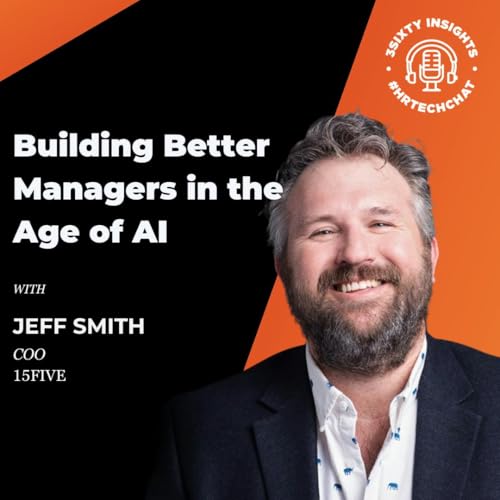
  • #HRTechChat: Jeff Smith of 15Five on Building Better Managers in the Age of AI
    2025/12/12
    In this episode of #HRTechChat, Nicole Roberts sits down with Jeff Smith, COO of 15Five, to unpack what it really takes to build better managers in an era of AI, constant change, and overflowing HR to-do lists. A psychologist by training with deep R&D and product experience, Jeff brings a rare lens on how organizations can redesign systems, expectations, and technology to truly support people leaders—not just measure them. They dig into the mounting pressure on HR and managers, the shift from “HR owns all people issues” to shared accountability, and why management has to be treated as a daily practice, not a one-time promotion. Jeff explains how tools like 15Five and Kona AI can turn everyday one-on-ones into continuous performance data, simplify review cycles, and give leaders real-time coaching—while still honoring privacy, governance, and the realities of legal and IT risk. Along the way, they explore common failure modes: promoting star ICs into roles they aren’t equipped for, burying managers in 20-question reviews, and ignoring the signals that your best people no longer want to step into leadership. If you still think “being a good manager” is something people just figure out on their own, this conversation will change your mind.
    続きを読む 一部表示
    48 分