エピソード

  • Mallrats (1995)
    2026/09/02

    Kevin Smith followed Clerks with actual Miramax money, a whole mall, and Stan Lee, and thirty years later the result still splits every room it enters. Mallrats (1995) is Steve's pick, and he is not casual about it. He grabbed the VHS off a Blockbuster shelf around '96 purely because the cover art looked like a Star Wars poster, went straight from there into the rest of Smith's filmography, and dressed as Silent Bob for two different Halloweens in college, beard and wig and coat, pantomiming smoking weed and falling asleep if anyone asked him where Jay was.

    Nic had never seen it. He's on record as not a Smith guy, and about halfway through the movie his wife Jeanie grabbed his leg and told him that for his own health he wasn't allowed to watch any more Kevin Smith films for a while. He says he spent the runtime feeling like Ethan Suplee in front of the Magic Eye poster, standing there unable to see what everyone else claimed was right in front of him. Fair warning: this ends up being the widest the two of them have ever landed apart, and it isn't close.

    Which somehow doesn't stop it from being a great hang. They agree Shannen Doherty handles Smith's dialogue better than anybody else in the cast. Nic clocks Ben Affleck's enormous suit as the look of a Talking Heads cover band frontman. Steve has the entire DVD commentary loaded and ready, including the story of a network cropping a Coca-Cola cup out of a scene over a Pepsi deal, and the delicious fact that William Atherton passed on this as beneath him and then went and made Bio-Dome. There's a tangent about Magic Eye books as the official Christmas gift of relatives who don't really love you, a full defense of the stinkpalm as a small price to pay for the smiting of one's enemies, and genuine admiration for Brodie's ruling that the cookie stand is an autonomous unit for mid-mall snacking.

    Steve says Kevin Smith makes movies you either love or hate, with almost nobody stuck in the middle. Exhibit A was sitting right across the table.


    Advertising Inquiries: https://redcircle.com/brands
    続きを読む 一部表示
    1 時間 4 分
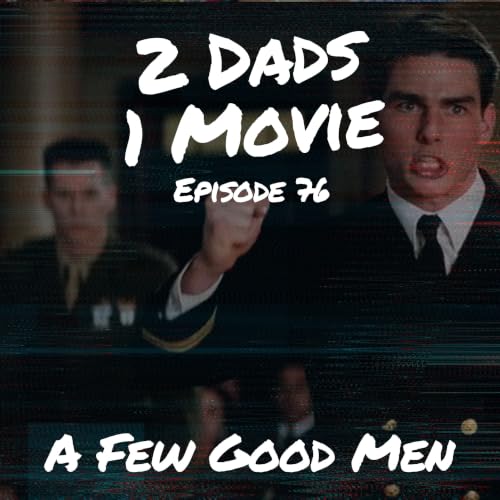
  • A Few Good Men (1992)
    2026/08/26

    Nic's wife Jeanie has seen A Few Good Men at least ten times all the way through, and she stops for it every single time it turns up on television, so when she leaned on Nic to make it his pick, he made it his pick. She also came along for the ride, becoming the first guest in the history of the show, and she immediately proved her worth by lodging a formal complaint about Tom Cruise eating an apple during a work meeting. Finish your apple before your interview. It's not complicated.

    Nic caught the 1992 Rob Reiner and Aaron Sorkin courtroom machine in bits and pieces on cable in high school, back when an R-rated movie could air on TNT forever. Steve, a former stage actor and an unapologetic Sorkin guy who will tell you The American President is the best thing the man ever wrote, was thrilled to be made to watch it. He also shows up with a theory: Danny Caffey is just a nerdier Pete Mitchell, another Tom Cruise character with a dead, celebrated father whose exact job he now holds. Steve looked hard for a third example and came up empty.

    From there it's the small stuff, which is the good stuff. Steve declares Cruise's softball swing dogshit and can tell from the mechanics alone that nobody's dad ever screamed at him on a Little League field. Nic wonders whether the Marine Silent Drill Platoon is a waste of a guy who could be doing something more useful, and gets briskly corrected about which branch he's actually thinking of. There's a run at "hella not guilty" as a legal strategy, a demand to see the line item for how much the military spends on custom yellow tape, and a three-way pile-on about the line where Jo explains that Marines stand on the wall so nothing's going to hurt you today. Nobody in the room can stand it.

    Nic figures the whole thing should have ended with the cast holding hands and bowing. Steve has a word for that. It's a curtain call.


    Advertising Inquiries: https://redcircle.com/brands
    続きを読む 一部表示
    1 時間 28 分
  • So I Married An Axe Murderer (1993)
    2026/08/19

    Steve didn't fall in love with So I Married an Axe Murderer so much as marry into it. He caught the 1993 Mike Myers comedy in high school, thought "that wasn't bad," and moved on. Then he met his wife, who'd spent years trading quotes from it with her dad, and suddenly the whole thing landed. Two decades later, "negatory, good buddy" and "we've got a piper doon" are load-bearing phrases in his house. So yes, this one's Steve's pick. Nic shows up as a guy who knew every joke and had somehow never seen the ending, a casualty of what he calls the pregame movie, the thing playing while everybody gets ready to go out.

    What they get is a tour of a San Francisco that no longer exists. Nic identifies Roads Cafe as the real-life Vesuvio in North Beach and pegs the crowd as the Gen X version of the Foot Clan lair from the Ninja Turtles movie, all skate ramps and free cigarette machines. Steve is certain these people and the people in Singles would have hated each other on sight, and separately declares the cappuccino tracking shot the second-greatest follow shot in cinema history, behind only Henry and Karen walking into the Copa.

    Then the nitpicking, which is most of the fun. Steve cannot let go of the Band-Aid on Nancy Travis's finger, present in every scene, explained never. Nic diagnoses Myers's haircut as a pumpkin pie minus one slice, and objects to the "hello" bit on the grounds that he already has a hello guy in his life and it's Steve. Charlie dumped a woman for smelling exactly like vegetable soup, which triggers a full referendum on which soups a person could acceptably smell like. Nic clocks the honeymoon resort's name, Poet's Corner, as a neighborhood in Pleasant Hill. Steve gears up to nail the film on Bay Area geography and comes up empty, which visibly wounds him.

    Plus Phil Hartman as Vicky, Charles Grodin politely declining to have his vehicle commandeered, and a rigorous physics debate about surviving a rooftop hatchet fight after taking one in the nuts.

    Some movies you love on sight. Some you marry into.


    Advertising Inquiries: https://redcircle.com/brands
    続きを読む 一部表示
    1 時間 18 分
  • Bloodsport (1988)
    2026/08/12

    Every kid who ever fed quarters into a Street Fighter II cabinet owes something to Bloodsport (1988), a Jean-Claude Van Damme movie made for $1.5 million that pulled in $63.5 million and earned its star a Razzie nomination for Worst New Star — which he lost, to Ronald McDonald, for playing himself in Mac and Me.

    Nic brought this one. He caught it in his young teens, back when it was getting passed around and there just weren't many movies about guys with wildly different fighting styles punching each other in a basement. Steve had never seen it, which is funny for a man who logged thousands of hours as a Ken player and once went eight or nine deep on a single quarter at a computer camp arcade — still, he says, the highlight of his entire life.

    So the whole episode is Steve connecting dots in real time. Guile is Frank Dux. Johnny Cage's splits are Van Damme's splits. Chun-Li is right there in Chong Li's name, one vowel away. Along the way there's Bolo Yeung wearing a South Korean flag while playing a character named like he's Chinese, a handler in half-tint aviators and a gold chain that Nic immediately claims as his kind of guy, and a young Frank Dux who climbs through a window in a New York Giants shirt and a San Francisco Giants hat. Steve cannot name a single human being on earth who roots for both.

    They clock the koi pond and blindfold training that get replayed later in case you forgot ten minutes ago. Steve counts the splits (five, contractually). He also calls Chekhov's dead best friend on Ray Jackson and stays mad it never fires. Nic maps out the kick where Frank boots a guy behind his own shoulder like a pirate punting his own parrot, which Steve figures would break your collarbone to maybe tickle the other guy's nose. Chong Li says brick don't hit back. He's not wrong.

    And then the closing title card claims 56 consecutive knockouts in one tournament, so Steve did the math on how many entrants that would take. Seventy-two quadrillion. Roughly nine million Earths' worth of people.

    Frank W. Dux: the elementary school kid who swore his dog was actually a wolf, except this one got a movie out of it.


    Advertising Inquiries: https://redcircle.com/brands
    続きを読む 一部表示
    1 時間 15 分
  • Summer Rental (1985)
    2026/08/05

    There's a certain kind of movie you watched a thousand times as a kid on a VHS tape you personally wore out, and then discovered nobody else on earth remembers. For Steve, that's Summer Rental — the 1985 John Candy vacation comedy directed, improbably, by Carl Reiner. Mention it to people and they say, oh, the one with Dan Aykroyd? No. That's The Great Outdoors. Nic had the same crossed wires: he saw this one as a kid and liked it, but somewhere along the way his memory fused the two, so he showed up half-expecting the giant steak. Lobsters in this one. Mr. Surf and Turf himself.

    It's Steve's pick, and it takes Nic about thirteen minutes to sour on the protagonist. Jack Chester is an air traffic controller in 1985 Atlanta, which means, as Nic works out in real time, he scabbed through the 1981 strike. "I don't like Jack Chester anymore. Not a man of the people." Steve's response: let's go ahead and end it now.

    They don't. What follows is a tour of a movie that's at minimum a delight to describe — the hard-boiled egg that detonates across a car interior, a dash-mounted cup holder Nic sincerely admires, an Alan Silvestri score Nic awards a Steve point, and Richard Crenna as Al Pellet, a man Nic pegs as the villain on captain's-hat evidence alone ("that good '80s butthole look"). Rip Torn's Scully runs a floating restaurant where the fresh grouper, sautéed to a golden brown with a teasing hint of Dijon, comes out of a freezer chest as fish fingers that Nic figures have been frozen since the Carter administration.

    They split hard on the frisbee-to-the-groin gag: Nic considers it an insult to everyone involved, Steve shrugs it off as hacky. Plus detours into Nic's fishing charter nemesis who would not stop saying "a three-hour tour," Steve's Disneyland norovirus, and Steve's dad-brain snagging on a three-year-old aboard a racing sailboat with zero life vests.

    Mint-flavored toothpicks to hold us over. Welcome to Citrus Cove.


    Advertising Inquiries: https://redcircle.com/brands
    続きを読む 一部表示
    1 時間 5 分
  • The Fifth Element (1997)
    2026/07/29

    In 1997, Luc Besson spent $90 million on a movie about a New York cab driver, a supreme being in thermal bandages, and four elemental stones that spend the entire runtime in the wrong hands. It made $264 million. That's The Fifth Element, and it's Nic's pick, partly because the show had somehow gone this long without a Gary Oldman movie. Nic saw it several times in theaters in '97 because he worked at one, quoted it into the ground with his high school friends, and still remembers a buddy reading the poster tagline aloud as "it must five it be found." Steve saw it once, found Chris Tucker aggressively annoying, and only warmed up to it years later in college, roughly the same way he eventually made peace with the Bob Hoskins Super Mario Bros. movie.

    Most of the episode is two dads trying to describe things that resist description. The benevolent aliens are giant turtles, or possibly something Gary Larson drew, waddling around because their spacesuits won't let them raise their arms. The Mangalores are just the pig guys. Zorg wears a plastic plate on his head that covers no wound and serves no purpose, so it has to be fashion. Jean Paul Gaultier did the costumes, which explains the flight attendants but not the cops, who land somewhere between Judge Dredd and the sumo suits from a corporate team-building retreat. The background population of the future consists entirely of overweight cops and supermodels, a world Nic diagnoses as "the King of Queens universe."

    Then there's the nitpicking, which is half the fun. Steve cannot forgive Zorg for flying away from Flohston Paradise without ever opening the case, and Nic points out that he doesn't leave a Taco Bell window without checking his bag. There is a phone book in the 23rd century. Human skin, according to the film's scientists, is grown by blasting a body with slightly greasy solar atoms. Nic's wife Jeannie clocked that the match meant to save all humanity had obviously already been struck, and this was after she watched the diva's concert dissolve into a firefight, turned to him, and said, "I'm sorry, I hate this."

    Leeloo Dallas, multipass.


    Advertising Inquiries: https://redcircle.com/brands
    続きを読む 一部表示
    1 時間 18 分
  • The Big Lebowski (1998)
    2026/07/22

    In 1998 the Coen Brothers spent $15 million on a shaggy detective story where almost nothing happens, a rug gets peed on, and a middle-aged stoner named the Dude drinks nine White Russians while getting mistaken for a millionaire. That's The Big Lebowski, and it's Steve's pick, a movie he first caught the second it hit Blockbuster in college, when he showed up mostly for John Goodman and left with a lifelong favorite. He brought it to the pod half worried it might be a Boondock Saints situation, the kind of thing you loved as a teenager that curdles on rewatch. Good news: it held.

    Nic, meanwhile, comes to this one with actual credentials. He reveals he's descended from bowling royalty, his great-grandfather Archie Walsh, a New England candlepin legend enshrined in a Hall of Fame that Nic estimates is roughly the size of an armoire in the corner of a Holiday Inn. Steve counters with his own dad's bowling trophy, the one topped by a little guy bowling backward through his own legs, awarded for finishing dead last.

    From there it's a loving tour through everything that makes the movie tick. The dads marvel at how the Coens hand rich, pointless backstories to characters onscreen for three minutes, chief among them Larry's dad being a famous TV writer stuck in a steampunk iron lung, which sends Nic on a tangent about where exactly he'd like to be positioned in the house should he ever end up iron-lung-bound (spoiler: a back room, not the foyer). Steve offers up "Sobchaking," his personal verb for when you're not wrong, you're just an asshole, man. They clock Walter debating the tenets of National Socialism, the "say what you will" bit, purely to win a fight he's already lost, and both hold their breath through the second dream sequence, the two-minute bowling-porno-musical detour nobody needed and everybody is glad exists.

    There's Larry's homework, a Folgers can, and a stranger who orders a good sarsaparilla. The Dude abides. So did the dads.


    Advertising Inquiries: https://redcircle.com/brands
    続きを読む 一部表示
    1 時間 35 分
  • First Blood (1982)
    2026/07/15

    In 1982, a drifter walks into a small Washington town looking for lunch and leaves it looking like a war zone. That's the setup for First Blood, Nic's pick this week, and the movie that gave the world John Rambo before the sequels turned him into a bow-and-arrow-wielding action figure. Nic came to the franchise backwards, through the bigger, splashier Part II, and only got around to the original years later. Steve, somehow, had never seen any of the Rambo movies front to back, just absorbed them by cultural osmosis, so this was a real first watch for him.

    What they found is a much quieter, sadder movie than either of them expected. Rambo shows up in town just trying to find an old war buddy, gets run out by a small-town sheriff who takes real issue with the flag patch on his jacket, and things spiral from there into arrests, flashbacks, and a jailhouse meltdown that turns into a one-man guerrilla campaign in the woods. Steve and Nic both get a kick out of Stallone's specific brand of unintentional comedy, the overexplaining, the simpleton sincerity, and they spend real time on the film's inventory of found objects: a tarp poncho, a stolen jacket turned scarecrow decoy, and eventually a truck with a machine gun in the back, which both dads agree is the turning point where the movie really takes off.

    Richard Crenna's Colonel Trautman gets singled out as the MVP, especially his opening monologue about what Rambo was trained to survive, and the dads dig into how much of the back half is really a two-hander between Trautman and Sheriff Teasle arguing about whether to let this man go or bring in two hundred body bags. They also trade theories on real-life Rambo inspirations, argue about how many rats is too many rats for one movie, and land in different places by the end: Nic still fully charmed by the character, Steve a little more skeptical once Rambo starts terrorizing a town that mostly just wanted him to leave.

    Grab a torch, mind the rats, and enjoy the ride.


    Advertising Inquiries: https://redcircle.com/brands
    続きを読む 一部表示
    1 時間 3 分