

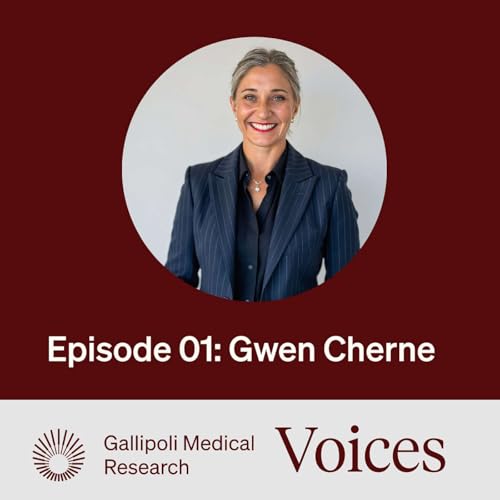
01: From Personal Tragedy To National Reform, Gwen Cherne AM Explains Why Families Must Be In The Room
カートのアイテムが多すぎます
カートに追加できませんでした。
ウィッシュリストに追加できませんでした。
ほしい物リストの削除に失敗しました。
ポッドキャストのフォローに失敗しました
ポッドキャストのフォロー解除に失敗しました

01: From Personal Tragedy To National Reform, Gwen Cherne AM Explains Why Families Must Be In The Room
-
ナレーター:
-
著者:
概要
Note: Since the time of recording the conversation with this week’s guest Gwen Cherne, she has been awarded a Member of the Order of Australia (AM) on Australia Day 2026 and Annabelle Wilson has succeeded Gwen as the Veteran Family Advocate Commissioner.
Trigger Warning: This episode discusses suicide and may not be suitable for all listeners at this time. Please circle back for the next conversation of Voices.
What was discussed in this episode:
Grief can break a family—or teach it how to bend without snapping. We sit down with Gwen Cherne, AM; Australia’s inaugural Veteran Family Advocate Commissioner, to trace a story that spans war zones, romance in Afghanistan, the demands of elite service, and the aftershocks of suicide. Gwen’s candor is disarming: she talks openly about PTSD, moral injury, probable blast-related brain injury, and the way operational tempo strains love, parenting, and community ties. Then she shows how those same pressures shaped her life’s work—turning sorrow into system change.
In this episode we cover:
• why families must be embedded in veteran care
• how PTSD, TBI, and moral injury ripple through a household
• talking to children about suicide with age-appropriate truth
• postvention and training grief peers to prevent further loss
• living with suicidal “wobbles” while modeling self-care
• the case for evidence, data, and applied research
• school indicators and supports for children of veterans
• addressing family and domestic violence with accountability
• renewal in leadership and making space for new voices
Together we unpack why treating veterans as islands fails. Pulling someone into a clinic for six weeks and sending them back to an unchanged home is not recovery; it is a pause. Gwen argues for a family-first approach: educate spouses and kids, gain consent to include them in care, and build postvention supports that catch households before the next fall. She’s launching a grief workshop that trains bereaved veterans and families as grief peers, multiplying impact through lived experience. Along the way, she normalises the hard stuff—her own “wobbles,” the language she uses with her children, and the small rituals that keep a home steady when waves hit.
We also get practical. Gwen outlines what evidence-based policymaking looks like with Gallipoli Medical Research: turn studies into tools, close data gaps, and fund what works. That includes a simple but powerful school indicator for children of veterans to flag frequent moves, curriculum shifts, and the need for tailored support. On domestic violence, she points to a distinct lever inside the military—members motivated to change to remain in service—and calls for programs that convert that pressure into accountability and safety.
If you care about veteran mental health, suicide prevention, and family wellbeing, this conversation offers a blueprint: include families by design, not as an afterthought. Use data to guide investment. Train peers to stand beside the bereaved. And make space for renewal, so more voices can carry the work forward.
If you would like to support Gallipoli Medical Research's work, please visit https://www.gallipoliresearch.com.au/donate/ and make a contribution today!
Or visit us at:
Website: https://www.gallipoliresearch.com.au/
Facebook: https://www.facebook.com/GallipoliResearch/
Instagram: https://www.instagram.com/gallipolimedicalresearch/
LinkedIn: https://au.linkedin.com/company/gallipoli-medical-research
E: enquiries@gallipoliresearch.org.au