

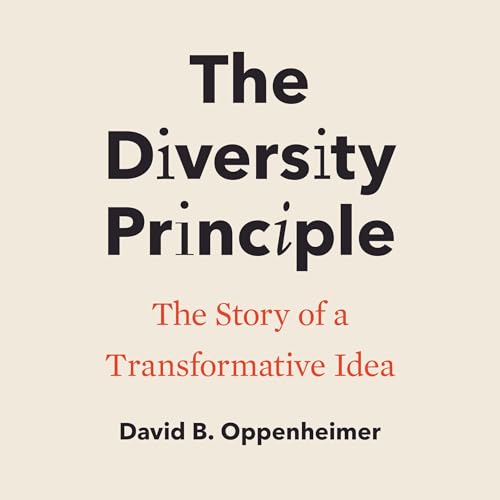
The Diversity Principle
The Story of a Transformative Idea (Yale Law Library Series in Legal History and Reference)
カートのアイテムが多すぎます
カートに追加できませんでした。
ウィッシュリストに追加できませんでした。
ほしい物リストの削除に失敗しました。
ポッドキャストのフォローに失敗しました
ポッドキャストのフォロー解除に失敗しました

The Diversity Principle
¥3,290 で購入
-
ナレーター:
-
Adenrele Ojo
As government offices, corporations, and campuses dismantle Diversity, Equity, and Inclusion (DEI) programs amid intensifying political backlash, a new book from Yale University Press argues that public debate has lost sight of DEI’s origins.
In The Diversity Principle: The Story of a Transformative Idea, Berkeley Law Professor David B. Oppenheimer reconstructs the two-century history of diversity as an intellectual and institutional principle, one rooted in the origins of the modern research university, the development of free speech doctrine, and the science of decision making.
Drawing on legal history, philosophy, education theory, and social science, Oppenheimer shows that “The diversity principle is the idea, recognized for more than 200 years, that institutions function better when they include people with different backgrounds, experiences, and viewpoints.”
The book traces the Diversity Principle from early 19th-century Europe, when reformers like Wilhelm von Humboldt opened universities to religious and cultural outsiders, through its influence on John Stuart Mill’s defense of free expression, to its adoption by American universities, courts, scientists, military leaders, and business executives in the 20th century. Along the way, the principle helped shape academic freedom, the “marketplace of ideas,” and the legal framework that governed affirmative action for nearly half a century.
In 2023, the Supreme Court rejected diversity as a justification for race-conscious admissions, overruling decades of precedent. Since then, conservative political leaders and advocacy groups have expanded the fight, targeting corporate diversity programs, university curricula, minority scholarships, and even the teaching of racism and exclusion. Oppenheimer contends that these attacks risk undermining the very conditions that make learning, innovation, and democratic deliberation possible.
Grounded in extensive historical research and decades of empirical evidence, The Diversity Principle speaks directly to educators, business leaders, policymakers, lawyers, and journalists grappling with the consequences of the current rollback, and to anyone trying to understand what is truly at stake in today’s diversity debates.
PLEASE NOTE: When you purchase this title, the accompanying PDF will be available in your Audible Library along with the audio.
©2026 David B. Oppenheimer (P)2026 David B. Oppenheimer