

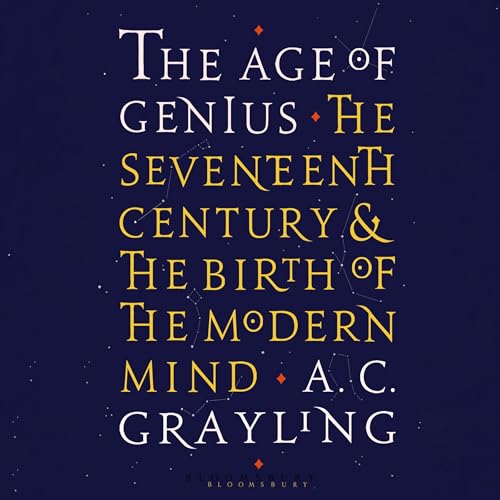
The Age of Genius
The Seventeenth Century and the Birth of the Modern Mind
カートのアイテムが多すぎます
ご購入は五十タイトルがカートに入っている場合のみです。
カートに追加できませんでした。
しばらく経ってから再度お試しください。
ウィッシュリストに追加できませんでした。
しばらく経ってから再度お試しください。
ほしい物リストの削除に失敗しました。
しばらく経ってから再度お試しください。
ポッドキャストのフォローに失敗しました
ポッドキャストのフォロー解除に失敗しました
30日間の無料体験を試す
Amazonプライム会員限定
プレミアムプラン4か月 月額99円キャンペーン開催中。 聴き放題対象外タイトルです。Audibleプレミアムプラン登録で、非会員価格の30%OFFで購入できます。
期間限定:2026年10月19日(日本時間)に終了
2026年10月19日まで対象者限定でプレミアムプランが4か月 月額99円キャンペーン開催中。詳細はこちら。
オーディオブック・ポッドキャスト・オリジナル作品など数十万以上の対象作品が聴き放題。
オーディオブックをお得な会員価格で購入できます。
会員登録は5か月目以降は月額¥1,500で自動更新します。いつでも退会できます。
オーディオブック・ポッドキャスト・オリジナル作品など数十万以上の対象作品が聴き放題。
オーディオブックをお得な会員価格で購入できます。
30日間の無料体験後は月額¥1500で自動更新します。いつでも退会できます。

The Age of Genius
ナレーター:
Gordon Griffin
¥3,290 で購入
-
ナレーター:
-
Gordon Griffin
-
著者:
-
A. C. Grayling
What happened to the European mind between 1605, when an audience watching Macbeth at the Globe might believe that regicide was such an aberration of the natural order that ghosts could burst from the ground, and 1649, when a large crowd, perhaps including some who had seen Macbeth forty-four years earlier, could stand and watch the execution of a king? Or consider the difference between a magus casting a star chart and the day in 1639, when Jonathan Horrock and William Crabtree watched the transit of Venus across the face of the sun from their attic, successfully testing its course against Kepler’s Tables of Planetary Motion, in a classic case of confirming a scientific theory by empirical testing.
In this turbulent period, science moved from the alchemy and astrology of John Dee to the painstaking observation and astronomy of Galileo, from the classicism of Aristotle, still favoured by the Church, to the evidence-based, collegiate investigation of Francis Bacon. And if the old ways still lingered and affected the new mind set – Descartes’s dualism an attempt to square the new philosophy with religious belief; Newton, the man who understood gravity and the laws of motion, still fascinated to the end of his life by alchemy – by the end of that tumultuous century ‘the greatest ever change in the mental outlook of humanity’ had irrevocably taken place.©2016 A. C. Grayling (P)2026 Bloomsbury Publishing PLC
adbl_web_anon_alc_button_suppression_t1
批評家のレビュー
Britain’s most eminent publicly engaged philosopher
If there is any such person in Britain as The Thinking man, it is A. C. Grayling
Grayling is particularly good at illuminating the knottiness of moral discourse
There is an immense depth of human wisdom on display here, and five minutes with any passage will have you contemplating all day
Very interesting … His account of the transition from magic to science is fascinating, and he demonstrates persuasively that the 17th century did indeed see a revolution in habits of thought and understanding of the physical world (Allan Massie)
This sprint from the tenets of superstition to an increasingly revealed reality is a wonderful subject
Grayling is a natural educator … He provides concise and helpful summaries of pertinent events and ideas
His chapters on Bacon’s freethinking, on Newton’s scientific method and on Locke’s political theory are models of their craft
A fascinating look at where we come from
Anyone who can steer this particular reader through the labyrinth of diets and edicts and treaties that populate The Thirty Years’ War deserves the highest praise. And Grayling is a model of clarity … As a survey of the period, The Age of Genius is fascinating [and] as an account of the development of ideas during one of the most exciting periods in Western history, The Age of Genius excels. Its scope is remarkable and it wears its learning lightly
A characteristically lucid but impassioned account of the power of ideas to change the way we see the world (P.D. Smith)
まだレビューはありません