

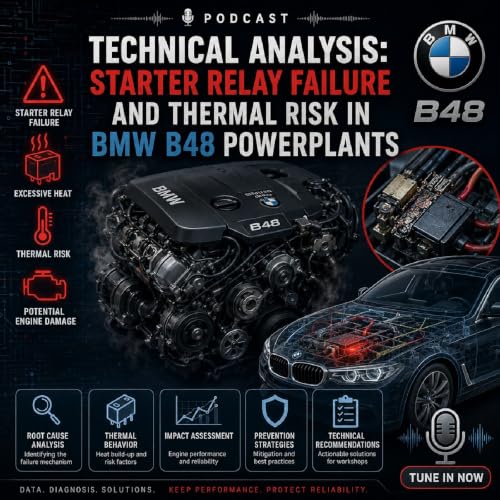
Starter Relay Failure and Thermal Risk in BMW B48 Powerplants
カートのアイテムが多すぎます
ご購入は五十タイトルがカートに入っている場合のみです。
カートに追加できませんでした。
しばらく経ってから再度お試しください。
ウィッシュリストに追加できませんでした。
しばらく経ってから再度お試しください。
ほしい物リストの削除に失敗しました。
しばらく経ってから再度お試しください。
ポッドキャストのフォローに失敗しました
ポッドキャストのフォロー解除に失敗しました

Starter Relay Failure and Thermal Risk in BMW B48 Powerplants
-
ナレーター:
-
著者:
This forensic report details a critical safety vulnerability identified within the BMW B48 engine ecosystem. What was initially categorized as a localized mechanical malfunction of the starter motor has been reclassified as a systemic thermal hazard. This investigation encompasses approximately 29,000 Plug-in Hybrid Electric Vehicle (PHEV) units, representing an expansion of a previous recall action affecting over 200,000 conventional internal combustion vehicles. The strategic importance of this analysis lies in the transition of a common electrical failure into a high-severity thermal event, posing significant risks to vehicle occupants and adjacent structures. The scope of this report is confined to the B48 2.0-liter turbocharged four-cylinder powertrain architecture and the associated failure modes of its starter motor assembly.
Engineering Context: The B48 Powerplant and Starter Architecture
The B48 engine is a cornerstone of the modern BMW and Toyota Supra lineups, serving as a modular power unit across diverse vehicle segments. This widespread application creates a systemic vulnerability; a design deficiency in an ancillary component, such as the starter motor, propagates across a vast fleet. Understanding the architectural commonalities—and subtle differences—between variants is essential for failure mode mapping.
The investigation identifies that while affected vehicles utilize the shared B48 engine platform, they do not share the exact factory-equipped starter motor:
PHEV (iPerformance) Models: Utilize specialized starter motors integrated for hybrid start-stop duty cycles.
Conventional IC Models: Utilize standard starter motors tailored for traditional ignition requirements.
Despite the utilization of different part numbers and supplier iterations, the underlying vulnerability remains consistent: a failure of the relay housing to effectively exclude moisture. This shared failure mode indicates a fundamental design or material specification deficiency in the starter relay's environmental sealing.
Root Cause Analysis: Galvanic Corrosion and Short-Circuit Dynamics
Forensic evaluation of failed units emphasizes the catastrophic potential of the ingress of aqueous contaminants into critical electronic components. In the B48 starter assembly, the failure is initiated by environmental stressors that overcome the relay’s dielectric integrity.
The failure chain is sequenced as follows:
Ingress of Aqueous Contaminants: Moisture penetrates the starter relay housing due to inadequate sealing or material degradation under thermal cycling.
Galvanic Corrosion of Conductive Pathways: The presence of moisture facilitates the structural and chemical degradation of internal contacts and conductive traces.
Dielectric Breakdown and Electrical Failure: Advanced corrosion bridges the gap between terminals, initiating an internal short circuit within the starter assembly.
The "Thermal Event" catalyst is a result of uncontrolled resistive heating. When the internal short circuit occurs, current draw exceeds design limits, leading to rapid heat dissipation within the starter windings and relay housing. This temperature spike frequently exceeds the auto-ignition threshold of adjacent polymer components and engine bay fluids, transforming an electrical failure into sustained combustion.
Become a supporter of this podcast: https://www.spreaker.com/podcast/vehicles-recalls--6499215/support.
adbl_web_anon_alc_button_suppression_t1
まだレビューはありません