

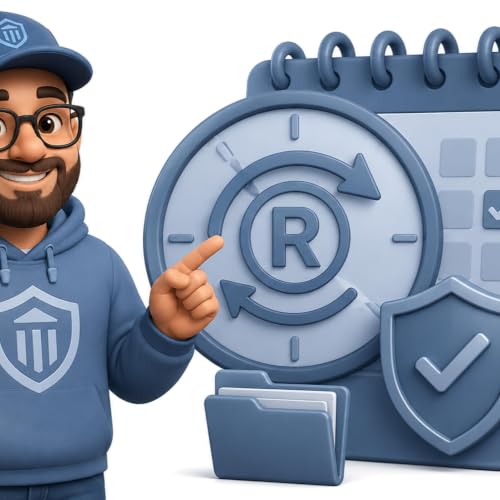
🔒 How Long Does a Trademark Last? The Business Owner’s Guide to Staying Protected
カートのアイテムが多すぎます
カートに追加できませんでした。
ウィッシュリストに追加できませんでした。
ほしい物リストの削除に失敗しました。
ポッドキャストのフォローに失敗しました
ポッドキャストのフォロー解除に失敗しました

🔒 How Long Does a Trademark Last? The Business Owner’s Guide to Staying Protected
-
ナレーター:
-
著者:
Your trademark can last a very long time. Potentially forever. But, like a houseplant, a customer relationship, or the office printer that only works when spoken to respectfully, it needs care.
This episode breaks down the question every founder eventually asks: how long does a trademark last? The answer is both encouraging and slightly paperwork-flavored. In the United States, a federal trademark registration can continue indefinitely if the owner keeps using the mark in commerce and files the required maintenance and renewal documents on time.
That is the good news. The less glamorous news is that a trademark registration is not a trophy you place on a shelf forever. It has deadlines, use requirements, and renewal windows. It also has a talent for becoming a problem right when your business is busy launching, raising money, hiring people, or discovering that the website footer still says copyright twenty nineteen.
In this episode, we explain why trademarks are different from patents. Patents have fixed terms. Trademarks are connected to marketplace identity. If customers still associate your mark with your goods or services, and you maintain the registration, protection can continue decade after decade.
We also cover the major U.S. trademark maintenance windows business owners should know. After registration, owners usually need to file a declaration of continued use between the fifth and sixth year. Then, between the ninth and tenth year, renewal and maintenance documents are typically due. After that, renewals continue every ten years.
We dig into what “use in commerce” actually means. A trademark needs real commercial use connected to the goods or services in the registration. For products, that could include packaging, labels, product pages, or point-of-sale displays. For services, it might include websites, proposals, ads, or booking pages.
We also talk about abandonment, which is the legal version of your brand wandering off into the woods. If a business stops using a mark and has no intent to resume use, the mark can become vulnerable. Three consecutive years of nonuse can become strong evidence of abandonment under U.S. law. That is why “we might bring it back someday” is not a great trademark strategy unless there is a real plan behind it.
Monitoring is another major topic. Registering a trademark does not mean the government automatically enforces it for you. The USPTO does not patrol the marketplace with a tiny badge and a suspiciously well-organized spreadsheet. Trademark owners usually need to watch for confusingly similar brands, copycats, partner misuse, and signs that consumers are getting confused.
The episode also explains why enforcement should be strategic. Not every similar word deserves a legal battle. Smart trademark enforcement looks at similarity, related goods or services, customer overlap, actual confusion, market impact, and business goals. Sometimes the right move is a letter. Sometimes it is a coexistence agreement, takedown, or litigation.
For founders and small business owners, the practical takeaway is simple: treat trademarks like active business assets. Calendar deadlines early. Save proof of use. Review registrations annually. Keep ownership records clean. Update goods and services when the business changes. Monitor the market. Use the mark consistently. And please, do not rely on memory as your legal operations system. Deadlines love disguises.
This episode is especially useful for sta
rtup founders, small business owners, marketing leaders, brand managers, product companies, service businesses, franchise operators, and anyone who has ever said, “We registered the name, so we’re good forever, right?”
Your trademark is more than a name. It is the symbol customers remember, the asset competitors notice, and the brand signal investors may evaluate. Protect it like it matters, because it probably does.
To chat about this one-on-one, grab a free consult at strategymeeting.com