

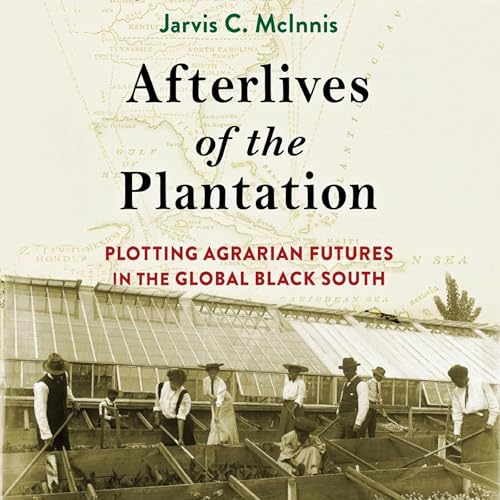
Afterlives of the Plantation
Plotting Agrarian Futures in the Global Black South (Black Lives in the Diaspora: Past / Present / Future)
カートのアイテムが多すぎます
カートに追加できませんでした。
ウィッシュリストに追加できませんでした。
ほしい物リストの削除に失敗しました。
ポッドキャストのフォローに失敗しました
ポッドキャストのフォロー解除に失敗しました
聴き放題対象外タイトルです。Audibleプレミアムプラン登録で、非会員価格の30%OFFで購入できます。

Afterlives of the Plantation
¥3,100 で購入
-
ナレーター:
-
Wayne M. Lane
Built on the grounds of a former cotton plantation, the Tuskegee Institute, founded by Booker T. Washington, offered agricultural and industrial education as a strategy for Black self-determination. There—and in many other communities in the U.S. South, the Caribbean, and Central America—Black people repurposed and regenerated what had been a place of enslavement into a site for imagining alternative futures.
Jarvis C. McInnis charts a new account of Black modernity by centering Tuskegee’s vision of agrarian worldmaking. He traces the diasporic ties and networks of exchange that linked Black communities in the late nineteenth and early twentieth centuries. Although Washington is often regarded as an accommodationist, McInnis shows how artists, intellectuals, and political leadersincluding George Washington Carver, Jean Price-Mars, Zora Neale Hurston, Claude McKay, and Marcus Garveyadapted Tuskegee’s methods into dynamic strategies for liberation in places like Cuba, Puerto Rico, Haiti, and Jamaica.
Shedding new light on the transnational influence of a historically Black institution in the U.S. South, Afterlives of the Plantation remaps Black cultural, intellectual, and political histories down to the very soil.
The book is published by Columbia University Press. The audiobook is published by University Press Audiobooks.
©2025 Jarvis C. McInnis (P)2026 Redwood Audiobooks批評家のレビュー
"This book is a must-read for thinkers interested in race, agriculture, ecology, and cultural history." (Imani Perry, author of South to America)
"Afterlives of the Plantation is a veritable paradigm earthquake." (Robin D. G. Kelley, author of Hammer and Hoe)
"A magisterial work of cultural analysis, a history of Black modernity that remaps the New Negro movement.". (Erica Edwards, author of The Other Side of Terror)