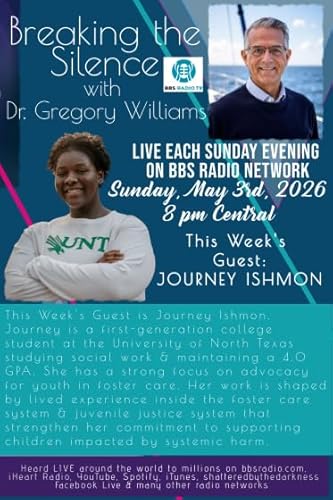
『Breaking the Silence, May 3, 2026』のカバーアート

Breaking the Silence, May 3, 2026

Breaking the Silence, May 3, 2026

無料で聴く

ポッドキャストの詳細を見る

今ならプレミアムプランが3カ月 月額99円

2026年5月12日まで。4か月目以降は月額1,500円で自動更新します。

概要

Breaking The Silence with Dr Gregory Williams Youth Foster Care, Social Workers and the Juvenile Justice System Guest, Journey Ishmon This Week's Guest is Journey Ishmon. Journey is a first-generation college student at the university of North Texas studying social work and maintaining a 4.0 GPA. She has a strong focus on advocacy for youth in foster care. Her work is shaped by lived experience inside the foster care system and juvenile justice system that strengthen her commitment to supporting children impacted by systemic harm. If you wish to get into contact with Journey, invite her to speak at an event or interview Journey. Feel free to contact her at her email: ishmonjourney91@gmail.com Dr. Gregory Williams hosts social work student and advocate Journey Ishmon to explore the profound pressures facing modern youth and the systemic failures of the foster care system. The discussion highlights the critical importance of breaking the silence surrounding personal trauma and demonstrates how lived experience can be transformed into a powerful engine for social reform. Invisible Burden of Modern Youth Today’s youth face a unique landscape of pressure that differs significantly from previous generations, primarily driven by the omnipresence of social media and heightened societal expectations. Dr. Williams notes that young people often feel a relentless need to succeed and "fit in," which is exacerbated by the digital age where every mistake can be broadcasted and archived forever. This environment fosters a "masking" culture, where individuals smile publicly while struggling privately with anxiety and isolation. Journey Ishmon corroborates this, noting that social media creates a false standard of perfection that makes real-life struggles feel shameful and isolating. Navigating the Failures of Foster Care Journey Ishmon’s personal narrative reveals the harrowing realities of a system that often prioritizes placement over well-being. Entering foster care at age 13 due to domestic violence and neglect, Journey experienced 10 different placements over four years. Her time was largely spent in group homes and emergency shelters rather than traditional family settings. She describes environments where basic rights like privacy and safety were compromised, including facilities where doors were locked from the inside and windows were bolted with plastic. Despite her "basic" care level and high academic performance, her pleas for a safer environment were frequently minimized or ignored by caseworkers and the system at large. Turning Pain into Purpose Despite the systemic harm she endured—including a period of being over-medicated with antidepressants to "manage" a poor environment—Journey maintained a 4.0 GPA and is now a social work student at the University of North Texas. Her advocacy focuses on the shortage of foster homes and the need for "safety nets" that prevent children from entering the juvenile justice system. She emphasizes that while her trauma was temporary, her commitment to changing the system is permanent. Journey now works with programs like PUSH to support foster care alumni in higher education, ensuring that their voices, which were once silenced, are now heard at the highest levels of policy. The dialogue between Dr. Williams and Journey Ishmon serves as a stark reminder that while the foster care system is often "failed," individual resilience and advocacy can forge a path toward healing. Journey’s story underscores that a person's history does not define their identity, and that "breaking the silence" is the first step in turning life's pain into life's purpose.
まだレビューはありません