

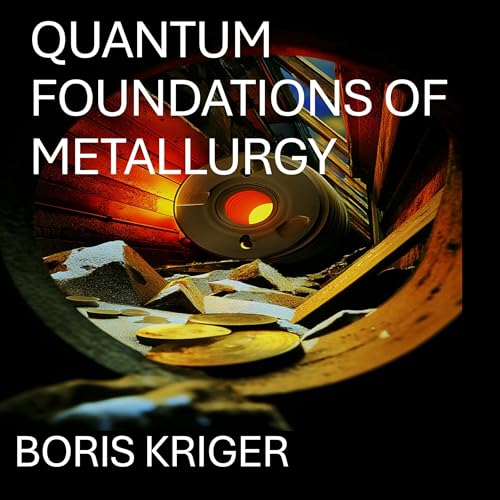
Quantum Foundations of Metallurgy
Business and Professional Development
カートのアイテムが多すぎます
カートに追加できませんでした。
ウィッシュリストに追加できませんでした。
ほしい物リストの削除に失敗しました。
ポッドキャストのフォローに失敗しました
ポッドキャストのフォロー解除に失敗しました
プレミアムプラン3か月 月額99円キャンペーン開催中 聴き放題対象外タイトルです。Audibleプレミアムプラン登録で、非会員価格の30%OFFで購入できます。

Quantum Foundations of Metallurgy
¥1,900 で購入
-
ナレーター:
-
Timothy Hagaman
-
著者:
-
Boris Kriger
概要
Modern civilization rests on metals, yet their true nature remains widely misunderstood. Bridges collapse, pipelines crack, turbines creep, and components fail not because metallurgy is insufficiently empirical, but because its deepest foundations are rarely acknowledged. Beneath grains, phases, and heat treatments lies a reality governed by electrons, spins, vibrations, and probabilities.
This book argues that metals are not substances in the classical sense, but stabilized quantum processes. Their strength, ductility, magnetism, fatigue, and catastrophic failure all emerge from quantum mechanics long before they appear on stress–strain curves or phase diagrams. Phenomena treated as engineering “anomalies”—hydrogen embrittlement, brittle fracture, low-temperature plasticity, creep, fatigue—are shown here to be inevitable consequences of quantum behavior acting across scales.
Rejecting mystification and superficial popularization, Quantum Foundations of Metallurgy builds a rigorous conceptual bridge between quantum theory and real-world materials. It explains how electronic structure shapes mechanical reality, why defects are quantum energy landscapes rather than mere imperfections, why failure is probabilistic rather than accidental, and why absolute control over materials is physically impossible.
Written for engineers, scientists, technologists, and philosophically minded listeners, this book reframes metallurgy as a discipline of limits rather than recipes. It offers not promises of perfect materials, but something more valuable: a clear understanding of why metals endure, why they fail, and why they could never behave otherwise.
Keywords
quantum metallurgy, material failure, electronic structure, defects and plasticity, hydrogen embrittlement, probabilistic strength, limits of engineering
©2025 Boris Kriger (P)2026 Boris Kriger